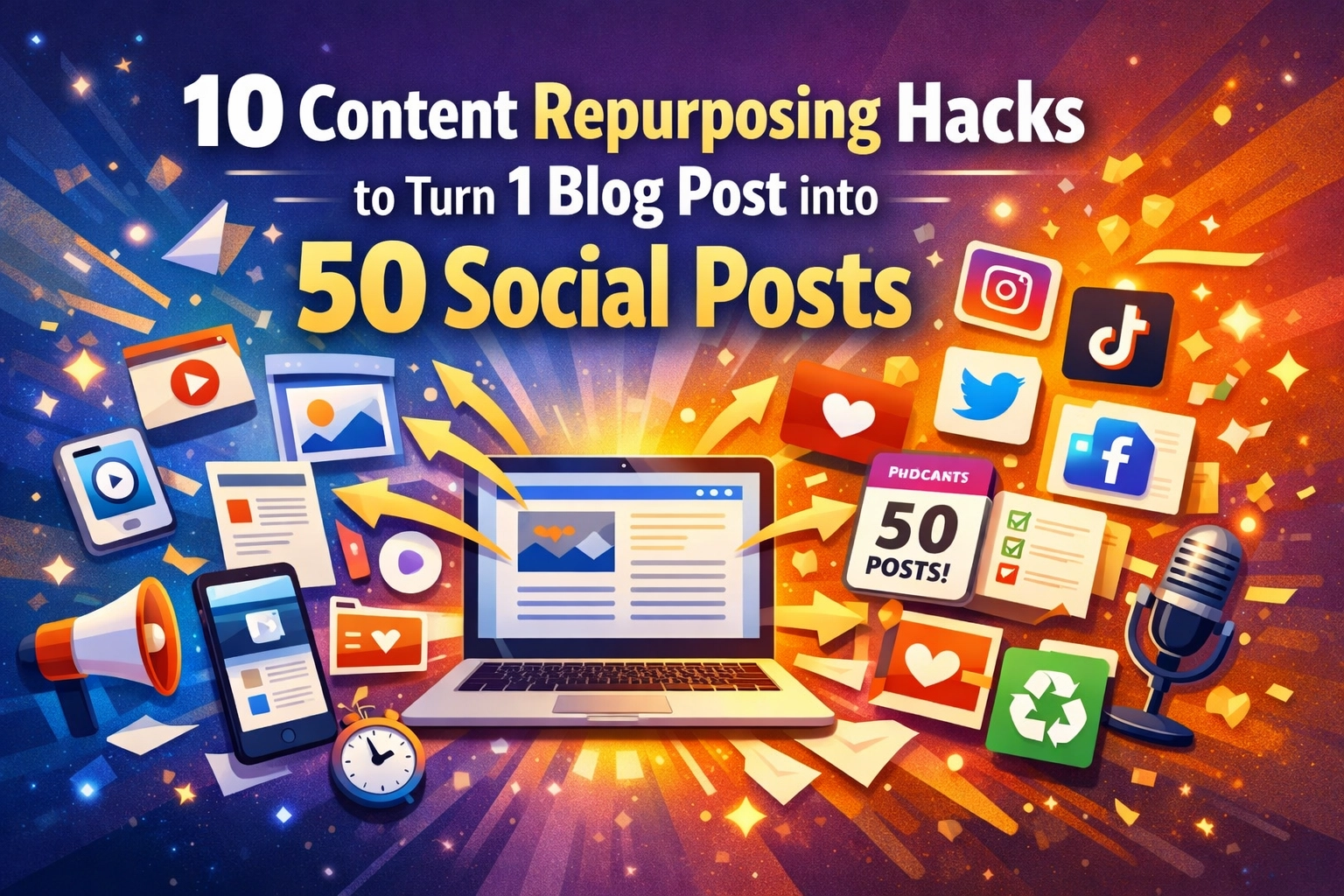
Content creation is often viewed as a linear treadmill: research, write, publish, repeat. However, for high-growth digital brands, this model is fundamentally inefficient. The most successful content strategies today rely on "Content Atomization": the process of breaking down a single, high-value long-form asset into dozens of modular pieces.
According to recent industry data, companies that repurpose content see a 34% increase in organic traffic without increasing their production budget. By treating your blog post as a "pillar" asset, you can generate over 50 unique social media touchpoints. This approach maximizes your Return on Content Investment (ROCI) and ensures your message reaches users across different platforms, regardless of their preferred media format.
In this guide, we will analyze ten technical hacks to deconstruct one blog post into a 50-post social ecosystem.
1. Extract Key Statistics as High-Impact Visuals
Data-driven content is the most shared type of information on platforms like LinkedIn and X (formerly Twitter). A single comprehensive blog post usually contains between 3 to 10 specific data points, internal findings, or cited industry statistics.
Instead of burying these numbers in a paragraph, extract them. Create a "Statistic Card" for each. Use high-contrast typography and minimal background noise to make the data the star.
The Strategy:
- Identify every percentage, dollar amount, or growth metric in your post.
- Create a dedicated graphic for each using a brand-consistent template.
- Write a caption that explains the implication of that statistic.
- Post Count: 5–8 unique posts.

2. Convert Core Takeaways into LinkedIn PDF Carousels
LinkedIn’s algorithm prioritizes "Dwell Time": the amount of time a user spends looking at a post. PDF carousels are the most effective tool for increasing this metric. By taking the 5–7 main headers of your blog post and turning them into a slide deck, you provide a mini-education within the feed.
Technical Implementation:
- Slide 1: The Hook (Use a "How-To" or "Result-Based" headline).
- Slides 2–6: One core insight per slide with 2-3 bullet points.
- Slide 7: The CTA (Call to Action) directing them to the full blog post for the "deep dive."
- Post Count: 3–5 carousels (by grouping different sub-sections).
3. Architect Recursive Twitter (X) Threads
A long-form blog post is essentially a pre-written Twitter thread. However, the mistake most creators make is simply copying and pasting. To gain traction, you must follow a specific thread architecture: The Hook, The Bridge, The Meat, and The Summary.
The Workflow:
- Tweet 1: A bold claim or a question based on your blog's conclusion.
- Tweets 2–10: Each tweet should cover one sub-header or one "step" from your article.
- Tweet 11: A summary of the value provided.
- Tweet 12: The link to the original blog post.
- Post Count: 3–5 threads (focused on different angles of the same topic).
4. Transform "How-To" Sections into Sequential Stories
If your blog post includes a process or a tutorial, it is perfect for Instagram or Facebook Stories. Stories thrive on chronological progression. By posting one "step" every hour or using the "Tap for Next Step" mechanic, you create an interactive experience.
Execution:
- Use the "Poll" or "Slider" sticker on each step to check if the audience understands.
- Capture a screen recording of the process if it's software-based.
- Highlight the series as a "Permanent Story Highlight" to drive ongoing traffic.
- Post Count: 10–12 individual story frames.
5. Script 60-Second Video Recaps (Reels/TikTok/Shorts)
Short-form video is no longer optional. A 1,500-word blog post contains approximately 10–12 minutes of spoken content. You can easily slice this into multiple 60-second scripts.
The Technical Hook:
The first 3 seconds of your video must address a specific pain point mentioned in your blog.
- Video 1: The "Why" (The problem your blog solves).
- Video 2–4: The "How" (Individual steps from the blog).
- Video 5: The "Result" (The case study or outcome mentioned in the text).
- Post Count: 5–7 high-energy short-form videos.
6. Curate Controversy and Thought Leadership Quotes
Every well-written blog post has "nuggets" of wisdom: sentences that encapsulate a complex idea perfectly. These are your "Quote Cards."
Look for sentences where you take a stand, challenge an industry norm, or provide a unique perspective. These "Hot Takes" drive high engagement because they invite debate in the comments.
The Design Rule:
Use large, legible fonts. Ensure your brand handle is on the graphic so it remains credited when reshared.
- Post Count: 5–10 quote graphics.

7. Deconstruct Infographics into Modular Units
If your blog post contains a large infographic, don't just post the whole thing at once. On mobile devices, long infographics are difficult to read.
Instead, "chunk" the infographic. Post the top section on Monday, the middle on Wednesday, and the conclusion on Friday. Each piece serves as a standalone educational unit that leads back to the full visual on your site.
- Post Count: 3–5 modular graphics.
8. Generate Interactive Polls from Blog Dilemmas
Engagement is a two-way street. Use the core questions or dilemmas raised in your blog post to create polls.
Example:
If your blog post is about "Remote vs. Hybrid Work," create a poll asking: "Which model boosted your productivity more in 2026?"
- Link the blog post in the first comment of the poll as the "Expert Analysis" on the topic.
- Post Count: 3–5 interactive polls.
9. Create a Downloadable Checklist Lead Magnet
Convert the actionable items of your blog post into a one-page PDF checklist. While this is primarily a lead generation tool, it provides endless social media fodder.
You can post "Teaser" screenshots of the checklist or record a "Flip-through" video of the document. This adds a tangible sense of value to your content that a simple text post cannot provide.
- Post Count: 2–4 promotional posts for the resource.

10. Utilize AI to Generate Platform-Specific Variations
The final hack to reach the 50-post milestone is leveraging Large Language Models (LLMs) like Claude or GPT-4. You can feed your blog post into an AI and ask for "10 provocative questions based on this text" or "10 variations of this post written for a Technical CTO vs. a Junior Developer."
The Prompt Strategy:
"Analyze the attached blog post. Generate 5 LinkedIn posts that focus on ROI, 5 Twitter posts that focus on technical implementation, and 5 Facebook posts that focus on community and culture."
This ensures that even if you are sharing the same information, the "voice" of the post matches the psychological state of the user on that specific platform.
- Post Count: 10–15 text-based variations.
The Mathematical Breakdown: Reaching 50 Posts
To visualize how we reach the 50-post mark from a single blog post, look at this distribution:
| Format | Quantity | Platform |
|---|---|---|
| Data/Stat Cards | 7 | LinkedIn, X, Instagram |
| PDF Carousels | 3 | LinkedIn, Instagram |
| X Threads | 4 | X (Twitter) |
| Story Steps | 10 | Instagram, Facebook |
| Short-form Videos | 6 | TikTok, Reels, YouTube Shorts |
| Quote Cards | 8 | All Platforms |
| Polls | 4 | LinkedIn, X |
| AI Variations | 8 | All Platforms |
| Total | 50 |
The Compound Effect of Repurposing
By implementing these hacks, you move away from being a "content creator" and become a "content distributor." The technical depth of your original blog post provides the authority, while the 50 social posts provide the visibility.
When Google AdSense crawlers see a consistent flow of traffic coming from diverse social signals to a high-word-count, data-rich article, it signals that your site is a legitimate authority. This not only helps with monetization approval but also builds a sustainable brand ecosystem that lives long after the "Publish" button is pressed.
About the Author: Malibongwe Gcwabaza
Malibongwe Gcwabaza is the CEO of blog and youtube, a premier digital media consultancy specializing in high-density content strategies and algorithmic optimization. With over a decade of experience in digital publishing and brand scaling, Malibongwe has pioneered techniques in content atomization that help businesses maximize their organic reach. His focus remains on bridging the gap between technical SEO and engaging multimedia storytelling to drive measurable ROI for modern creators.
About the Author


