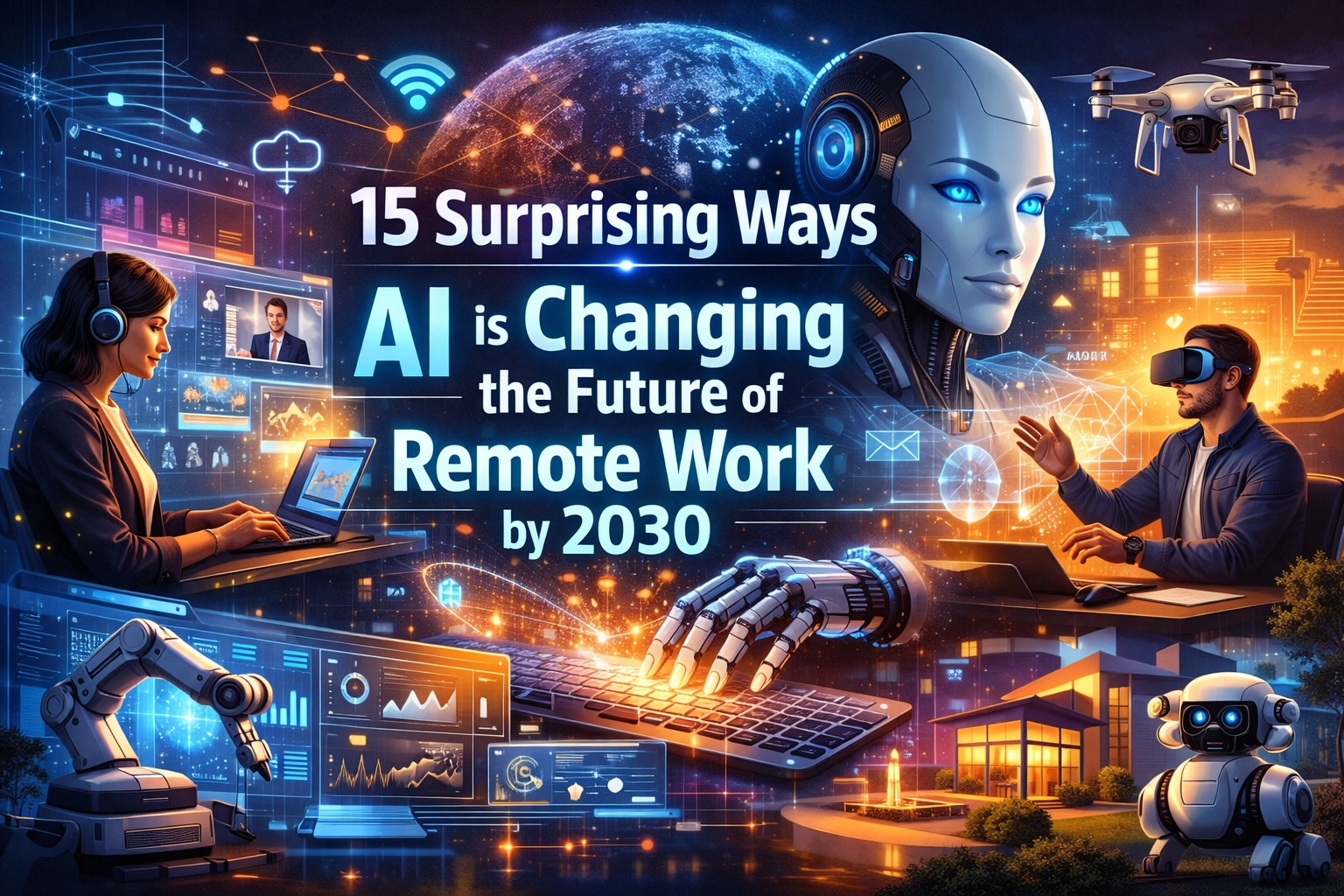
By 2030, the concept of "remote work" will have undergone a fundamental shift. We are moving past the era of digital nomadism being defined by Slack pings and Zoom fatigue. Research indicates that by 2030, remote digital jobs are projected to grow by 25%, reaching approximately 92 million roles globally. However, the nature of these roles will be unrecognizable to today’s workforce.
The catalyst for this transformation is the integration of Agentic AI: systems that don't just suggest text but independently execute complex workflows. As we move toward a global workforce where 60% of employees operate in hybrid or fully remote environments, AI is the infrastructure holding it all together.
Here are 15 surprising ways AI is fundamentally altering the remote work landscape by 2030.
1. The Transition from Copilots to Autonomous Agents
In 2024, we used AI as a "copilot" to help write emails or generate code. By 2030, the remote workforce will be dominated by "Agentic AI." These are autonomous systems capable of breaking down high-level goals into actionable tasks. Instead of a remote project manager manually assigning tickets, an AI agent will analyze a project's technical requirements, check team availability via API integrations, and assign tasks based on historical performance metrics. The remote worker’s role shifts from "task performer" to "agent supervisor," focusing on handling edge cases where human judgment is required.
2. Zero-Latency Universal Translation in Virtual Meetings
Language barriers have long been a friction point for distributed global teams. By 2030, real-time, AI-driven voice cloning and translation will make language irrelevant. Technical teams in Tokyo, Berlin, and Nairobi will participate in the same video call, with each participant hearing the others in their native tongue, synced with realistic lip movements (Deepfake-as-a-Service). This level of integration allows companies to hire based strictly on technical merit rather than linguistic proficiency.
3. Predictive Project Management and the Death of "Status Updates"
The most significant time-sink in remote work is the "meeting about the meeting." AI systems will soon eliminate this by utilizing predictive analytics. By monitoring GitHub commits, Jira tickets, and Figma updates in real-time, AI can predict if a project is likely to miss a deadline two weeks before it happens. It can automatically redistribute resources or alert stakeholders without a single human having to compile a status report.

4. The Rise of "Context Engineering" as a Primary Skill
As routine tasks are automated (with over 50% of current tasks expected to be handled by AI by 2030), a new high-value skill emerges: Context Engineering. Remote workers will be judged on their ability to feed AI systems the correct specialized data, constraints, and organizational "tribal knowledge." Success in a remote setting will depend on how well an individual can architect the information environment for their AI agents to operate effectively.
5. AI-Driven Ergonomics and Biometric Well-being Monitoring
Digital burnout is a leading cause of churn in remote teams. By 2030, AI-integrated workstations will monitor employee well-being via subtle biometric markers. Using computer vision and wearable data, AI can detect signs of cognitive load or physical strain. It might suggest a "mandatory" screen break, adjust the color temperature of your smart lighting to boost focus, or automatically reschedule non-urgent meetings if it detects high stress levels.
6. Spatial Computing and AI-Generated Virtual Offices
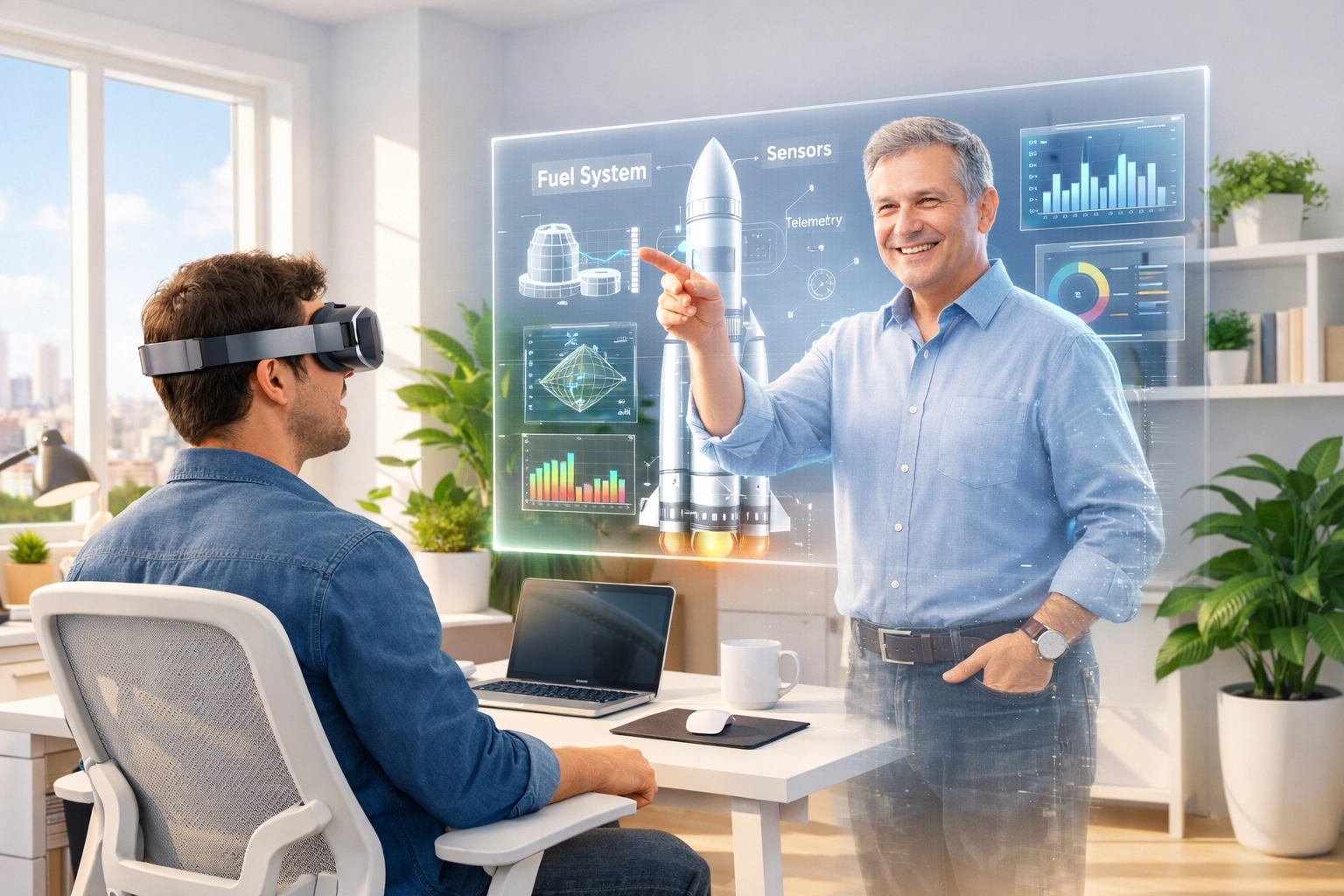
While the early "metaverse" felt clunky, 2030 will see the convergence of AI and Spatial Computing (Vision Pro/Meta Quest 4). AI will dynamically generate virtual office environments tailored to a team's current task. Working on a creative brainstorm? The AI generates a sprawling, open-air digital lounge. Need deep focus on a technical audit? It shifts into a minimalist, distraction-free environment. These spaces will use AI "NPCs" (Non-Player Characters) to act as digital librarians or technical assistants within the virtual space.
7. Autonomous Knowledge Management (Internal RAG)
One of the hardest parts of remote work is finding information hidden in private folders or old chat logs. By 2030, every remote-first company will run its own private LLM utilizing Retrieval-Augmented Generation (RAG). This "Corporate Brain" will index every document, meeting transcript, and decision ever made. A new hire can simply ask the AI, "Why did we choose PostgreSQL over MongoDB for the 2025 infrastructure upgrade?" and receive a cited, accurate technical summary in seconds.
8. AI-Synthesized Onboarding and Digital Twins
Training a remote employee traditionally takes weeks of manual oversight. In 2030, new hires will interact with "Digital Twins" of their senior colleagues. These AI personas, trained on the communication styles and technical expertise of the team, can answer 90% of onboarding questions and perform interactive code reviews or design critiques, allowing the human mentors to focus on high-level cultural integration.
9. The Automation of Middle Management
AI is exceptionally good at optimization and resource allocation: tasks that currently occupy middle management. By 2030, we will see "Algorithmic Governance" where AI handles performance tracking, budget adherence, and compliance monitoring. This leads to flatter organizational structures where remote contributors have more autonomy, reporting to AI-enhanced dashboards rather than human supervisors.
10. Bio-Sync Scheduling for Global Teams
Coordinating across time zones is a logistical nightmare. AI scheduling tools in 2030 will go beyond "find an open slot." They will use "Bio-Sync" data to schedule meetings when all participants are at their peak cognitive performance. If the developer in London is a morning person and the designer in New York is a night owl, the AI identifies the precise 30-minute window where their "circadian focus" overlaps.
11. Hyper-Personalized Async Communication
Video messages (like Loom) will be transformed. You will be able to record a 2-minute update, and AI will customize the delivery for each recipient. It might summarize the technical details for the engineering lead but focus on the ROI and timeline for the CFO, all using your voice and likeness. This ensures that every stakeholder gets the context they need without the sender creating multiple versions.
12. Automated Cybersecurity at the Remote Edge
Remote work expanded the "attack surface" for hackers. By 2030, AI-managed security will be baked into the home network. These "Autonomous SOCs" (Security Operations Centers) will reside on the remote worker's router, using machine learning to detect anomalous traffic patterns and instantly isolating compromised devices before they can touch the corporate VPN.
13. AI-Led Conflict Resolution and Team Sentiment
In a remote environment, subtle interpersonal conflicts can fester because they aren't caught in person. AI sentiment analysis tools will monitor public communication channels (Slack, Discord, Teams) to flag "cultural drift" or rising tension. It won't spy on content but rather analyze metadata and tone to suggest a "team-building sync" or a 1-on-1 before a minor disagreement turns into a resignation.

14. The 4-Day Workweek via "Productivity Injection"
The dream of the 4-day workweek will finally become a reality for remote workers, not through policy, but through sheer efficiency. As AI takes over data entry, scheduling, and basic drafting, the "work" that requires human input will shrink. Companies will shift to output-based compensation rather than hours-logged, as AI provides the transparent metrics needed to prove that a 32-hour week is as productive as a 40-hour one.
15. The Rise of the "Niche Specialist" Economy
AI lowers the barrier to entry for complex tasks, but it raises the ceiling for expertise. By 2030, remote work will favor the "Hyper-Specialist": someone who uses AI to handle 90% of a project but provides the critical 10% of expert human intuition. This will lead to a surge in high-profit side hustles and fractional roles, as experts can manage multiple high-level positions simultaneously using their own personal AI stacks.
Technical Considerations: The Infrastructure of 2030
Transitioning to this AI-driven remote future isn't just about software; it requires a robust technical foundation:
- Edge Computing: To reduce latency in VR and real-time translation, more AI processing will happen on local devices rather than in the cloud.
- Data Sovereignty: Companies must implement rigorous "Data Clean Rooms" to ensure that as AI agents process sensitive remote work data, they don't leak trade secrets into public LLM training sets.
- Energy Efficiency: The massive compute power required for 24/7 AI agents will necessitate a shift toward more energy-efficient models (like Small Language Models or SLMs) that can run on a standard laptop.
The Human Element: Staying Grounded
Despite the technical marvels, the risk of "digital disconnection" is real. As AI handles the "doing," the "being" becomes more important. Success in 2030 will belong to remote workers who use AI to reclaim their time for deep work, creative strategy, and genuine human connection.
About the Author: Malibongwe Gcwabaza
Malibongwe Gcwabaza is the CEO of blog and youtube, a forward-thinking digital agency specializing in the intersection of AI and remote work culture. With over a decade of experience in digital transformation, Malibongwe focuses on helping small businesses and remote teams leverage agentic workflows to increase productivity without losing the human touch. He is a frequent speaker on the ethics of AI governance and a passionate advocate for the decentralization of the global workforce.
Ready to prepare your team for 2030? Start by auditing your current "manual" workflows. Every task you automate today is a step toward the autonomous, high-efficiency future of remote work. Stay tuned to our blog for more deep dives into the tools and tactics that are defining the next decade of digital business.
About the Author


