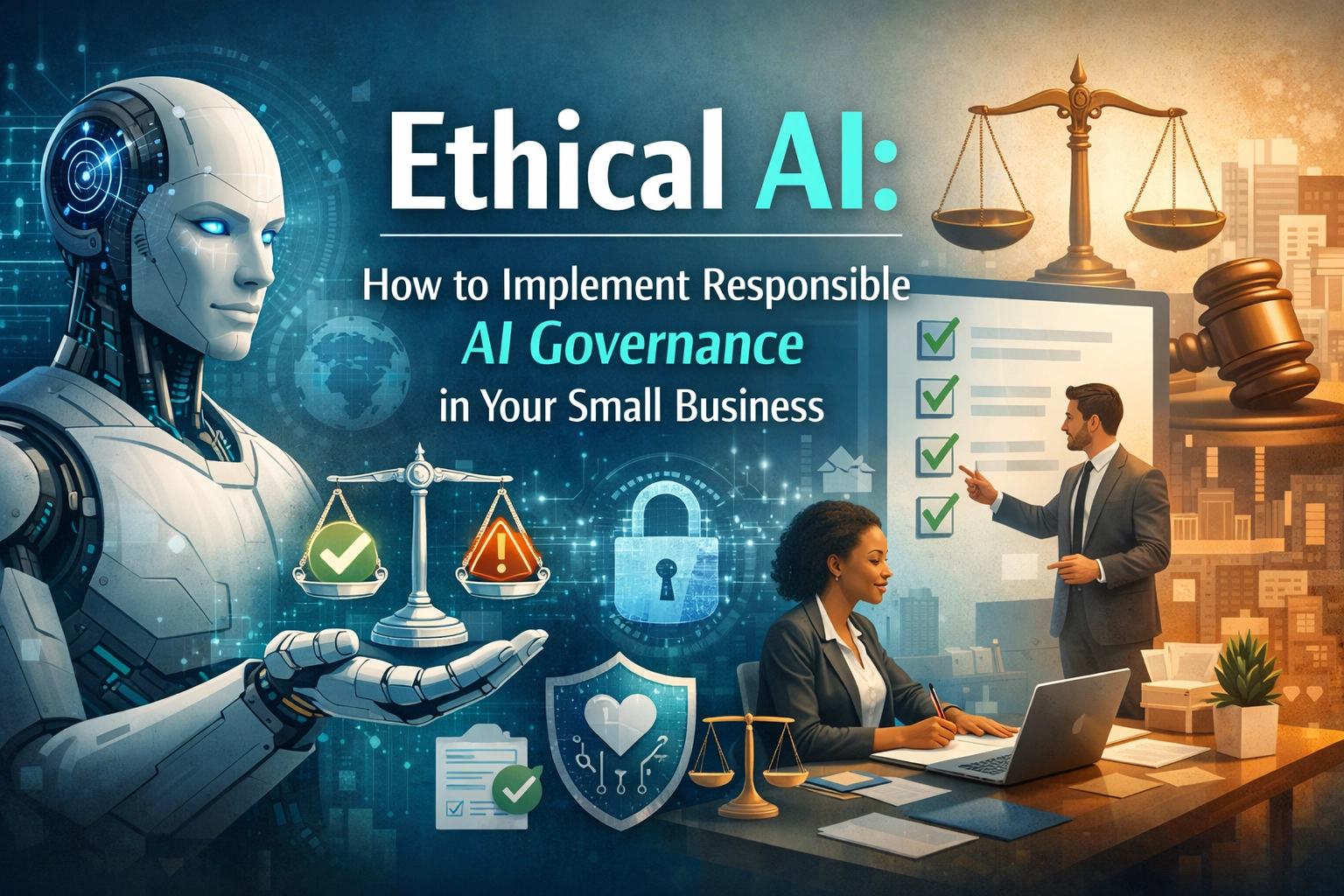
By 2026, the conversation around Artificial Intelligence has shifted from "How do we use it?" to "How do we control it?" For small and medium-sized businesses (SMBs), the stakes have never been higher. While enterprise giants have entire legal departments dedicated to AI compliance, small businesses are often one "hallucinated" legal contract or one biased hiring algorithm away from a reputational and financial crisis.
Ethical AI governance is no longer a luxury or a niche concern for philosophers; it is a fundamental operational requirement. With the global regulatory landscape: led by the EU AI Act and evolving NIST frameworks: clamping down on "black box" algorithms, SMBs must implement structured governance to stay competitive and compliant.
This guide provides a technical roadmap for implementing a responsible AI governance framework tailored for the constraints and agility of a small business.
The Three Pillars of SMB AI Governance
To build a responsible system, you must move beyond vague mission statements. Your governance should be built on three technical pillars: Algorithmic Fairness, Operational Transparency, and Data Accountability.
1. Algorithmic Fairness: Mitigating Hidden Bias
Bias in AI doesn't usually happen because of malicious intent; it happens because of "dirty" or non-representative training data. For an SMB using AI for customer segmentation or recruitment, biased outputs can lead to discriminatory practices.
Technical Implementation:
- Dataset Auditing: Before feeding proprietary data into a Fine-Tuned Model or a Retrieval-Augmented Generation (RAG) system, conduct a statistical distribution check. Is your data over-representing a specific demographic?
- Adversarial Testing: Intentionally "stress-test" your AI prompts. If you are using an AI agent for customer service, feed it queries from various cultural dialects to ensure the sentiment analysis remains consistent and fair.

2. Operational Transparency: Killing the "Black Box"
Transparency means being able to explain why an AI reached a specific conclusion. In a technical sense, this involves moving toward Explainable AI (XAI). If a customer asks why their discount code was rejected by your automated system, "The AI said so" is no longer a legally or socially acceptable answer.
Technical Implementation:
- System Cards: Maintain a "System Card" for every AI tool you use. This document should list the model version (e.g., GPT-4o, Claude 3.5 Sonnet), the specific parameters used (Temperature, Top-P), and the intended use case.
- Logging and Traceability: Implement a logging layer in your API calls. Use tools that record the prompt, the context retrieved from your vector database, and the final output. This creates an audit trail for future reviews.
3. Data Accountability: Beyond GDPR
In 2026, data privacy is about more than just encryption. It’s about Data Provenance. You need to know exactly where the data used to "teach" your local business bots came from and whether you have the right to use it for machine learning purposes.
Technical Implementation:
- Data Minimization Layers: Use a middleware layer to strip Personally Identifiable Information (PII) before sending data to third-party LLM providers.
- Consent Mapping: Ensure your CRM flags which customer data can be used for "AI-driven personalization" versus standard communication.
A Step-By-Step Governance Roadmap for SMBs
Implementing governance doesn't require a million-dollar budget. It requires a disciplined, four-phase approach.
Phase 1: The AI Inventory and Risk Assessment
You cannot govern what you haven't mapped. Small businesses often suffer from "Shadow AI": employees using unapproved tools like free versions of ChatGPT to process sensitive company data.
- Conduct a Tool Audit: List every AI-powered tool currently in use (from Notion AI to specialized accounting software).
- Assign Risk Categories:
- Low Risk: Generative AI for internal brainstorming or social media captions.
- Medium Risk: AI for internal data analysis or customer support.
- High Risk: AI used for hiring, financial forecasting, or handling medical/legal data.
Phase 2: Selecting a Framework (NIST vs. OECD)
Rather than inventing your own rules, adopt a modified version of an established framework. For SMBs, the NIST AI Risk Management Framework (AI RMF) is highly recommended due to its practical focus on "Manage, Map, and Measure."
- The "Human-in-the-Loop" (HITL) Protocol: Define exactly where a human must intervene. For example, any AI-generated financial report must be signed off by a human accountant before being sent to a stakeholder.

Phase 3: Technical Integration of Guardrails
Guardrails are the automated checks that prevent your AI from "going rogue."
- Prompt Injection Protection: If you have a customer-facing chatbot, implement a "filtering" layer that detects attempts to bypass the bot’s instructions.
- Output Validation: Use secondary, smaller "checker" models (like an 8B parameter Llama-3 model) to scan the output of your main model for toxic content or hallucinations before it reaches the user.
Phase 4: The Quarterly Ethical Audit
Governance is not a "set it and forget it" task. Large language models (LLMs) suffer from Model Drift: where their performance degrades or changes over time as the provider updates the underlying weights.
- Benchmark Testing: Every three months, run a set of standard "Golden Queries" through your AI systems. Compare the 2026 outputs to your baseline. If the accuracy or tone has shifted significantly, your governance team needs to adjust the system prompts.
The Legal Landscape: What SMBs Need to Know in 2026
The regulatory environment has matured. In 2026, the EU AI Act has full extraterritorial reach. If your South African or American small business serves European customers, you are subject to their classification system.
Key Regulatory Risks:
- Transparency Obligations: You must disclose to users that they are interacting with an AI.
- Copyright Liability: Ensure your AI tools have "indemnity clauses" regarding the data they were trained on.
- Prohibited Practices: Avoid using AI for "social scoring" or real-time biometric identification unless you have specific, high-level legal exemptions.

The Competitive Advantage of "Trust-First" AI
While governance feels like a hurdle, it is actually a powerful marketing tool. In an era of AI-generated sludge and "deepfake" scams, consumers are migrating toward brands they can trust.
By publishing an AI Ethics Manifesto on your website, you are signaling to your customers that you value their data and their humanity.
- Case Study: A small boutique law firm implemented an AI governance policy that guaranteed no client data was used to train public models. They saw a 30% increase in high-net-worth client acquisitions who were previously wary of "digital leaks."
Conclusion: Starting Small, Thinking Big
Responsible AI governance for a small business isn't about complexity; it’s about consistency. Start by banning "Shadow AI," move to a "Human-in-the-Loop" policy for high-risk tasks, and commit to a quarterly audit of your tools.
The goal isn't to be perfect: AI is an evolving field. The goal is to be deliberate. When you treat AI as a powerful but unpredictable employee that requires oversight, you protect your business, your customers, and your future.
Actionable Checklist for Monday Morning:
- Draft a one-page "Acceptable AI Use Policy" for your staff.
- Check the "Privacy Settings" on your primary AI tool (e.g., toggle off "Use my data for training").
- Identify one "High Risk" AI process and assign a human "Reviewer" to it.

About the Author: Malibongwe Gcwabaza
CEO of blog and youtube
Malibongwe Gcwabaza is a forward-thinking leader at the intersection of technology and business strategy. With over a decade of experience in digital transformation, he specializes in helping small to medium-sized enterprises navigate the complexities of the modern tech landscape. Under his leadership, blog and youtube has become a premier destination for actionable insights into AI, SEO, and business automation. Malibongwe is a staunch advocate for "Democratized AI," believing that with the right governance, even the smallest businesses can outcompete global giants. When he isn't exploring the latest LLM benchmarks, he's focused on building sustainable, tech-driven ecosystems that prioritize human creativity.
About the Author


