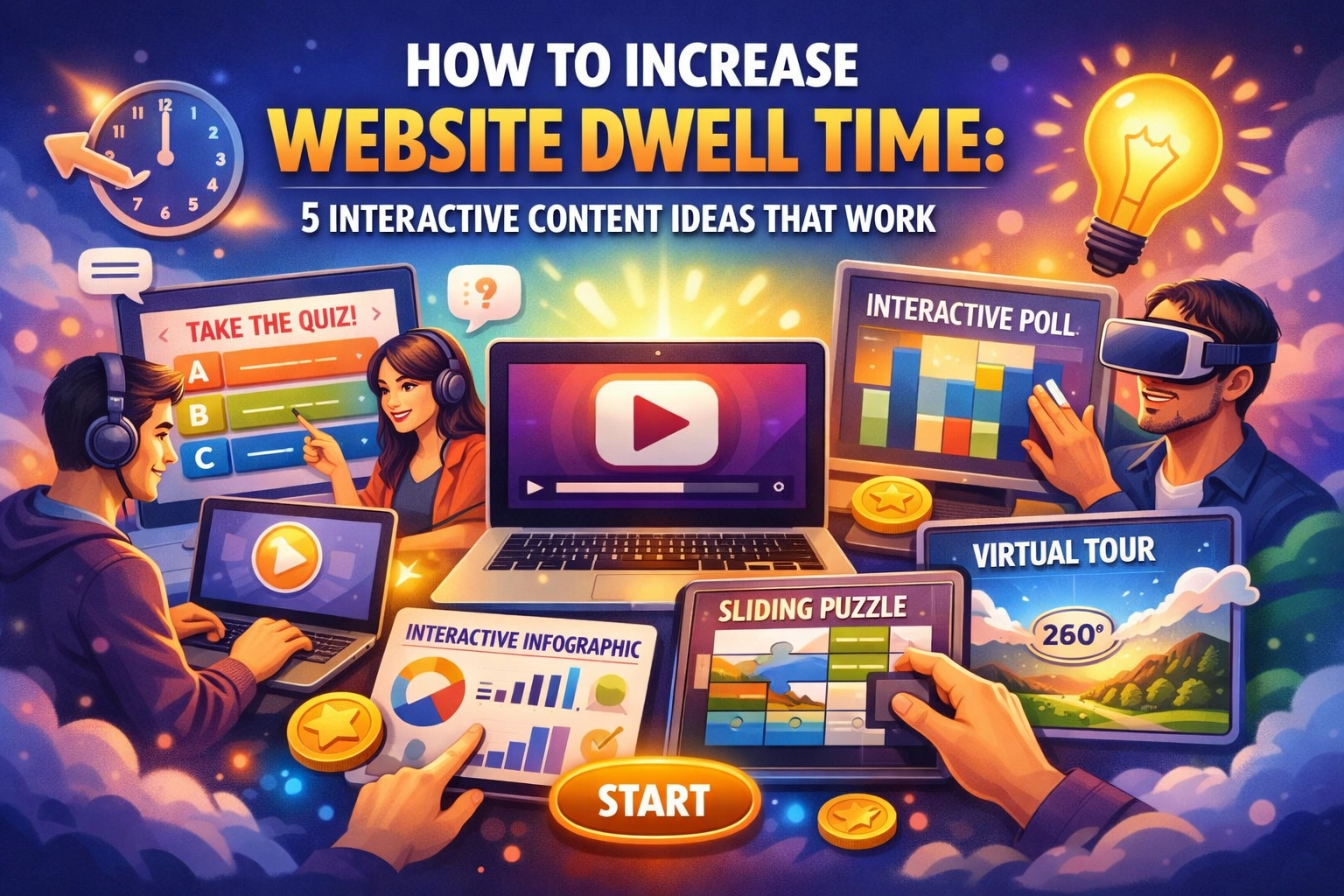
Dwell time is often misunderstood as a simple synonym for "time on page," but in the evolving landscape of 2026 SEO, it has become a critical signal of content depth and user satisfaction. While Google’s official stance on dwell time as a direct ranking factor remains nuanced, the correlation between high dwell time and high-ranking content is undeniable. When a user clicks a search result and spends four minutes engaging with the page before returning to the SERP (or better yet, not returning at all because their intent was met), it signals to search algorithms that your page provided the "Satisfied Click."
To achieve this in an era of AI-generated summaries and declining attention spans, static text is no longer sufficient. You need to move from passive consumption to active participation. Interactive content transforms a reader into a user, forcing a psychological shift from scanning to problem-solving.
Here are five technically sophisticated interactive content strategies designed to maximize dwell time, improve engagement metrics, and satisfy the sophisticated search intent of 2026.
1. Multi-Variable ROI and Value Calculators
Static "How-To" guides are great, but they often leave the reader doing the mental math. By embedding a custom-coded calculator, you provide immediate, personalized utility. According to industry data, interactive tools like calculators generate conversion rates up to 3x higher than static lead magnets.
The Technical Implementation
A simple JavaScript-based calculator can be embedded via an iframe or a custom block in your CMS. However, for 2026, the focus is on Multi-Variable Input. Instead of a simple "Cost x Quantity" tool, build an "Efficiency Impact Calculator."
For example, if you are in the B2B SaaS space, don't just calculate price. Calculate the "Opportunity Cost of Manual Data Entry." Users spend an average of 3 to 5 minutes inputting their specific data points, adjusting sliders, and reviewing the generated reports. This is "active dwell time": the highest quality engagement signal you can send to a search engine.
Key Features for Success:
- Real-time visual feedback: Use libraries like Chart.js or D3.js to update a graph instantly as the user moves a slider.
- PDF Export: Allow users to download their results in exchange for an email address, bridging the gap between dwell time and lead generation.
- Mobile-First Sliders: Ensure touch targets are optimized for mobile users, who account for over 60% of web traffic.

2. Branching Narrative Quizzes (Self-Segmentation Tools)
The era of "Which Disney Character Are You?" is over. In a professional context, quizzes must serve as self-segmentation tools. A branching narrative quiz adapts the subsequent questions based on the user's previous answers. This keeps the user engaged because every step feels relevant to their specific situation.
Psychology of the "Endowment Effect"
When a user spends 90 seconds answering questions about their business challenges, they become psychologically invested in the outcome (the Endowment Effect). They are far more likely to read the detailed results page, increasing the overall time spent on your domain.
From a technical perspective, these should be built using conditional logic. If a user selects "E-commerce" as their industry, the next question shouldn't be about "Lead Generation for Realtors."
Data Insight: Research indicates that interactive quizzes hold attention for an average of 2 minutes and 45 seconds, compared to the 37 seconds spent on a standard blog post.
3. Interactive Data Visualizations and "Scrollytelling"
In 2026, users are weary of static infographics. They want to interrogate the data themselves. "Scrollytelling" is a technique where the narrative of the page changes as the user scrolls, triggering animations or updating data visualizations.
Advanced Technical Stack
Using a combination of GSAP (GreenSock Animation Platform) and ScrollTrigger, you can create a page where a graph builds itself as the reader scrolls through the analysis. For example, if you're writing a report on "Market Trends in Renewable Energy," let the user hover over different regions of a map to see localized data points.
This interactivity forces "micro-engagements." Each hover, click, and scroll-pause is tracked by modern analytics (like GA4's user_engagement events), notifying search engines that the user is deeply interacting with the DOM (Document Object Model) elements.
Why it works for Dwell Time:
- Exploratory Learning: Users spend time "playing" with the data.
- Reduced Bounce Rate: The visual stimulation reduces the urge to hit the "back" button.
- High Shareability: Unique data tools earn high-quality backlinks, which indirectly supports long-term SEO.

4. Embedded AI Micro-Agents and "Chat-with-this-Page"
One of the most significant shifts in 2026 is the integration of RAG (Retrieval-Augmented Generation) directly on the page. Instead of a generic chatbot, you can embed a "Page Concierge": an AI agent trained specifically on the content of that single long-form article.
Technical Integration
By using an API (like OpenAI’s Assistants API or a LangChain implementation), you can allow users to ask questions like, "Summarize the third point for me" or "How does this apply to a small business with a $500 budget?"
This keeps the user on the page while they get specific answers, rather than them leaving your site to ask a general AI (like ChatGPT or Claude) for a summary. You are essentially providing the search interface within your own ecosystem.
Implementation Tip: Ensure the AI agent is visually distinct but non-intrusive. A small floating action button (FAB) that expands into a focused chat window works best for maintaining reading flow while offering deep-dive capabilities.
5. Shoppable or Educational Video Hotspots
Video is a well-known dwell time booster. Marketers report that video increases dwell time by up to 80%. However, passive video is being replaced by interactive video. This involves adding "hotspots" or clickable elements within the video timeline.
How to Execute
Using platforms like H5P or specialized HTML5 video wrappers, you can overlay buttons on top of your video content. If you're demonstrating a product, a hotspot could allow the user to click to see "Technical Specs" without pausing the video. If it's an educational piece, you can insert a "Check your understanding" pop-up quiz at the 2-minute mark.
Technical Consideration: Be wary of page load speeds. Use a "Facade" or "Lazy Load" technique for your interactive video. This means the heavy scripts only load once the user clicks a "Play" button or a preview image, ensuring your Core Web Vitals (specifically Largest Contentful Paint) remain within the "Good" range.

Optimizing the Technical Foundation for Interactivity
Interactivity is a double-edged sword. If your interactive elements are slow to load or buggy, they will actually decrease dwell time by frustrating the user. To ensure your interactive content supports your SEO and AdSense goals, follow these technical guidelines:
1. Prioritize Interaction to Next Paint (INP)
As of 2024, INP is a Core Web Vital. It measures the latency of every tap, click, or keyboard interaction that occurs during the entire lifespan of a user’s visit to a page. If your interactive calculator takes 500ms to respond to a slider movement, your INP score will suffer, potentially hurting your rankings. Aim for an INP of under 200ms.
2. Strategic Use of "Above the Fold"
Do not place your heaviest interactive elements at the very top of the page. This can delay the loading of the main content. Instead, place a compelling text-based hook and a hero image, then introduce the interactive element roughly 15-20% down the page. This ensures the user is already "hooked" by the context before they encounter the tool.
3. GA4 Custom Event Tracking
To prove these ideas work, you must track them. Don't just look at "Average Engagement Time." Set up custom events for:
calculator_interactionquiz_start/quiz_completevideo_hotspot_clickdata_viz_hover
By analyzing which elements lead to the longest sessions, you can refine your content strategy to focus on the tools that resonate most with your specific audience.
Conclusion: The "Active User" Advantage
In the current landscape of the web, the winner is not the one who provides the most information, but the one who provides the most usable information. Interactive content bridges the gap between a search query and a solved problem. By implementingROI calculators, branching quizzes, scrollytelling, AI micro-agents, and interactive videos, you transform your website from a static billboard into a dynamic laboratory.
This depth of engagement is exactly what search engines: and more importantly, human users: are looking for in 2026. High dwell time is the natural byproduct of a website that respects the user's time by making it more productive.
About the Author: Malibongwe Gcwabaza
Malibongwe Gcwabaza is the CEO of blog and youtube, a premier digital consultancy specializing in advanced content strategies and Generative Engine Optimization (GEO). With over a decade of experience in technical SEO and digital architecture, Malibongwe has helped hundreds of brands transition from static content models to high-engagement, interactive ecosystems. His approach combines data-driven insights with a "user-first" philosophy to drive sustainable organic growth. When he isn't optimizing dwell time, Malibongwe explores the intersection of AI ethics and decentralised web technologies.
About the Author


