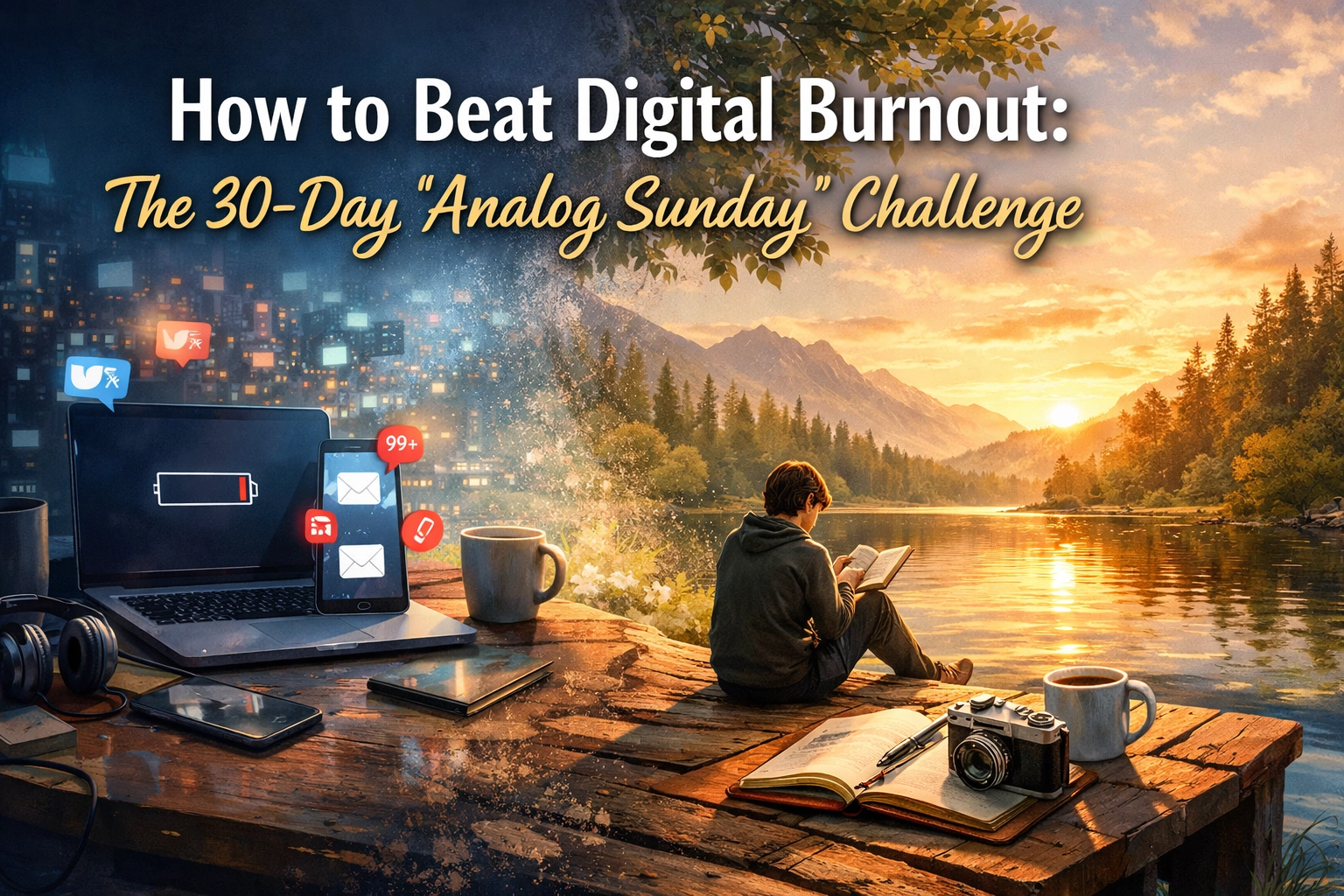
By March 2026, the average knowledge worker spends approximately 11.5 hours per day interacting with digital interfaces. This figure isn’t just a statistic; it represents a fundamental shift in human biology. Our neural pathways are being pruned for rapid-fire information consumption, leading to a phenomenon known as "Attention Residue." When we switch between Slack, emails, and social feeds, our brains don't transition cleanly; a part of our cognitive load stays stuck on the previous task. The cumulative result is digital burnout: a state of chronic mental fatigue, decreased empathy, and a fragmented sense of self.
The #analog2026 movement has emerged not as a rejection of technology, but as a survival mechanism. It is an act of "digital hygiene." To combat this, the 30-Day Analog Sunday Challenge provides a structured framework to reclaim 24 hours of every week for non-digital existence. This isn’t about a "digital detox" that you abandon after a weekend; it is about rewiring your brain’s default mode network to prioritize depth over speed.
The Science of Digital Burnout: Why 2026 is Different
The burnout we face today is more aggressive than that of the early 2020s. With the integration of Agentic AI and hyper-personalized feeds, the "hooks" used by the attention economy have become more sophisticated. We are no longer just looking at screens; we are interacting with algorithms designed to predict our next dopamine craving before we even feel it.
Physiologically, digital burnout manifests as elevated cortisol levels and a suppressed prefrontal cortex. Constant notifications keep us in a state of "continuous partial attention," which prevents the brain from entering the "Default Mode Network" (DMN). The DMN is the brain state responsible for creativity, self-reflection, and long-term planning. Without it, we become reactive rather than proactive.

The Framework: What is an Analog Sunday?
The Analog Sunday Challenge is a 30-day commitment (four consecutive Sundays) where you remove all digital intermediaries from your life for a full 24-hour cycle. This means:
- No Smartphones: Use a "dumb phone" or a landline for emergencies only.
- No Screens: No TV, no laptops, no Kindles (E-ink is a grey area, but for this challenge, we recommend physical books).
- No Digital Audio: No Spotify or podcasts. If you want music, use vinyl, CDs, or a radio.
- No GPS: Use physical maps or your internal sense of direction.
The goal is to move from "Glass-Based Interaction" to "Tactile-Based Interaction."
Week 1: The Withdrawal and the Physicality of Boredom
The first Sunday is objectively the hardest. You will likely experience "Phantom Vibration Syndrome": the sensation that your phone is vibrating in your pocket even when it’s in another room. This is a physiological response to the interruption of a dopamine loop.
The Technical Mechanism: Dopamine Reset
In Week 1, your brain is searching for the high-frequency rewards it gets from scrolling. When these rewards are removed, you encounter a "boredom gap." Most people avoid this gap by reaching for a device. In this challenge, you must lean into it.
Tasks for Week 1:
- The Box Ritual: On Saturday night at 9:00 PM, place all your devices in a physical lockbox. Do not open it until Monday morning.
- Tactile Engagement: Spend at least three hours on a manual task. This could be gardening, woodworking, or even deep-cleaning a room. The goal is to stimulate the mechanoreceptors in your hands, which provides a different type of sensory feedback than a touchscreen.
- Monotasking: If you eat, just eat. Do not read or listen to music. Notice the textures and flavors. This begins the process of resensitizing your reward system.
Week 2: Rediscovering Haptics and Tangible Media
By the second Sunday, the initial panic usually subsides, replaced by a strange sense of "slowness." This is where you begin to replace digital consumption with analog production.
The Value of "Slow Media"
In a digital environment, everything is searchable and hyperlinked. In an analog environment, information is linear. Reading a physical book requires a different cognitive load than reading a blog post. You cannot "CMD+F" a paperback. This forces the brain to build a mental model of the information, leading to better retention and deeper focus.
Tasks for Week 2:
- The Physical Library: Spend the day with a physical book or a long-form magazine.
- Analog Navigation: Go for a walk or a drive without a GPS. If you get lost, use a paper map or ask a person for directions. This engages the hippocampus, the part of the brain responsible for spatial memory, which often atrophies when we rely on turn-by-turn navigation.
- Handwriting: Write a letter or a journal entry. The neuro-circuitry involved in handwriting is far more complex than typing, and it has been shown to improve emotional processing.

Week 3: Deep Focus and Social Restoration
One of the most insidious effects of digital burnout is the erosion of social presence. We are often "together but alone," checking phones while sitting across from friends. Week 3 focuses on restoring the quality of human interaction.
The "Table Phone" Problem
Research shows that the mere presence of a smartphone on a table: even if it is turned off: reduces the quality of the conversation and the perceived empathy between participants. It acts as a constant reminder of "elsewhere."
Tasks for Week 3:
- The Analog Meetup: Invite a friend over or meet at a park. The rule is simple: neither of you can bring a phone.
- Extended Deep Work (Non-Digital): Spend four hours on a hobby that requires deep focus. Whether it’s painting, playing a musical instrument, or restoring a piece of furniture, notice how your "flow state" feels when there are zero digital interruptions.
- Observational Journaling: Go to a public place (like a café or a park) and simply watch. Record your observations in a notebook. This helps move the brain from "internalized anxiety" to "externalized curiosity."
Week 4: Integration and the Hybrid Future
The final Sunday is about reflecting on the past month and deciding which parts of the analog lifestyle you want to carry into your digital workweek. You shouldn't go back to your old habits on Monday morning.
Building a "Digital Satiety" Model
Digital satiety is the point at which you have consumed enough information to be informed, but not so much that you are overwhelmed. Most of us pass this point by 9:00 AM.
Tasks for Week 4:
- The Audit: Look back at your journals from the last three weeks. What did you miss? What did you realize you didn't need?
- Designing Your "Digital Perimeter": Create a set of rules for your workweek. For example: "No screens before 8:00 AM," "Greyscale mode on the phone after 7:00 PM," or "Laptop-free meetings."
- The Legacy Plan: Commit to keeping "Analog Sunday" as a permanent fixture in your life.

Tools for the Analog Transition
While the goal is to use fewer tools, some physical items can make the transition easier and more enjoyable:
| Digital Tool | Analog Replacement | Benefit |
|---|---|---|
| Google Calendar | Paper Planner / Wall Calendar | Visualizes time as a limited resource. |
| Notes App | Leather-bound Notebook | Encourages slower, more thoughtful recording. |
| Spotify | Vinyl or Radio | Forces you to listen to an entire album or human-curated content. |
| Kindle | Library Book | Reduces blue light exposure and increases tactile satisfaction. |
| Apple Watch | Mechanical Watch | Removes the "notification wrist" twitch. |
Data-Driven Insights: The Results of Digital Fasting
In a 2025 study on "The Cognitive Effects of Periodic Digital Abstinence," participants who engaged in 24-hour weekly breaks reported:
- 32% Increase in Deep Work Capacity: The ability to focus on a single difficult task for over 90 minutes.
- 18% Improvement in Sleep Quality: Likely due to the reduction in blue light and the lowering of evening cortisol.
- Increased "Awe" Response: A heightened appreciation for nature and physical surroundings.
Digital burnout isn't a lack of discipline; it's the result of an environment that is mismatched with our biology. The 30-Day Analog Sunday Challenge is a recalibration. By stepping back from the digital world, you aren't falling behind: you are gathering the cognitive resources necessary to lead in a world that is increasingly distracted.

Actionable Tips for Success
- Notify Your Circle: Tell your family and colleagues on Friday that you will be offline on Sunday. This eliminates the "anxiety of being unreachable."
- Prepare Your Environment: Buy your groceries, print out your recipes, and pick out your books on Saturday. If you have to go online to find a recipe on Sunday, the challenge is compromised.
- Use an Analog Alarm Clock: Don't let your phone be the first thing you touch in the morning.
- Embrace the "Fidget": You will feel restless. This is your nervous system looking for a scroll. Keep a physical object nearby: a stress ball, a sketchpad, or even a deck of cards: to occupy your hands.
The transition from a high-frequency digital life to a low-frequency analog one is uncomfortable at first. But on the other side of that discomfort is a version of yourself that is calmer, more creative, and significantly more present.
About the Author: Malibongwe Gcwabaza
Malibongwe Gcwabaza is the CEO of blog and youtube, a media company dedicated to navigating the intersection of human productivity and emerging technology. With over 15 years of experience in digital strategy and corporate leadership, Malibongwe focuses on how high-performing teams can leverage AI and automation without sacrificing mental health or creative integrity. He is a frequent speaker on "The Future of Work" and an advocate for the #analog2026 movement, practicing weekly digital sabbaticals to maintain a competitive edge in an increasingly automated world.
About the Author


