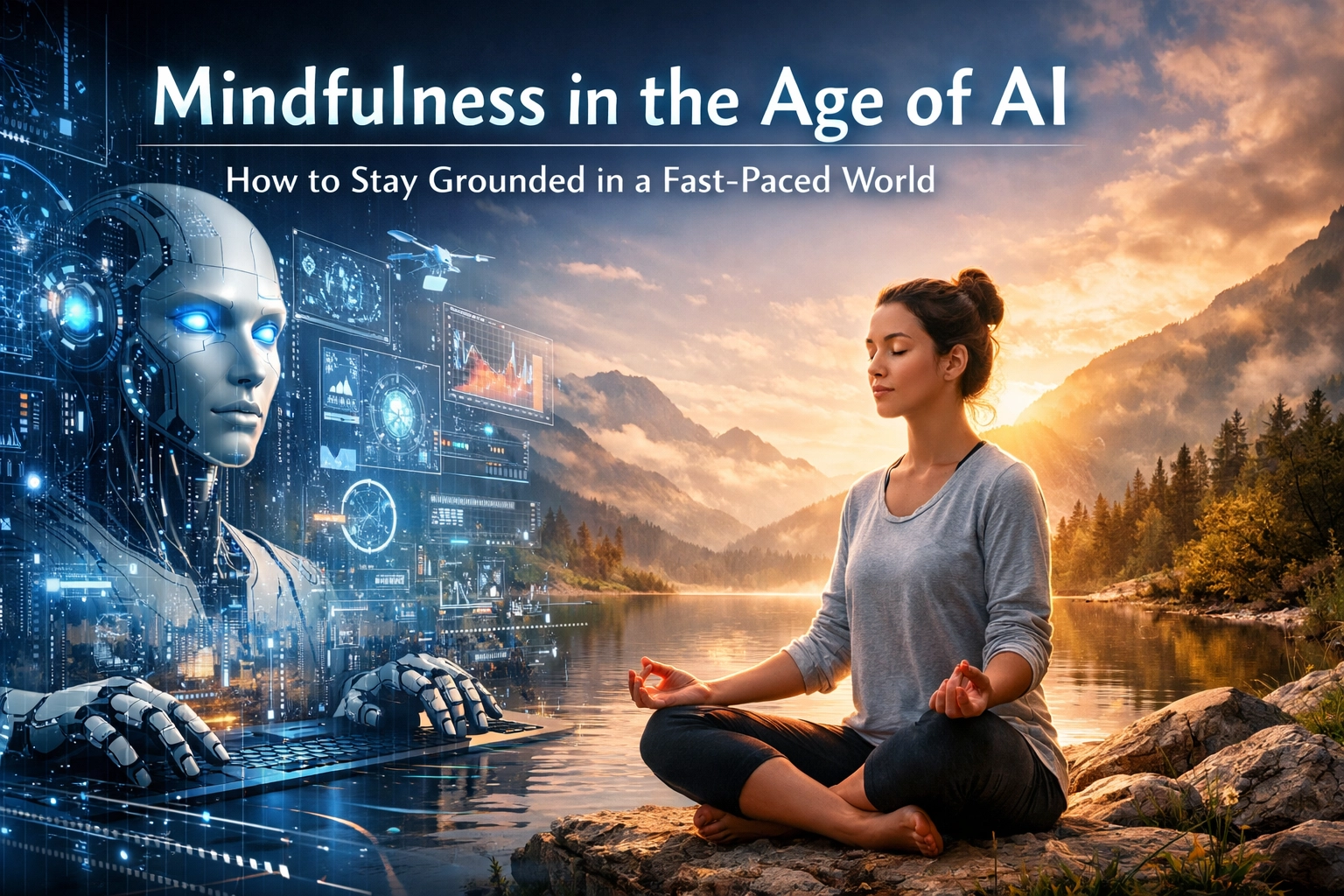
As we navigate the first quarter of 2026, the integration of Artificial Intelligence into our daily workflows and personal lives has moved past the "novelty" phase into a state of total ubiquity. We aren't just using AI; we are living alongside agentic systems that predict our needs, draft our communications, and manage our schedules. However, this shift has brought a specific psychological phenomenon to the forefront: "Techno-Overload 2.0."
The speed of information processing has accelerated beyond human evolutionary biological limits. While an LLM can process millions of tokens per second, the human prefrontal cortex remains tethered to a linear, much slower processing speed. This disparity creates a friction point characterized by chronic cortisol spikes, decision fatigue, and a fragmented sense of self. To stay grounded, we must move beyond basic "digital detoxes" and implement a technical, biological, and philosophical framework for mindfulness.
The Neuroscience of the AI-Driven Mind
To understand why we feel ungrounded, we have to look at the Default Mode Network (DMN) and the Salience Network in the brain. The DMN is active when we are daydreaming, reflecting on the past, or thinking about the future. In a pre-AI world, boredom triggered the DMN, allowing for creativity and self-integration.
In 2026, "boredom" has been effectively eradicated by generative algorithms. Every micro-moment of downtime is filled with hyper-personalized content. This keeps our Salience Network: the system responsible for toggling between internal reflection and external stimuli: in a state of constant "high alert."
The Cortisol Loop of Instant Gratification
Recent data from neurological studies in late 2025 indicates that the average knowledge worker toggles between tasks 47% more frequently than they did in 2023. Each "successful" interaction with an AI: getting a perfect prompt result or an automated task completion: triggers a dopamine hit. However, the subsequent "drop" leads to a craving for more interaction, creating a loop that mimics addiction. This isn't just a habit; it is a physiological restructuring of our attention spans.

Strategic Grounding: The "Cognitive Preservation" Framework
Staying grounded in 2026 requires more than just sitting cross-legged for ten minutes. It requires a strategic approach to how we interface with technology.
1. Intentional Cognitive Offloading
We often use AI to "save time," but we rarely decide what to do with the time we save. Often, we simply fill it with more work. "Cognitive Offloading" is the technical term for using external tools to reduce mental load. To stay grounded, you must distinguish between procedural offloading (letting AI handle repetitive tasks) and existential offloading (letting AI make value-based decisions for you).
- The Rule: If a task requires empathy, ethical judgment, or personal taste, do not offload it. Use AI for the "how," but never for the "why."
2. High-Fidelity Sensory Anchoring
The more time we spend in digital environments: especially with the rise of mixed reality and spatial computing: the more our proprioception (our sense of body position) atrophies. Grounding requires "High-Fidelity" physical inputs.
- Technical Implementation: Use a weighted lap pad during deep-work AI prompting sessions. The consistent pressure provides "proprioceptive input" to the nervous system, signaling safety to the amygdala and preventing the "floaty" feeling associated with long-term digital immersion.
Agentic Mindfulness: Using AI as a Mirror, Not a Crutch
It is a paradox, but AI itself can be one of the most effective tools for maintaining mindfulness, provided it is used as a biofeedback mechanism.
Biofeedback and HRV Monitoring
In 2026, wearable technology has reached a point of near-medical grade accuracy. Heart Rate Variability (HRV) is the gold standard metric for measuring the state of your Autonomic Nervous System. A high HRV indicates a resilient, grounded state, while a low HRV indicates a "fight or flight" response.
By integrating your HRV data with your AI workspace, you can create "Stress-Aware Environments." Some modern productivity suites now offer API hooks that will automatically simplify your UI or suggest a breathing break if your HRV drops below a specific threshold. This is not "outsourcing" your calm; it is using data to build self-awareness.

AI-Driven Reflection
Instead of using an AI to write your journal, use it to interrogate your journal. Feed your handwritten (and then scanned) notes into a private, local-first LLM to look for patterns in your emotional state.
- Prompt Example: "Analyze my last five journal entries. What recurring triggers am I identifying in my interactions with the project management AI, and how do these correlate with my reported stress levels?"
The "Analog Sunday" Protocol
To maintain a baseline of human presence, we must implement what I call the Analog Sunday Protocol. This isn't about being anti-technology; it’s about recalibrating the human hardware.
- Zero-Token Window: For 12 hours, interact with zero generative systems. No ChatGPT, no Claude, no personalized feeds.
- Tactile Engagement: Engage in an activity with high physical resistance: gardening, woodworking, or physical writing. The "latency" of the physical world is the cure for the "instantaneity" of the AI world.
- Monotropic Focus: Practice doing exactly one thing. If you are eating, just eat. If you are walking, just walk. This strengthens the prefrontal cortex's ability to resist the "multi-tab" urge.

Ethical Attention: Reclaiming the Human Narrative
The "Age of AI" is essentially an "Age of Abundance" in terms of content, which makes "Attention" the most scarce and valuable commodity on Earth. Mindfulness is the act of reclaiming that commodity.
When we allow an algorithm to dictate our focus, we are essentially giving up our agency. To be grounded is to be the primary director of your attention. This has profound implications for mental health. Statistics from the Global Mental Health Report 2025 showed a direct correlation between "Autonomous Attention Hours" (time spent on self-directed tasks) and overall life satisfaction.
The "Five-Minute Buffer"
Before opening any AI interface, implement a mandatory five-minute buffer. During this time, ask:
- What is my specific objective?
- How do I want to feel after this interaction?
- Am I using this tool to create, or to avoid the discomfort of thinking?
By inserting a "wedge of consciousness" between the impulse and the action, you move from reactive consumption to intentional creation.

The Future of Longevity and Mental Health
Looking toward 2030, the most successful individuals won't be those who can prompt the fastest, but those who can stay the calmest. As AI takes over the "logical" and "computational" aspects of our work, the "human" aspects: intuition, presence, and deep listening: become the true competitive advantages.
Mindfulness is no longer a "nice-to-have" wellness perk; it is a critical survival skill for the 21st century. It is the practice of maintaining your "Human OS" in a world dominated by silicon.
Concrete Steps to Start Today
| Strategy | Action | Frequency |
|---|---|---|
| HRV Gating | Set an alert for when your HRV drops below your baseline. | Real-time |
| The 20-20-20 Rule | Every 20 mins, look 20 feet away for 20 seconds (Digital eye strain affects the nervous system). | Hourly |
| Prompt Auditing | Review your AI interactions for "lazy thinking" patterns. | Weekly |
| Sensory Grounding | Use cold-water immersion (face or hands) to reset the vagus nerve. | As needed |
Conclusion: The Quiet Revolution
The fast-paced world of AI is not going to slow down. If anything, the "Great Acceleration" is just beginning. Staying grounded isn't about stopping the world; it’s about finding the still point at the center of the turning wheel.
By understanding the neuroscience of our digital interactions, leveraging AI as a biofeedback tool, and fiercely protecting our physical sensory experiences, we can thrive in this new era without losing our humanity. The ultimate "hack" in the age of AI is simply being present.
About the Author: Malibongwe Gcwabaza
Malibongwe Gcwabaza is the CEO of blog and youtube, a forward-thinking media company dedicated to navigating the intersection of emerging technology and human potential. With over a decade of experience in digital strategy and a deep passion for cognitive ergonomics, Malibongwe focuses on how AI can be harnessed to augment: rather than replace: human creativity.
Under his leadership, blog and youtube has become a leading voice in "Responsible AI" and "Digital Wellness," advocating for a future where technology serves the human spirit. When he isn't analyzing the latest LLM benchmarks, Malibongwe is an avid practitioner of Vipassana meditation and a proponent of "Low-Tech" hobbies that keep the mind sharp and the spirit grounded. He believes that the more "artificial" our world becomes, the more "intelligent" our focus must be.
About the Author


