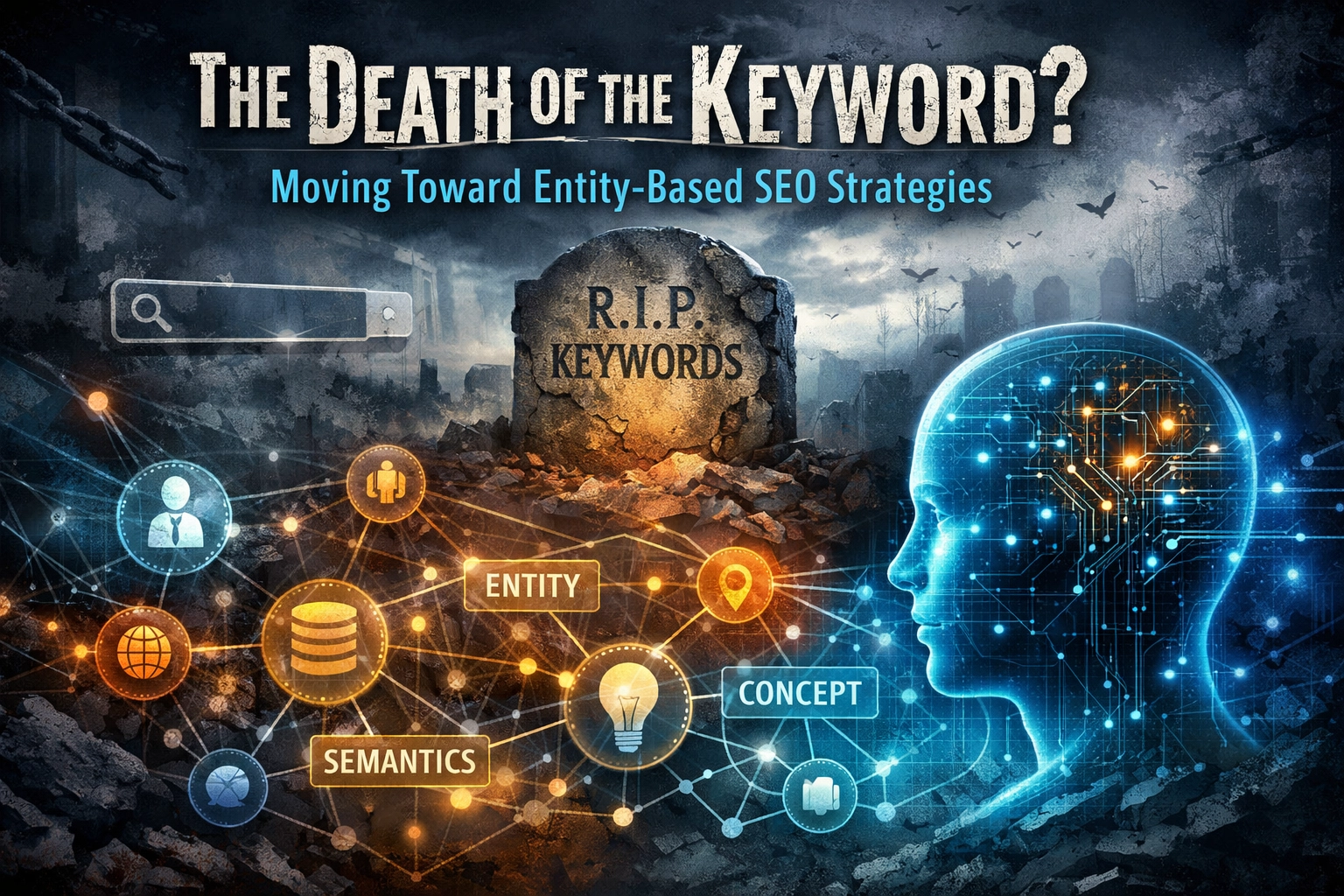
Search Engine Optimization has undergone a fundamental shift that many practitioners are still struggling to quantify. For decades, the "keyword" was the atom of SEO: the smallest indivisible unit of search. We tracked rankings for specific strings of characters, optimized headers for exact matches, and calculated keyword density with mathematical precision. However, as we navigate 2026, the industry has moved into a post-keyword era.
While keywords haven't vanished, they have been demoted. They are no longer the primary focus of Google’s ranking algorithms. Instead, the "Entity" has taken center stage. This shift from "strings to things" represents the most significant architectural change in search history, moving from a system that matches text to a system that understands the underlying reality of the world.
Understanding the Entity: The New Unit of Search
To understand why keywords are losing their dominance, we must define what an entity is in the context of a search engine. According to Google's own patents, an entity is a thing or concept that is "singular, unique, well-defined, and distinguishable."
An entity isn't just a word; it is a node in a massive network. For example, "Apple" is an entity. Depending on the context, Google identifies it as a fruit (entity), a multi-trillion dollar technology company (entity), or a record label (entity). Each of these entities has "attributes" (color, stock price, founders) and "relationships" (Steve Jobs was a founder of Apple Inc.).
When you optimize for entities, you aren't just trying to show up for a search query; you are trying to establish your brand as a recognized node within Google’s Knowledge Graph.

The Drivers of Change: Hummingbird, BERT, and MUM
The transition to entity-based SEO didn't happen overnight. It was driven by a series of algorithmic milestones:
- Hummingbird (2013): This was the first major step toward semantic search. It allowed Google to understand the intent behind a query rather than just the words used.
- RankBrain (2015): Google’s first machine learning component, which helped process ambiguous queries by connecting them to known concepts.
- BERT (2019): Bidirectional Encoder Representations from Transformers allowed Google to understand the context of words in relation to all other words in a sentence, rather than in a linear fashion.
- MUM (2021) and Agentic AI (2025/2026): These models can process information across different languages and formats (images, video, text) to understand complex entities and provide direct answers.
In 2026, with the rise of Generative AI Overviews (SGE) and Agentic search, Google is no longer just a "search" engine; it is an "answer" engine. It synthesizes information. If your content is built purely on keyword frequency, it lacks the relational data that AI needs to summarize your expertise.
Why Keywords Are No Longer Enough
In the old model, if you wanted to rank for "best cloud storage," you wrote a page where that phrase appeared in the H1, the first paragraph, and the alt text of three images.
In the entity model, Google looks for the presence of related entities that must exist for a page to be authoritative. If you are writing about "cloud storage" but fail to mention "end-to-end encryption," "latency," "data redundancy," or "SaaS architecture," Google’s NLP (Natural Language Processing) models conclude that your content is shallow.
The search engine is essentially checking your work against its internal Knowledge Graph. It expects to see a "cluster" of related concepts. If those concepts are missing, you lack "Topical Authority," regardless of how many times you repeat the primary keyword.
Strategic Implementation: How to Build Entity Authority
To succeed in this new landscape, SEO strategy must move away from spreadsheet-driven keyword lists and toward "Topic Maps."
1. Leverage Structured Data (Schema.org)
Structured data is the bridge between human-readable content and machine-readable data. By using JSON-LD schema, you are explicitly telling Google: "This entity (Organization) authored this entity (Article) which discusses these entities (Product, Person, Place)."
To maximize entity SEO, go beyond basic Article schema. Use:
sameAs: Link your entity to its corresponding entry on Wikipedia, LinkedIn, or official databases.aboutandmentions: Explicitly define the main entities discussed in your content using DBpedia or Wikidata URLs.AuthorandPerson: Establish the E-E-A-T (Experience, Expertise, Authoritativeness, Trustworthiness) of the individual writing the piece.
2. The Power of Content Clustering
Instead of creating isolated pages for every keyword variation, create "Pillar Pages" that act as the hub for a major entity. Surround that pillar with "Cluster Content" that addresses the attributes and related entities.

For instance, if your Pillar Entity is "Sustainable Investing," your cluster should include:
- Attributes: ESG Scores, Carbon Offsets, Green Bonds.
- Related Entities: SEC Regulations, Kyoto Protocol, Renewable Energy Stocks.
- Internal Linking: Use descriptive anchor text that reinforces these relationships. Don't use "click here." Use "Impact of ESG Scores on Portfolio Growth."
3. NLP Analysis and Gap Mapping
Before publishing, use NLP tools (like Google’s Natural Language API demo) to see how a machine "sees" your text. It will extract entities and assign them a "salience" score. Salience measures how central an entity is to the text. If your target topic has low salience in your own writing, the search engine will not rank you for it.
4. Establishing a "Brand Entity"
Google wants to know who you are. A website is an entity, and a brand is an entity. To build this:
- Maintain a consistent NAP (Name, Address, Phone) across the web.
- Secure mentions on high-authority, "seeded" sites (news outlets, industry journals).
- Foster a robust "About Us" page that clearly links the company to its leadership team and physical locations.
The Role of E-E-A-T in Entity SEO
Google’s Search Quality Rater Guidelines place heavy emphasis on E-E-A-T. From an entity perspective, E-E-A-T is the process of verifying the relationship between a "Source" and a "Topic."
If a medical doctor (Entity A) writes about heart health (Entity B), Google recognizes a strong, authoritative relationship. If a lifestyle blogger with no medical background writes about heart health, that relationship is weak. In 2026, Google uses "Author Entities" to rank content. This is why having a clear, verifiable author bio with links to professional credentials is no longer optional: it is a core ranking factor.
Case Study: The Shift in "Near Me" Searches
A practical example of entity-based SEO is the "near me" search. Previously, businesses would try to rank for "Plumber in Johannesburg" by stuffing the city name everywhere. Today, Google uses the "User" entity (location data) and the "Business" entity (Google Business Profile) to create a match based on proximity and reputation.
The keyword "near me" isn't even necessary anymore; Google assumes the local intent based on the entity's category. Success now comes from having high-quality reviews (sentiment entities), local citations, and proximity: not keyword density.

Technical SEO in the Entity Age
Technical SEO has evolved to support entity discovery. Search engines now use "Crawl Budgets" more efficiently by prioritizing pages that update the Knowledge Graph.
- URL Structure: Keep it logical and hierarchical to show how entities are nested.
- Internal Linking: Treat your internal links as a "Web of Data." Every link is a relationship statement.
- Breadcrumbs: These provide clear navigational paths that reinforce the hierarchy of topics.
Is the Keyword Really "Dead"?
To say the keyword is dead is a hyperbole, but to say it is "sufficient" is a lie. Keywords are still the "interface" between the user and the search engine. Users still type words into boxes or speak them to assistants.
However, the keyword is now merely a signal of intent. Once the search engine understands that intent, it translates the keyword into an entity query. If your SEO strategy only covers the "signal" and ignores the "entity," you are optimizing for a version of the web that no longer exists.
Conclusion: Preparing for the Semantic Future
The move toward entity-based SEO is a move toward quality. It rewards deep research, topical expertise, and clear communication. It punishes "content farms" that produce thousands of words of fluff designed to hit keyword metrics without providing actual substance.
To stay ahead in 2026:
- Audit your content for entity gaps.
- Double down on Schema to make your data machine-readable.
- Focus on Topical Authority rather than individual keyword rankings.
- Build a verifiable Brand and Author presence to satisfy E-E-A-T requirements.
The search engine is finally learning to read like a human, but it processes data like a supercomputer. Your job is to provide the data it needs to understand exactly who you are and what you know.
About the Author: Malibongwe Gcwabaza
Malibongwe Gcwabaza is the CEO of blog and youtube, a premier digital strategy firm specializing in the intersection of content creation and algorithmic evolution. With over a decade of experience in the tech and media landscape, Malibongwe has led digital transformations for brands looking to dominate search results through technical precision and simple, effective communication. Under his leadership, blog and youtube has become a thought leader in the shift toward AI-driven search and semantic SEO. When he isn't dissecting Google’s latest core updates, he is focused on empowering creators to build sustainable, data-backed digital legacies.
About the Author


