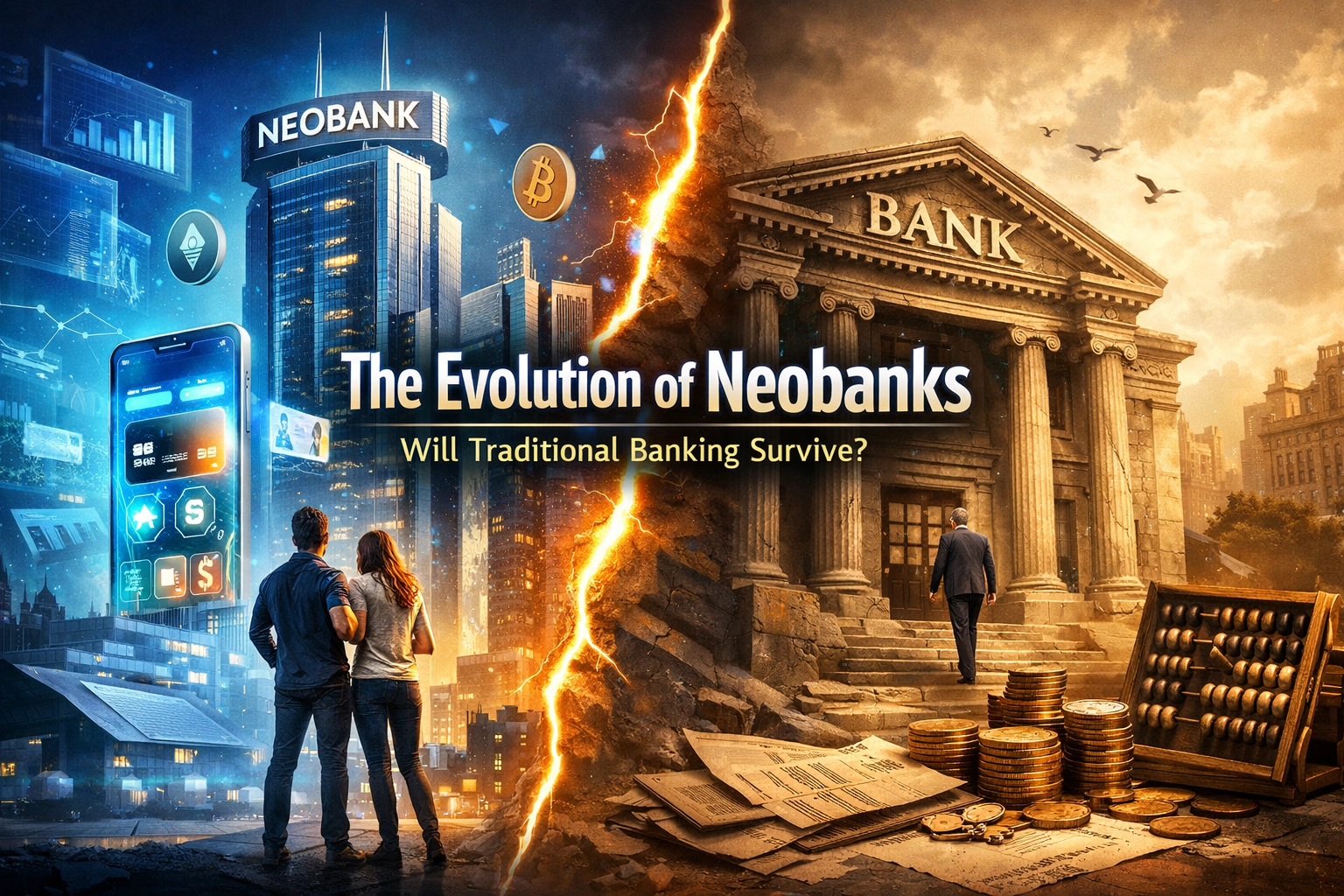
By March 2026, the term "challenger bank" has started to feel like a relic of the past. We aren’t just "challenging" anymore; we’re witnessing a total structural realignment of the global financial system. When neobanks first hit the scene a decade ago, they were essentially pretty user interfaces sitting on top of old-school banking rails. They were the "travel cards" you used to avoid foreign exchange fees.
Today, that narrative has flipped. Neobanks are securing full banking charters, launching IPOs with multi-billion dollar valuations, and building "super-apps" that handle everything from your mortgage to your mobile data. But as the lines between "fintech" and "bank" continue to blur, a massive question remains: Does the traditional high-street bank have a future, or are we watching a slow-motion extinction?
From "Skinny" Apps to Full-Scale Institutions
The early days of neobanking were defined by limited features and heavy reliance on Banking-as-a-Service (BaaS) partnerships. Companies like Chime and early-stage Revolut didn't actually hold your money; a partner bank (like Bancorp or Stride) did the heavy lifting behind the scenes.
However, 2025 and early 2026 marked a pivotal shift toward regulatory maturity. Neobanks realized that to win the long game, they needed to own the stack.
- Direct Charters: Nubank’s 2026 conditional approval for a US banking license is a massive signal. By obtaining a charter, a neobank moves from being a middleman to a primary institution. This allows them to lend out their own deposits, significantly improving their net interest margins (NIM).
- The IPO Wave: Chime’s June 2025 IPO, which raised $864 million, and PicPay’s Nasdaq listing in early 2026, have provided the war chests needed to compete with the likes of JPMorgan Chase and HSBC.
- The Valuation Gap: In late 2025, Revolut was valued at a staggering $75 billion. For context, that puts it in the same league as some of the world's most established legacy banks, despite having a fraction of the physical infrastructure.

The Technical Moat: Cloud-Native vs. Legacy Spaghetti Code
The real reason traditional banks are sweating isn't just because neobanks have "cool apps." It’s because of the underlying architecture.
Most traditional banks are running on "legacy spaghetti code", COBOL-based systems that are decades old. When a traditional bank wants to launch a new feature, like a real-time spending insight tool or a crypto-integrated sub-account, it often takes months of middleware integration and patch-testing.
Neobanks are cloud-native. They utilize microservices architecture, which means they can deploy updates hundreds of times a day without taking the system offline. This agility allows for:
- Near-Zero Marginal Costs: Once the platform is built, adding the millionth customer costs almost nothing.
- Instant KYC/AML: Using AI-driven identity verification, neobanks can onboard a customer in three minutes, whereas a traditional bank might still require a physical branch visit or a 3-5 day manual review.
- Hyper-Personalization: Neobanks use data-driven insights to offer you a loan exactly when your balance is low or suggest an investment product based on your spending patterns.
The Super-App Strategy: Beyond the Ledger
We’re seeing a massive diversification in what a "bank" actually does. N26 and Revolut are no longer just places to store money; they are becoming lifestyle ecosystems.
As of 2026, the "Super-App" model has become the standard. These platforms now offer:
- Integrated Trading: Buying fractional stocks, ETFs, and crypto directly within the banking app.
- Automated Savings (Robo-advisors): Using "round-up" features and AI to invest spare change into diversified portfolios.
- Non-Financial Services: Revolut’s launch of global eSIMs and travel booking services proves that neobanks want to capture the "intent" of the user before they even spend the money.
By integrating these services, neobanks increase customer stickiness. If your bank is also your stockbroker, your travel agent, and your mobile provider, the friction of switching to a traditional bank becomes incredibly high.

The Reality Check: The 5% Revenue Problem
Despite the hype, we need to look at the data. Traditional banks still control approximately 95% of total banking revenues worldwide.
While neobanks are winning the "war for attention" among Gen Z and Millennials, the "war for deposits" is much harder. High-net-worth individuals and large corporations still largely rely on traditional institutions for complex needs like institutional lending, wealth management, and M&A advisory.
Traditional banks have also proven to be surprisingly resilient. Instead of rolling over, they are adopting a "if you can't beat 'em, join 'em" strategy:
- Digital Spin-offs: Banks like Marcus by Goldman Sachs or Finn by JPMorgan (though some have seen mixed success) represent attempts to build "neobanks" within the safety of a legacy balance sheet.
- Embedded Finance: Legacy banks are now offering their own APIs, allowing other companies to "embed" banking services into their products. This turns the legacy bank into a utility provider for the very fintechs that are trying to disrupt them.
Unit Economics: The Shift to Profitability
For years, the criticism against neobanks was that they were "burning VC cash to buy customers." They offered free accounts, free cards, and high-interest rates, all while losing money on every user.
That era ended in 2024. The focus has shifted to sustainable unit economics.
- Subscription Models: Many neobanks now offer "Metal" or "Ultra" tiers, charging $10-$60 a month for premium features. This provides a steady stream of recurring revenue that isn't dependent on interest rates.
- Interchange Fees: While still a major revenue driver, neobanks have diversified so they aren't solely reliant on the small percentage they get every time you swipe your card.
- Lending: This is the "Holy Grail." By securing banking charters, neobanks can now offer credit cards, personal loans, and mortgages. Lending is where the real profit in banking lies, and neobanks are finally getting a seat at the table.

User Experience (UX) as a Competitive Moat
In a world where interest rates are relatively similar across the board, UX becomes the primary differentiator. Traditional banks often view "digital" as a channel, a way to access the bank. Neobanks view "digital" as the product itself.
This manifests in small but significant ways:
- Transparency: No hidden "maintenance fees" or "out-of-network ATM fees" buried in a 40-page PDF.
- Control: The ability to freeze your card, change your PIN, or set spending limits instantly from your phone without calling a help desk.
- Speed: Getting your paycheck two days early (a feature pioneered by Chime) is a massive technical and UX win that legacy banks struggled to replicate for years.
Conclusion: Convergence, Not Displacement
So, will traditional banking survive? The answer is yes, but it won't look like it did in 2010.
We are moving toward a convergence. Neobanks are becoming more like traditional banks: seeking charters, focusing on profitability, and expanding into lending. Meanwhile, traditional banks are becoming more like neobanks: shutting down physical branches, overhauling their mobile apps, and moving their core systems to the cloud.
The winner in this evolution isn't necessarily one type of institution over the other; it’s the consumer. We now have access to lower fees, better technology, and more financial control than ever before. Whether your money sits in a 150-year-old vault or on a server in Northern Virginia, the "future of banking" is already in your pocket.

About the Author: Malibongwe Gcwabaza
Malibongwe Gcwabaza is the CEO of blog and youtube, a leading digital media firm dedicated to demystifying the intersection of finance and technology. With over a decade of experience in the fintech sector, Malibongwe has consulted for both legacy financial institutions and burgeoning neobanks, helping them navigate the complex regulatory and technical landscapes of the 21st century. He is a frequent speaker at global tech conferences and a passionate advocate for financial inclusion through digital innovation. When he isn't analyzing market trends, he’s likely exploring the latest in decentralized finance or mentoring the next generation of African tech entrepreneurs.
About the Author


