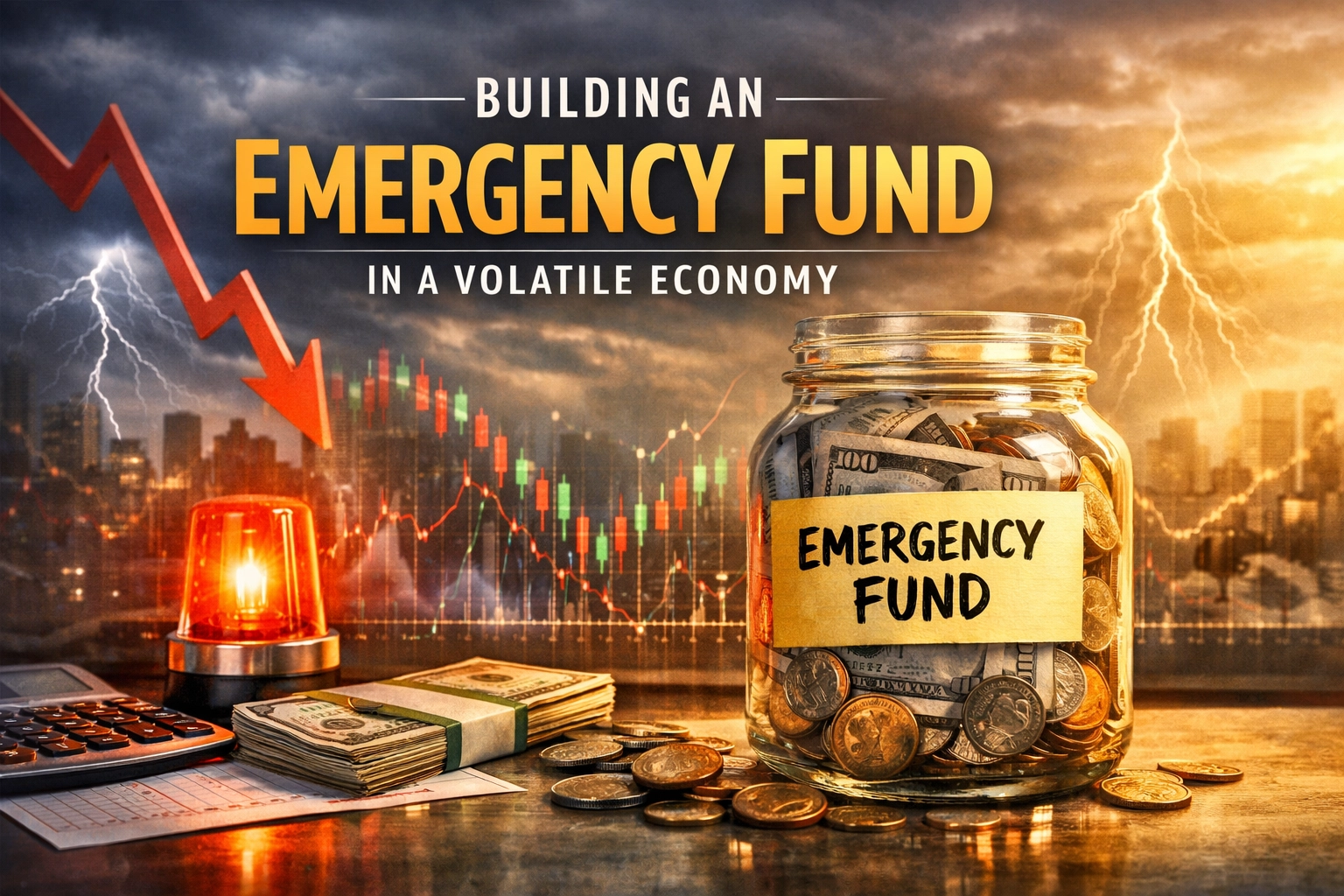
Economic stability used to feel like a marathon, steady, predictable, and mostly a matter of endurance. Today, it feels more like a game of dodgeball played on a trampoline. Between fluctuating inflation rates, sudden shifts in the labor market due to AI integration, and global supply chain hiccups, the traditional advice of "save a little every month" feels a bit like bringing a pocketknife to a tank fight.
If you’re looking at your bank account and wondering how much is actually enough to survive a layoff or a medical crisis in 2026, you aren’t alone. The math has changed. We are no longer just fighting against unexpected expenses; we are fighting against the erosion of purchasing power. An emergency fund that sits in a zero-interest checking account is technically losing value every single day.
To build a resilient safety net, we need to move beyond basic saving and start thinking about strategic liquidity management.
The New Math: Determining Your Personal Volatility Score
The old rule of thumb, three to six months of expenses, is a decent starting point, but it’s too generic for a volatile economy. Instead of a flat number, you need to calculate your Personal Volatility Score (PVS). This is a technical assessment of how likely you are to need your funds and how hard it would be to replace your income.
Consider these variables:
- Income Correlativity: If you work in a sector highly sensitive to interest rates (like real estate or tech startups), your risk is higher.
- Skill Fungibility: How long would it take you to find an equivalent salary if you were let go tomorrow? In a niche market, you might need a 12-month cushion.
- Fixed vs. Variable Costs: If 80% of your income goes to non-negotiable bills (mortgage, debt, insurance), you have very little "flex" in a crisis.
For someone in a stable government job with low overhead, 3 months is plenty. For a freelance developer or a CEO in a scaling startup, 9 to 12 months is the new "safe" zone.

The Inflation Trap: Why "Cash is King" is a Half-Truth
In a low-inflation environment, holding cash is fine. In a volatile economy where inflation might fluctuate between 3% and 7%, cash is a melting ice cube. If you have $50,000 sitting in a standard savings account earning 0.05% interest while inflation is at 5%, you are effectively paying $2,475 a year just for the "privilege" of having that money accessible.
To combat this, your emergency fund building strategy must focus on inflation-hedged liquidity. You want the money to be there when the car breaks down, but you also want it to keep its "buying power."
High-Yield Savings Accounts (HYSA)
This is your first line of defense. HYSAs are currently offering yields that actually compete with inflation, often ranging from 4% to 5.5% depending on the Federal Reserve's stance. The key here is FDIC insurance. In a volatile economy, the "safety" part of the safety net is non-negotiable.
Money Market Funds (MMFs)
Not to be confused with Money Market Accounts, MMFs are mutual funds that invest in short-term debt securities (like Treasury bills). They often provide slightly higher yields than HYSAs. While they aren't FDIC insured, they are managed to maintain a $1.00 net asset value, making them extremely stable.
The Tiered Emergency Fund Strategy
The biggest mistake people make is keeping their entire emergency fund in one bucket. This creates a "liquidity drag" where you have too much money doing nothing. Instead, use a Tiered Architecture.
Tier 1: The "Immediate" Bucket (1 Month of Expenses)
- Location: High-Yield Savings Account.
- Accessibility: Instant (transferable within 24 hours).
- Purpose: The "Oh no, the water heater exploded" moments. This is your psychological buffer.
Tier 2: The "Short-Term" Bucket (2–4 Months of Expenses)
- Location: T-Bill Ladders or Money Market Funds.
- Technical Detail: Treasury Bills (T-Bills) are backed by the U.S. government and are exempt from state and local taxes. By "laddering" them (e.g., buying 4-week, 8-week, and 13-week bills), you ensure that a portion of your cash becomes liquid every few weeks, while the rest earns a higher rate than a standard bank account.
- Hedge: This protects against state taxes and provides a slightly higher yield than Tier 1.
Tier 3: The "Deep Crisis" Bucket (6+ Months of Expenses)
- Location: Series I Savings Bonds or a conservative Brokerage Buffer.
- The I-Bond Advantage: I-Bonds are specifically designed to protect your purchasing power. They have a composite rate made of a fixed rate plus a variable inflation rate. During periods of high volatility, these are the ultimate "set it and forget it" hedge.
- The Catch: You cannot touch them for the first 12 months, and there’s a penalty if you withdraw before 5 years. This is why they belong in Tier 3, for the long-term "I lost my job for 6 months" scenario.

Counter-Intuitive Strategy: The Equity Buffer
Recent financial research has challenged the "all cash" dogma of emergency funds. While putting your rent money in the stock market is a recipe for disaster, there is a technical argument for a "Brokerage Buffer" once your Tier 1 and Tier 2 are fully funded.
A study by various financial analysts suggests that maintaining an all-cash fund over a 10-year period results in a massive "cash drag" (lost opportunity cost). If you have a particularly large safety net (say, 12 months), keeping the last 3 months in a broad-market index fund (like the S&P 500) might actually be safer in the long run.
The Math: Even if the market drops 30% right when you need the money, if that money has been growing at 10% for five years, you still have more than you started with. This is high-level risk management and should only be attempted once your immediate liquidity (Tiers 1 and 2) is rock solid.
Technical Execution: Automating the Hedge
You cannot rely on willpower in a volatile economy. You need a system that treats your emergency fund like a mandatory bill.
- Direct Deposit Split: Don't send your whole paycheck to your checking account. Set up your payroll to send 10-15% directly into your HYSA or a brokerage account. If you don't see it, you don't spend it.
- Sweeper Scripts: Many modern fintech apps allow you to set "sweepers." If your checking account balance goes above a certain threshold (e.g., $5,000), the excess is automatically moved into a higher-yielding asset like a Money Market Fund.
- Rebalancing: Every six months, look at your total expenses. If inflation has pushed your grocery bill up by 10%, your emergency fund needs to grow by 10% to maintain the same level of protection.
Data-Driven Decision Making: When to Use the Fund
One of the hardest parts of managing an emergency fund in a volatile economy is knowing when to pull the trigger. We often see people "hoarding" cash even during a crisis because they fear things will get worse.
Define an "Emergency" using a technical checklist:
- Is it Urgent? (Needs to be solved in <48 hours)
- Is it Necessary? (Health, housing, transportation, or ability to work)
- Is it Unexpected? (A yearly insurance premium is a budgeting issue, not an emergency).
If an expense doesn't hit all three, try to cash-flow it from your monthly budget first. Preserving your Tiered Fund is vital when the macro-economy is shifting.
The Psychology of the Safety Net
We often focus on the numbers, but the real value of an emergency fund in a volatile economy is the "Sleep Well at Night" (SWAN) factor. Financial stress is one of the leading causes of poor decision-making. When you are worried about making rent, you are more likely to accept a sub-optimal job offer, sell your investments at the bottom of a market cycle, or take on high-interest debt.
An emergency fund gives you the "power of no." It allows you to wait for the right opportunity rather than the first opportunity. In a volatile world, that patience is your greatest competitive advantage.
Summary of the Inflation-Hedged Emergency Plan
| Tier | Asset Type | Purpose | Liquidity |
|---|---|---|---|
| Tier 1 | HYSA | Immediate Crisis | 24 Hours |
| Tier 2 | T-Bill Ladder / MMF | Mid-Term Buffer | 1 – 4 Weeks |
| Tier 3 | I-Bonds | Inflation Protection | 1 Year+ |
| Buffer | Low-Cost Index Funds | Long-term Growth | 3-5 Days |
Building this isn't an overnight task. It starts with the first $1,000 and the first automated transfer. But once you move away from a static savings model to a tiered, inflation-hedged strategy, you stop being a victim of economic volatility and start being a manager of it.
About the Author: Malibongwe Gcwabaza
Malibongwe Gcwabaza is the CEO of blog and youtube, a digital media powerhouse dedicated to simplifying complex financial and technological concepts for the modern professional. With a background in strategic leadership and a passion for data-driven wealth management, Malibongwe focuses on helping individuals build resilient financial systems in an increasingly unpredictable global market. When he isn't dissecting economic trends, he's exploring the intersection of AI and content creation.
About the Author


