![[HERO] The Death of Keyword Density: Semantic Search in 2026](https://cdn.mar4lism.com/UbCUVc7LwSE.webp)
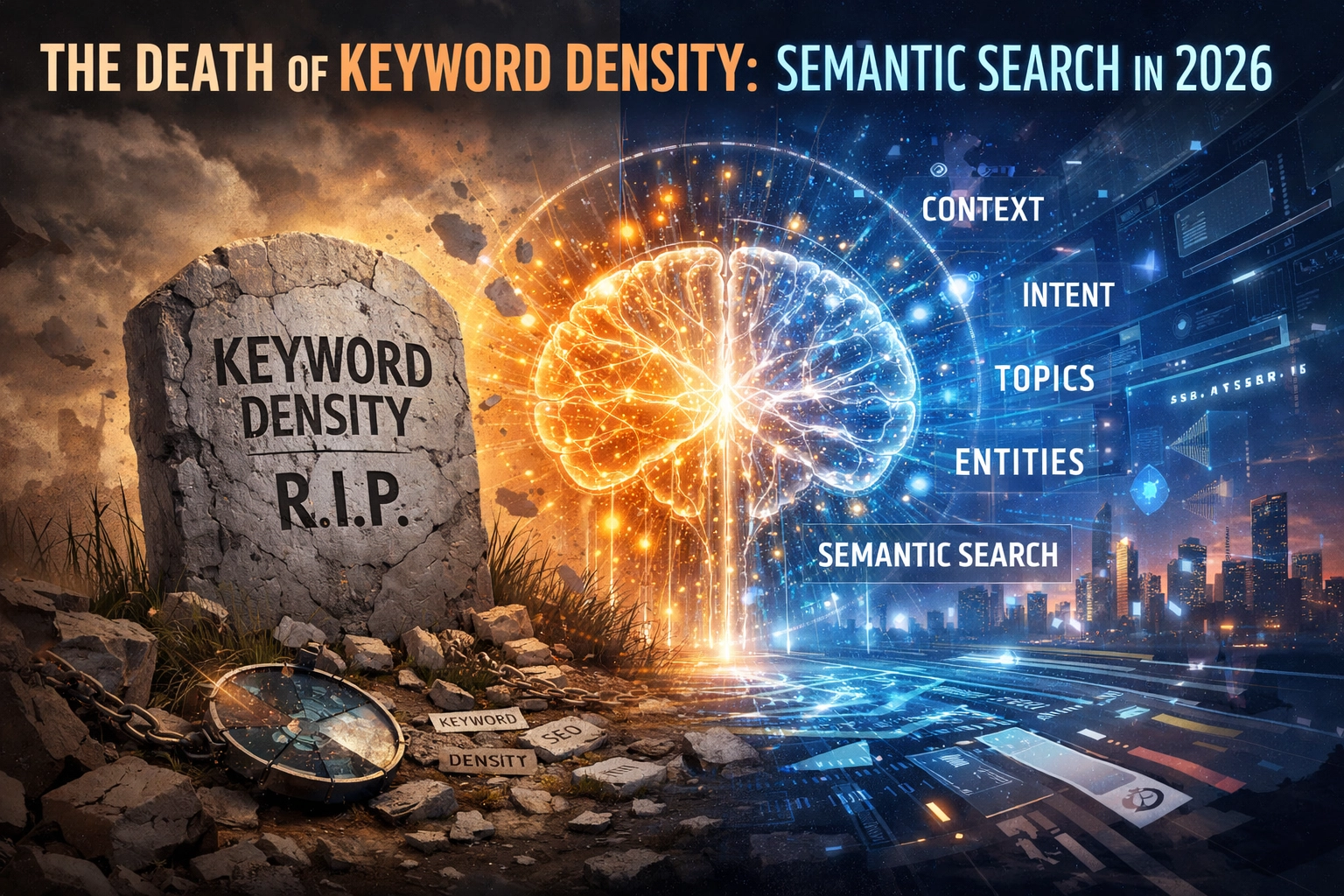
If you are still counting how many times your primary keyword appears in a 1,000-word article, you aren't just behind the times: you’re actively sabotaging your visibility. In March 2026, the concept of "keyword density" has officially moved from the SEO handbook to the digital museum of obsolete tactics, right next to meta-keywords and link farms.
The search landscape has undergone a seismic shift. We have moved from a "strings-based" search world to a "things-based" semantic ecosystem. Search engines: or more accurately, the AI agents that now mediate our relationship with the web: don’t look for matches; they look for meaning. If your content strategy is built on hitting a 2% density threshold, you are optimizing for a version of Google that hasn't existed in years.
The Post-Keyword Era: What Happened?
The transition didn't happen overnight, but the acceleration we’ve seen in the last 24 months has been staggering. The death of keyword density is the result of three converging forces: the maturation of Large Language Models (LLMs) in search indexing, the rise of AI Overviews (formerly SGE), and the 2024 Google API leaks which confirmed what many of us suspected: Google cares about "entities," not just phrases.
In 2026, search engines use vector embeddings to understand the "semantic distance" between concepts. When a user searches for "best way to secure a home network," the algorithm isn't looking for those exact seven words. It’s looking for a content cluster that addresses router firmware, WPA3 encryption, VLAN segmentation, and IoT isolation. If you mention "security" fifty times but fail to touch on the related technical entities, you won’t rank. The machine knows you’re blowing smoke.

Understanding Semantic Search and Entity-Based SEO
To survive in 2026, you have to stop thinking about words and start thinking about Entities. An entity is a well-defined object or concept: a person, place, item, or idea. Semantic search is the process of search engines understanding the relationship between these entities.
The Knowledge Graph vs. The Index
In the old days, Google had an "Index": a massive library of words. Today, they rely primarily on the Knowledge Graph. When you write about "Remote Work," the AI understands that this entity is connected to "Asynchronous Communication," "Zoom fatigue," "VPNs," and "Digital Nomad Visas."
If your content lacks these interconnected nodes, the search engine perceives the content as "thin" or "low-value," regardless of how long it is or how many keywords you crammed in. This is why we see high-density pages plummeting in rankings while comprehensive, technically rich guides that barely mention the "target keyword" are being used as the primary citations for AI Overviews.
The Rise of the "Citation Engine"
We no longer live in a world where the goal is simply to be "Result #1." In 2026, the goal is to be the Trusted Citation. With the majority of informational queries now answered directly by AI agents at the top of the SERP (Search Engine Results Page), "clicks" have been replaced by "mentions."
When an AI agent synthesizes an answer, it pulls from sources it deems authoritative. These sources aren't chosen based on keyword frequency. They are chosen based on:
- Semantic Completeness: Does this page cover the sub-topics a human would expect?
- Factual Accuracy: Does the data on this page align with the broader consensus of the Knowledge Graph?
- Information Gain: Does this page provide new or unique information that isn't just a rewrite of existing top results?
If your content is a generic rewrite of the top 5 results, you have zero "Information Gain." In the eyes of a 2026 search algorithm, you are redundant.

How to Optimize for Meaning (Not Math)
Since keyword density is dead, what do we actually do? The process for creating high-ranking content in 2026 is more like technical mapping than traditional copywriting.
1. Intent Mapping over Keyword Research
Traditional keyword research tools are still useful for finding "seeds," but they don't tell the whole story. You need to map the User Intent Journey. If someone searches for "Bitcoin Halving," are they looking for a definition, a live countdown, or an analysis of historical price impacts?
In 2026, Google’s "Navboost" (and its evolved iterations) tracks how users interact with different types of content for specific queries. If users consistently bounce from "Definition" pages to find "Price Charts," the algorithm will stop ranking definitions for that query. You must provide the exact utility the user is seeking, not just the words they typed.
2. Building Topic Clusters and Silos
You can't rank a single page for a competitive topic anymore. You need a "Domain Authority" that is built semantically. This means creating a pillar page and surrounding it with 10–15 supporting articles that cover every possible entity related to that topic.
For example, if you want to rank for "Sustainable Gardening," your cluster must include:
- Soil microbiology (The "Technical" entity)
- Native plant species (The "Geographic" entity)
- Composting chemistry (The "Process" entity)
- Water conservation tech (The "Tool" entity)
Linking these together with descriptive anchor text tells the search engine: "This site is a topical authority."
3. Implementing Advanced Schema Markup
If you aren't using Schema.org markup in 2026, you are essentially speaking a language the AI has to struggle to translate. By using JSON-LD to explicitly define your entities, you make it easy for the AI to "ingest" your data.
Tell the search engine exactly who the author is, what the main entities are, and what specific questions you are answering. This "machine-readable" layer is often what separates a page that gets a click from a page that gets cited in a voice search or an AI summary.

The "Hidden Gem" Factor: Why Expertise Wins
One of the biggest shifts we've seen since late 2024 is the "Hidden Gems" update. Google started prioritizing "first-person experience": the 'E' in E-E-A-T (Experience, Expertise, Authoritativeness, and Trustworthiness).
In 2026, AI can generate perfect, grammatically correct text about any topic. Because of this, the "commodity" of information has been devalued. What has increased in value is Primary Evidence.
- Did you actually test the software?
- Do you have original photos or data?
- Do you have a unique perspective that contradicts the generic consensus?
Keywords don't matter here. What matters is the "signal of humanity." Search engines are now specifically tuned to look for markers of real-world experience. If your blog post reads like a ChatGPT output from 2023, it will be buried.
Data-Driven Insights: What the 2026 Numbers Say
Recent industry analysis of over 500,000 queries in Q1 2026 shows a clear trend:
- Correlation between Keyword Density and Ranking: +0.04 (Virtually zero).
- Correlation between Entity Breadth and Ranking: +0.68 (Very strong).
- AI Overview Inclusion: 82% of cited sources used structured data (Schema) and had an "Expert" author profile.
- Bounce Rate Impact: Sites with high keyword density but low "Information Gain" saw a 40% increase in bounce rates compared to 2024, leading to a rapid loss in rankings.
The data is clear: the algorithm is rewarding depth, utility, and authority. It is punishing "optimization" in the traditional sense.

Technical Checklist for 2026 SEO
To transition away from keyword-centric thinking, follow this technical checklist for every piece of content you produce:
- Identify Primary Entities: Use tools like Google’s Natural Language API to see what entities the AI recognizes in your draft.
- Check for Semantic Gaps: Look at the "People Also Ask" sections and AI Overviews. Are you missing a sub-topic that the AI deems essential?
- Optimize for Natural Language Processing (NLP): Use clear, declarative sentences. Avoid flowery "filler" text that adds no semantic value.
- Author Verification: Ensure your author bio is linked to a verifiable social profile or an "About Us" page that proves expertise.
- Unique Data: Include at least one original chart, table, or piece of primary research.
The Future is Narrative, Not Numeric
We are moving into an era where "Search Engine Optimization" is becoming "AI Optimization." The machines are getting smarter, which actually makes our jobs simpler in one specific way: we can finally write for humans again.
When you stop obsessing over whether you’ve used the word "Digital Marketing" 14 or 15 times, you free up mental bandwidth to provide real value. You can focus on the nuances, the technical details, and the storytelling that actually converts a reader into a customer.
Keyword density was a crutch for an era when search engines were "dumb." In 2026, the crutch is gone. You either walk with authority, or you don't move at all.
About the Author: Malibongwe Gcwabaza
CEO of blog and youtube
Malibongwe Gcwabaza is a seasoned strategist in the digital content space, specializing in the intersection of AI and search technology. As the CEO of blog and youtube, he has led the company through the volatile transitions of the generative AI era, helping brands move from traditional SEO to entity-based authority. With a background in technical analysis and a passion for simple, effective communication, Malibongwe focuses on future-proofing content strategies in an ever-evolving digital landscape. When he isn't dissecting search algorithms, he’s exploring the latest in tech-driven lifestyle optimization.
About the Author


