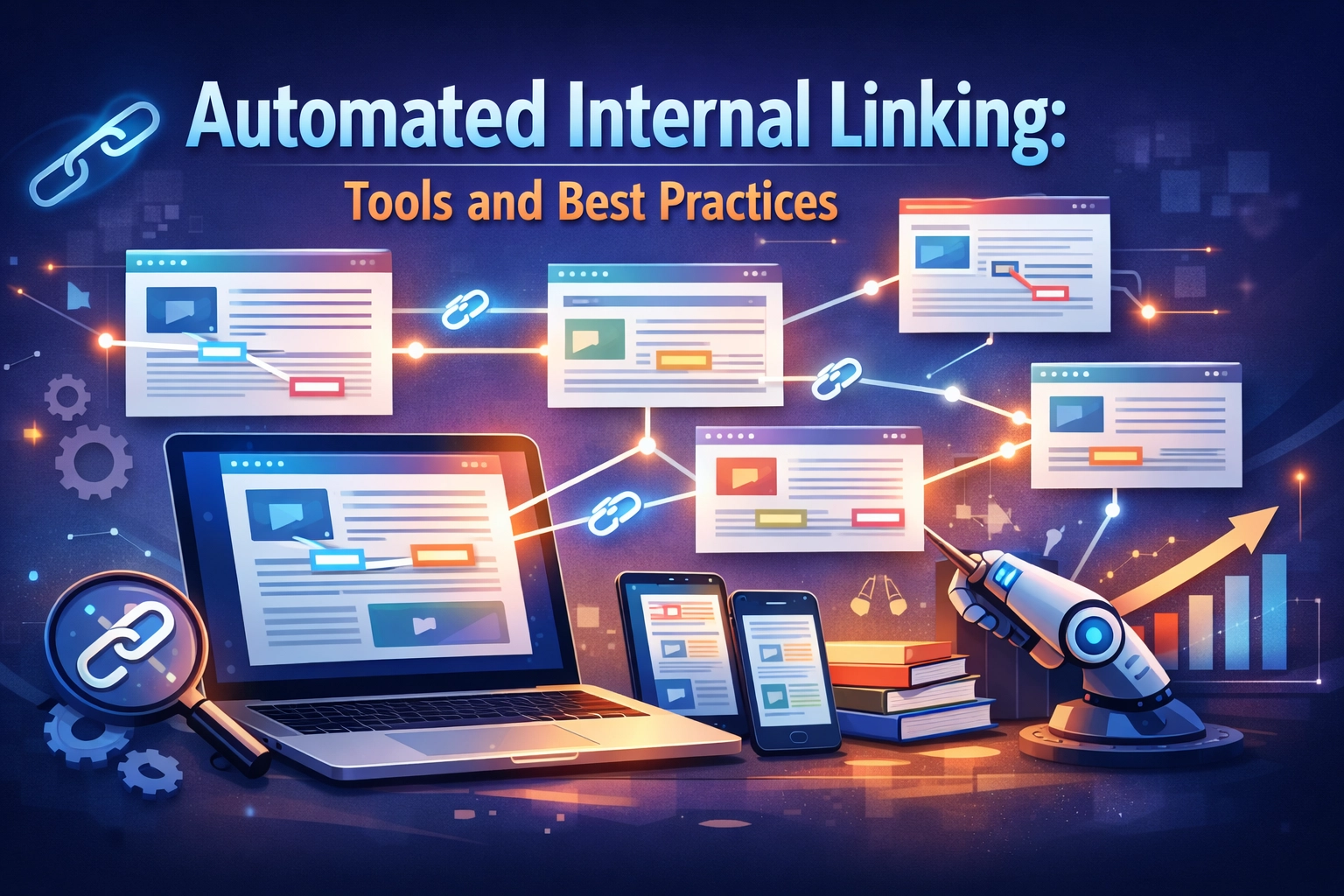
If you’ve been in the SEO game for more than a minute, you know the drill. You spend six hours crafting a masterpiece of a blog post, hit publish, and then, ugh: you realize you have to go back through 200 old articles to find spots to link to the new one. Or worse, you forget entirely, and your new content sits in an "orphaned" corner of your site, invisible to Google’s crawlers and your readers alike.
In 2026, manual internal linking isn't just a chore; it’s a massive bottleneck. With the explosion of AI-generated content, sites are growing faster than ever. If you’re still clicking through WordPress pages one by one to add hyperlinks, you’re losing the race. Automated internal linking tools have evolved from simple keyword-matchers into sophisticated, LLM-powered engines that understand context, user intent, and link equity flow.
Let’s break down the state of automated internal linking today, the tools that are actually worth your budget, and the best practices to ensure you don’t accidentally tank your SEO with "over-optimization."
Why Internal Linking is Different in 2026
Back in the day, we linked to help Google find pages. Today, Google finds pages just fine. The game now is Topical Authority and Information Gain.
With the Google Search updates of late 2024 and 2025, the algorithm has become incredibly sensitive to "content clusters." It doesn't just want to see that you have a page about "Bitcoin"; it wants to see a logical, semantic web that proves you understand the entire ecosystem. Internal links are the threads that sew that web together.
Automation isn't just about speed; it's about precision. An AI can scan 5,000 pages in seconds to find the exact paragraph where a link to your new guide on "Ethereum Layer 2 Scaling" would provide the most value to a reader. Humans simply can't compete with that level of data-driven mapping.

The Heavy Hitters: Best Automated Tools for 2026
The market has shifted. We've moved away from "Exact Match" plugins and toward tools that use vector embeddings to understand if two pieces of content are truly related.
1. Link Whisper (The 2025/2026 LLM Update)
Link Whisper remains the gold standard for WordPress users, but it’s a different beast than it was three years ago. Following its massive update in August 2025, it now integrates native LLM technology.
Instead of just looking for the keyword "digital marketing," it understands that a sentence about "growing your online presence" is a prime candidate for a link.
- The Pro: Its "Auto-Linking" feature allows you to set rules (e.g., "Every time I mention 'SEO Audit,' link to /services/seo-audit/"), but with modern guardrails to prevent it from looking spammy.
- The Con: It can still be a bit resource-heavy on smaller shared hosting environments.
2. LinkBoss: Semantic Mastery
If Link Whisper is the versatile all-rounder, LinkBoss is the surgical specialist. Our internal tests show that LinkBoss suggests links that are significantly more relevant (around 53% more relevant by semantic score) than traditional plugins.
- Unique Feature: The "Smart Internal Link Generator." If you have two pages that should be linked but don't have a natural transition, LinkBoss can actually use AI to write a new, contextually relevant paragraph for you that bridges the two topics.
3. Quattr: Enterprise-Grade Logic
For those managing massive publishing sites or e-commerce stores with 10,000+ URLs, Quattr is the play. It doesn't just look at the text; it looks at Google Search Console (GSC) data.
- Data-Driven: Quattr analyzes which pages have the highest impressions but low click-through rates and suggests internal links from your "powerhouse" pages to give those struggling URLs a boost in authority (and rankings).
4. InLinks: The Knowledge Graph Approach
InLinks takes a "top-down" approach. It builds a literal knowledge graph of your site. It identifies "entities" (topics) rather than just keywords. If you’re trying to build deep topical authority, InLinks is arguably the most sophisticated tool for mapping out silos.

The Technical "Why": Link Equity and Crawl Budget
To understand why you should automate, you have to understand the math behind it. Every page on your site has a certain amount of "Link Equity" (often called PageRank, though the modern version is far more complex).
When you have "orphan pages": pages with zero internal links pointing to them: that equity stops dead. Similarly, if your homepage links to 500 different pages, the "juice" passed to each page is diluted to almost nothing.
Strategic Automation helps you:
- Distribute Equity: Move authority from your high-traffic "Viral" posts to your high-conversion "Money" pages.
- Optimize Crawl Budget: Help Googlebot find your most important content faster by reducing the "click depth" (the number of clicks it takes to get from the homepage to a specific sub-page).
- Improve Dwell Time: By providing relevant "Next Steps" for the reader, you keep them on-site longer, which is a massive secondary ranking signal.
Best Practices for 2026: Don't Let the Robots Run Wild
Automation is a power tool. If you use it wrong, you’ll cut your fingers off. Here are the non-negotiable rules for using automated linking in 2026.
1. Prioritize User Behavior Over "SEO Score"
Don't link just to link. Use your automation tools to prioritize links based on where users actually click. If GSC shows that people searching for "How to start a blog" often click through to "How to pick a domain," your internal links should reflect that journey.
2. The "Niche Down" Silo Strategy
Avoid "cross-pollination" that doesn't make sense. If you have a site that covers both "Gardening" and "Crypto," your automated tool should be configured to keep those links separate. A link from a Bitcoin article to a tomato growing guide confuses both the user and Google’s entity recognition.
3. Anchor Text Diversity is Mandatory
In the early days of SEO, people used the same anchor text for every link (e.g., 500 links all saying "Best CRM"). In 2026, that is a fast track to a manual penalty.
- The Fix: Configure your tools to use a mix of:
- Exact Match: "Best CRM for small business"
- Partial Match: "Top-rated CRM software"
- Phrase Match: "When looking for the right CRM…"
- Generic/Branded: "Check out our guide here" or "The Blog and Youtube CRM list."

4. Monitor the "Link Health"
Automation can break. Sometimes a tool will create a "link loop" (Page A links to Page B, which links back to Page A), or it might link to a 404 page if a URL changes. Use an audit tool like Ahrefs or Screaming Frog once a month to ensure your automated links aren't creating a technical mess.
How to Set Up an Automated Workflow (The 2026 Blueprint)
If I were starting a new site today, here is the exact stack and workflow I would use:
- Initial Audit: Run Twylu or Quattr to see where the current gaps are. Identify your top 10% of pages that hold the most authority.
- Silo Mapping: Use InLinks to define your "Pillar" pages. Tell the tool: "These are my 5 most important pages. Everything else should eventually point back to these."
- The "Slow Roll" Deployment: Don't hit "Apply All" on 1,000 links at once. Start with one category. Let Google crawl it. Watch the rankings. If the trend is positive, expand.
- Semantic Bridging: For your most important "Money" pages, use LinkBoss to generate those AI-written paragraphs. This ensures the link isn't just a random blue word in a sentence, but a helpful recommendation.

The "Human in the Loop" Factor
Despite how good these tools are, they aren't perfect. The most successful SEOs in 2026 use a "Human in the Loop" model. This means you let the AI do 90% of the work: finding the opportunities, suggesting the anchor text, and identifying the destination: but a human (you or an editor) does a final "sanity check."
Does the link feel forced? Is it interrupting a critical sales pitch? Is the anchor text grammatically correct? A quick 10-second review per link can be the difference between a high-authority site and a site that looks like it was built by a bot.
Final Thoughts: The Competitive Edge
Internal linking is one of the few SEO levers you have 100% control over. You can't control who links to you (backlinks), and you can't always control how Google interprets your content. But you can control exactly how your site is structured.
By automating this process, you’re turning a tedious administrative task into a scalable competitive advantage. In a world where everyone is publishing content, the winner is the one who can organize that content most effectively for both humans and machines.
About the Author: Malibongwe Gcwabaza
Malibongwe Gcwabaza is the CEO of blog and youtube, a digital media powerhouse focused on scaling content ecosystems through the intersection of AI and traditional SEO. With over a decade of experience in the digital marketing space, Malibongwe has transitioned from manual site builds to overseeing complex, automated content engines that generate millions of monthly impressions. He is a firm believer that technology should handle the "grunt work" so that creators can focus on high-level strategy and storytelling. When he’s not deep-diving into the latest Google algorithm updates, he’s exploring the future of decentralized media and passive income at scale.
About the Author


