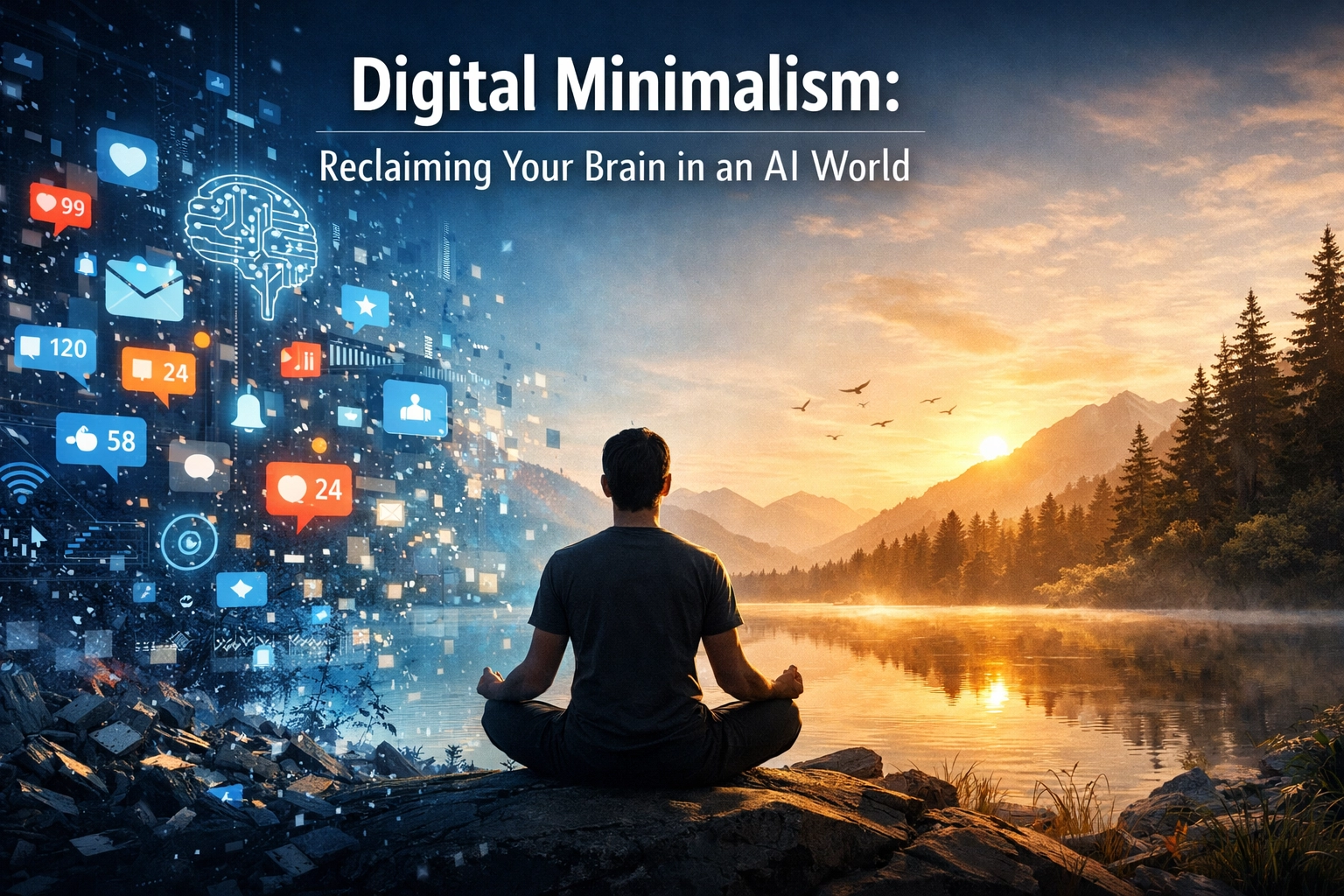
By 2026, the digital landscape has shifted from a series of tools we use into an all-encompassing environment that uses us. We have moved past the era of simple social media doom-scrolling and entered the age of Generative Attention: where AI agents, hyper-personalized feeds, and synthetic media are custom-built in real-time to keep our neural pathways firing.
Digital minimalism is no longer a "lifestyle choice" for the tech-averse; it is a critical survival strategy for cognitive sovereignty. If you aren't intentional about how you interact with the silicon world, your focus, your creativity, and your mental health are essentially being harvested as raw data.
The 2026 Attention Landscape: Hyper-Personalization as a Trap
A few years ago, we worried about algorithms recommending videos we might like. Today, Large Action Models (LAMs) and real-time generative engines create content specifically designed for our unique psychological profiles. This is "High-Entropy Consumption."
When every notification is perfectly timed by an AI that knows your circadian rhythm better than you do, the friction to disengage becomes almost insurmountable. We are seeing a measurable rise in "Cognitive Fragmentation," where the brain struggles to maintain a single thread of thought for more than 120 seconds.
The Neural Toll of Constant Connectivity
From a neurobiological perspective, the cost of this hyper-connectivity is staggering. Our brains are evolved for "Sparse Signaling": occasional hits of dopamine from finding food or social connection. The modern AI-driven environment provides "Dense Signaling," an endless stream of rewards that eventually leads to dopamine receptor down-regulation.
When your receptors are down-regulated, everyday life feels dull. You need more stimulation just to feel "baseline." This is why you find yourself checking your messages while watching a movie, or listening to a podcast at 2x speed while eating dinner. Your brain is starving for a signal density that the physical world cannot provide.
The Framework of Digital Minimalism 2.0
Cal Newport popularized digital minimalism years ago, but the rules have changed. In an AI world, simply "quitting Facebook" isn't enough. We need a more technical, surgical approach to our digital hygiene.
1. Neural Sovereignty via Latency Engineering
The most effective way to break an algorithmic loop is to reintroduce friction. The AI wants to minimize the time between your impulse and the gratification. To reclaim your brain, you must manually increase this latency.
- The 24-Hour Buffer: For any non-essential AI tool or app, implement a 24-hour waiting period before installation.
- Decouple the Hardware: Move high-stimulation apps (entertainment, news, generative social media) to a device that does not leave your house. Your phone should return to being a utility tool: maps, calls, basic messaging, and utility AI.
- Notification Blackouts: By 2026, "Do Not Disturb" isn't enough. Use DNS-level filtering (like Pi-hole or NextDNS) to block tracking and notification pings at the network level during deep-work blocks.
2. Moving from Generative Consumption to Generative Production
One of the biggest traps of the current AI era is "Passive AI Consumption": letting an AI summarize the world for you, curate your music, and write your emails. This leads to cognitive atrophy.
Digital minimalism in 2026 encourages "Active AI Orchestration." Instead of letting the AI drive, you use it as a high-powered tool for specific, time-bounded tasks.
The Rule: If you are using AI to avoid thinking, you are losing. If you are using AI to expand the scope of what you can build, you are winning.

Technical Strategies for a Low-Entropy Digital Environment
To truly reclaim your focus, you need to treat your digital environment like a high-performance lab.
Hardcoding Your Boundaries
- Grayscale Mode: It sounds simple, but stripping the color from your UI kills the "gamification" of your apps. Our brains are hardwired to respond to bright, saturated colors (especially red notification badges). Grayscale breaks the Pavlovian response.
- Eliminating the Feed: Use browser extensions and modified clients to remove the "Home" feeds from platforms like YouTube, LinkedIn, or X. You should only see search bars. This shifts your behavior from reactive (seeing what's there) to proactive (searching for what you need).
- Local-First Workflows: With the cloud being the primary delivery mechanism for distractions, moving to "local-first" software (like Obsidian for notes or local LLMs run via Ollama) allows you to work without an active internet connection, cutting the cord to the attention economy.
The Data-Driven Case for Solitude
Recent studies in 2025 indicated that individuals who practiced "Structured Solitude": defined as 30 minutes a day without any digital input: showed a 22% increase in Prefrontal Cortex (PFC) activity during problem-solving tasks. The PFC is responsible for executive function and impulse control. Essentially, boredom is the gym for your focus. When you deprive your brain of external input, it is forced to engage in "Default Mode Network" (DMN) processing, which is where original insights and self-reflection occur.

The 30-Day Digital Declutter: A Technical Protocol
If you feel your brain has been "colonized" by the algorithm, a standard weekend break won't cut it. You need a full system reset.
Phase 1: The Audit (Days 1-7)
Track every digital interaction. Use screen time tools, but go deeper. Note why you opened an app. Was it for a specific task, or a "micro-boredom" reflex? Identify the "High-ROI" tools (utility) vs. the "Low-ROI" tools (infinite feeds).
Phase 2: The Hard Reset (Days 8-22)
Remove all Low-ROI apps from all devices. If you need to check them, you must do so on a desktop computer, through a browser, with a 20-character password that isn't saved. This creates "High Activation Energy" for bad habits. During this period, you will experience "phantom vibration syndrome" and genuine irritability. This is your dopamine receptors recalibrating.
Phase 3: Reintroduction (Days 23-30)
Slowly bring back tools, but only if they serve a specific purpose. For every app you put back on your phone, you must define its "Operating Procedure."
- Example: "I only use LinkedIn on Tuesday and Thursday for 15 minutes to respond to messages."
Human-Centric ROI: The End Game
Why go through all this trouble? Because in an AI-saturated world, the most valuable commodity isn't information: it's deep focus.
The ability to sit with a complex problem for four hours without checking a device is becoming a superpower. As AI commoditizes average output, the only thing that will remain valuable is "Deep Human Work": the kind of work that requires synthesis, empathy, and high-level strategic thinking. These are all functions of a brain that isn't fragmented.
Digital minimalism isn't about living in the past; it's about being the master of the future. It’s about ensuring that when you use an AI, it’s a conscious choice made by a sovereign mind, not a compulsive click made by a dopamine-starved biological machine.
About the Author
Malibongwe Gcwabaza
CEO of blog and youtube
Malibongwe Gcwabaza is a forward-thinking tech strategist and the CEO of blog and youtube, a premier digital consultancy specializing in the intersection of AI, content strategy, and human-centric technology. With over a decade of experience in the digital media landscape, Malibongwe has helped hundreds of organizations navigate the complexities of the attention economy.
His work focuses on "Sustainable Tech Integration," ensuring that as we move toward an AI-driven future, we maintain the cognitive integrity and creative autonomy that make us human. When he’s not deconstructing algorithmic feedback loops, Malibongwe is an advocate for "Quiet Tech" and spends his time exploring the impact of digital wellness on executive performance.
Connect with Malibongwe on our platform for more insights into the future of work and technology.
About the Author


