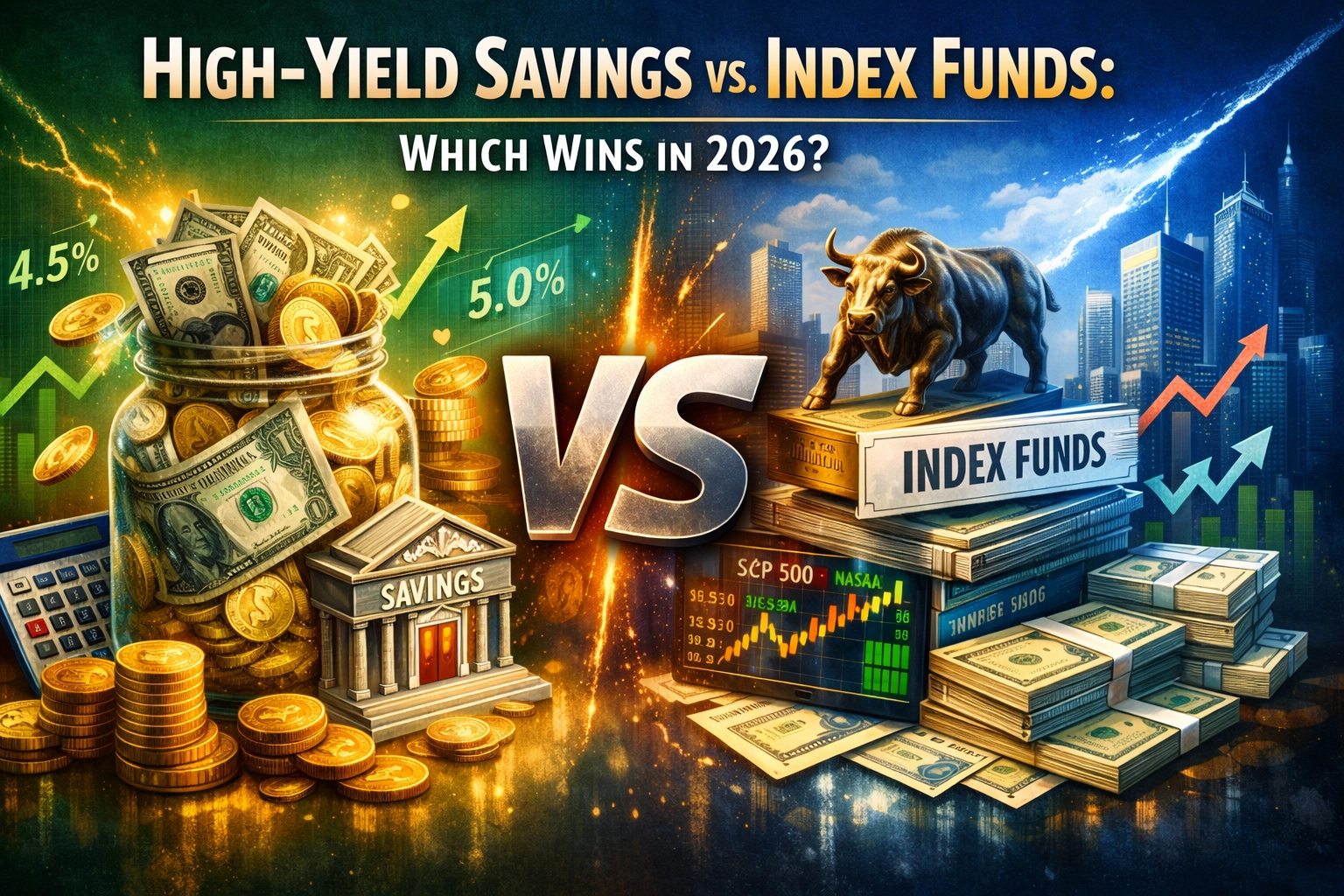
It is March 2026, and the financial landscape looks significantly different than it did just a few years ago. We’ve moved past the "zero-interest-rate policy" (ZIRP) era that defined the 2010s, and we’ve survived the volatility of the mid-2020s. Today, investors are staring at a fascinating dilemma: do you take the "guaranteed" 4.5% to 5% offered by High-Yield Savings Accounts (HYSAs), or do you ride the wave of the equity markets via Index Funds?
Choosing between these two isn't just a matter of "which makes more money." It’s a technical decision based on liquidity needs, risk tolerance, and the current macroeconomic climate. If you’re sitting on cash and wondering where to park it for the remainder of 2026, you need more than just a surface-level "it depends." You need a data-driven breakdown.
The State of Play: HYSAs in 2026
For a long time, savings accounts were where money went to die. Earning 0.01% meant inflation was eating your purchasing power faster than you could say "compound interest." In 2026, the narrative has flipped. High-Yield Savings Accounts are currently offering between 4.25% and 5.10% APY, depending on the institution.
The Technical Mechanics of HYSAs
HYSAs are essentially liquid debt instruments. When you deposit money, the bank uses that capital to fund loans (mortgages, auto loans, business credits). In 2026, because the central bank has maintained a "higher for longer" stance on interest rates to stabilize the economy, banks are forced to compete for your deposits to maintain their own liquidity ratios.
Key Advantages:
- FDIC/NCUA Insurance: Your money is protected up to $250,000 per depositor, per institution. In a world of digital bank runs and crypto collapses, this "boring" safety is a massive technical feature.
- Liquidity: Most HYSAs allow for 6 to 10 withdrawals per month without penalty. In 2026, many fintech platforms have integrated these accounts with real-time payment rails, making them nearly as accessible as a standard checking account.
- Zero Volatility: Your principal does not fluctuate. If you put in $10,000, you will always have at least $10,000 (plus interest).
The Engine of Wealth: Index Funds in 2026
If HYSAs are the "safe harbor," Index Funds are the "engine room." An index fund: whether it’s tracking the S&P 500, the Nasdaq 100, or a Total World Stock Index: is designed to capture the collective growth of the corporate world.
Why Index Funds Are Different Now
In 2026, the composition of major indices has shifted. We are seeing a heavy concentration in AI-integrated industrial firms and biotechnology, moving slightly away from the pure software-as-a-service (SaaS) dominance of 2021. This means that while the growth potential remains high, the drivers of that growth are more tied to tangible productivity gains.
Key Advantages:
- Compounding Growth: Historically, the S&P 500 has returned roughly 10% annually over long periods. Even after accounting for inflation, this outpaces any savings account.
- Tax Efficiency: Unlike HYSAs, where interest is taxed as ordinary income every year, index funds held in a brokerage account only trigger capital gains taxes when you sell. If you hold for more than a year, you qualify for lower long-term capital gains rates.
- Diversification: A single share of a Total Stock Market ETF gives you fractional ownership in thousands of companies. You aren't betting on one CEO; you’re betting on the global economy.
Direct Comparison: The 2026 Math
Let’s look at the numbers. Assume you have $50,000 to invest today.
Scenario A: The High-Yield Savings Account
- Annual Yield: 4.75%
- Balance after 1 year: $52,375
- Risk: Zero (Nominal)
- Tax Impact: You pay ordinary income tax on the $2,375 gain. If you’re in the 24% tax bracket, you lose roughly $570 to the IRS.
Scenario B: The Broad Market Index Fund
- Expected Return: 8% to 12% (Estimated for 2026 based on current earnings projections)
- Balance after 1 year: $54,000 to $56,000
- Risk: High. The market could drop 15% in a single quarter due to geopolitical tensions or a sudden shift in consumer spending.
- Tax Impact: $0 (assuming you don't sell).

The Inflation Trap
One technical detail many investors miss in 2026 is the Real Rate of Return.
- Formula: Nominal Interest Rate – Inflation Rate = Real Return.
If inflation is sitting at 3% and your HYSA is paying 4.75%, your real return is only 1.75%. While you are "gaining" money, your actual purchasing power is growing very slowly. Index funds, however, represent ownership in companies that can raise prices to match inflation. This makes them a superior long-term hedge against the rising cost of living.
When to Choose a High-Yield Savings Account
Safety isn't a sign of weakness; it's a strategic choice. In 2026, you should prioritize an HYSA for the following:
- The Emergency Fund: The standard rule of 3-6 months of expenses still applies. This money should never be in the stock market. If the economy takes a downturn and you lose your job, that’s exactly when the stock market will also be at its lowest point. Selling at a 30% loss to pay rent is a mathematical disaster.
- Short-term Goals (1-3 Years): Are you buying a house in 2027? Saving for a wedding? A market correction could delay those plans by years. The 4.75% yield is a gift for short-term savers.
- Psychological Stability: If seeing your account balance drop by 5% in a day makes you lose sleep, the "mental tax" of index funds might be too high for you.
When to Choose Index Funds
Index funds are the vehicle for your "future self." You should choose them for:
- Retirement Planning: If you aren't touching this money for 10+ years, the short-term volatility is irrelevant noise. The historical probability of the market being up over a 10-year period is overwhelmingly high.
- Wealth Building: You cannot save your way to true wealth at 5% interest. To move the needle significantly, you need the exponential power of equity growth.
- Passive Income (Dividends): Many index funds pay dividends. In 2026, these dividends are often reinvested automatically, purchasing more shares and accelerating the compounding process.

The "Hybrid" Strategy: Using Both
The smartest investors in 2026 aren't picking one; they are building a "barbell" portfolio.
- The Safe End: 20% of your liquid net worth in an HYSA. This provides a psychological floor and immediate cash for opportunities or emergencies.
- The Growth End: 80% in low-cost index funds (like VTI or VOO). This ensures you are participating in the growth of the global economy.
This technical approach allows you to be "aggressive" with your investments because you know your "base" is covered. If the market crashes in late 2026, you don't panic-sell because your rent and grocery money are sitting safely in a 5% HYSA.
Risk Factors to Watch in 2026
While the outlook is generally positive, 2026 carries specific risks for both options:
For HYSAs:
- Rate Cuts: If the central bank decides to lower interest rates to stimulate a slowing economy, your 5% APY could drop to 3% or lower within months. HYSAs have variable rates; they are not locked in like CDs (Certificates of Deposit).
- Inflation Spikes: If a supply chain disruption hits, inflation could outpace your interest rate, leading to a negative real return.
For Index Funds:
- Valuation Risk: If the "AI Boom" of the mid-2020s turns out to be overextended, we could see a significant "mean reversion" where stock prices fall to align with actual earnings.
- Regulatory Changes: Increased scrutiny on big tech (which makes up a huge portion of index funds) could cap the growth of the very companies driving the index higher.

Summary Table: HYSA vs. Index Funds
| Feature | High-Yield Savings (2026) | Index Funds (2026) |
|---|---|---|
| Expected Return | 4% – 5.5% | 7% – 11% (Historical Avg) |
| Risk Level | Extremely Low (FDIC Insured) | Moderate to High (Market Risk) |
| Liquidity | High (Immediate Access) | Moderate (T+1 Settlement) |
| Best For | Emergency funds, <3 year goals | Retirement, >5 year goals |
| Tax Treatment | Taxed as Ordinary Income | Capital Gains (More Favorable) |
Final Verdict
In 2026, the "winner" depends entirely on the purpose of your capital.
If you are looking for a place to store your emergency fund or save for a house down payment, the High-Yield Savings Account is the undisputed champion. The current interest rates provide a rare opportunity to earn a meaningful return without taking any market risk.
However, if you are looking to build long-term wealth and beat inflation over the next decade, Index Funds remain the gold standard. The volatility is simply the "price of admission" for the higher returns that equities provide.
Don't let the choice paralyze you. The biggest mistake in 2026 isn't picking the "wrong" one between these two: it's leaving your money in a traditional checking account earning 0.01%. Pick the strategy that aligns with your timeline and get your money working.
About the Author: Malibongwe Gcwabaza
CEO & Financial Strategist
Malibongwe Gcwabaza is the CEO of blog and youtube, a digital media company dedicated to simplifying complex financial and technological concepts for the modern era. With over a decade of experience in strategic planning and digital asset management, Malibongwe focuses on bridging the gap between traditional finance and the emerging digital economy. He is a firm believer in data-driven decision-making and advocates for financial literacy as a tool for global empowerment. When he isn't analyzing market trends, he's exploring the intersection of AI and content creation.
About the Author


