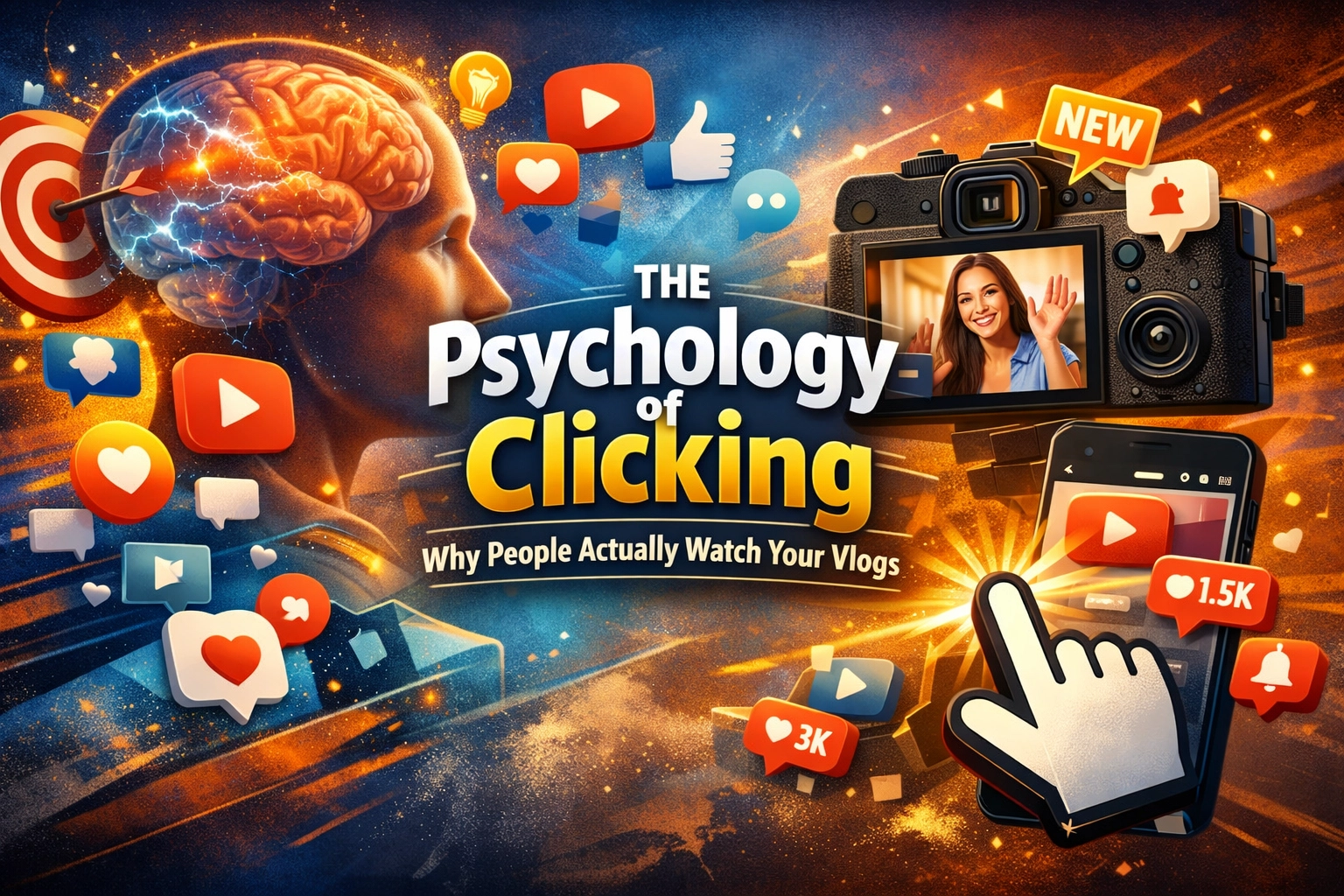
Most creators spend thousands of dollars on 4K cameras, G-Master lenses, and studio-grade lighting, only to wonder why their view counts remain stagnant. The hard truth is that while technical quality sets a professional floor, it is rarely the reason someone clicks or stays. The decision to engage with a vlog happens in the subconscious. It is a complex cocktail of neurochemistry, primal social needs, and the brain’s inherent desire for narrative closure.
If you want to move beyond the "starving artist" phase of vlogging and build a channel that AdSense actually rewards, you have to stop thinking like a videographer and start thinking like a behavioral psychologist.
The 50-Millisecond Filter: Why We Click
The "click" is a micro-transaction of trust. Before a viewer hears your voice or sees your B-roll, their brain has already performed a high-speed scan of your thumbnail and title. Humans process visual information roughly 60,000 times faster than text. In the approximately 50 milliseconds it takes for a viewer to scroll past your video, their amygdala, the part of the brain responsible for emotional processing, has already decided if you are a threat, a bore, or a source of value.
Visual Disruption and the "Pattern Interrupt"
The brain is designed to ignore the mundane to save energy. This is why "standard" vlogging thumbnails, a face with a surprised expression and some red arrows, are losing their effectiveness. They have become part of the visual background noise.
To trigger a click, you need Visual Disruption. This isn't about being louder; it's about being different. High-performing vlogs use color psychology to stand out. For example, using high-contrast colors that sit opposite each other on the color wheel (complementary colors) creates a sense of tension that the eye naturally gravitates toward.
The Zeigarnik Effect: The "Itch" for Closure
Once the click happens, the challenge shifts to retention. This is where the Zeigarnik Effect comes into play. Named after psychologist Bluma Zeigarnik, this principle states that people remember uncompleted or interrupted tasks better than completed ones.
In the context of vlogging, this means creating an "open loop" in the first 15 seconds. If you tell the viewer exactly what is going to happen and then show it, their brain marks the "task" as completed and triggers the urge to click away. However, if you present a problem, a mystery, or an emotional stakes-heavy situation without immediate resolution, the viewer’s brain remains in a state of tension. They stay because they physically need the closure.
Applying the Open Loop
Don't start your vlog with "Hey guys, today we are going to the beach." Start with the moment the car broke down on the way to the beach, then cut back to the beginning. You’ve created a question: How did they get from this sunny morning to a smoking engine? The viewer will watch until that loop is closed.
Mirror Neurons: The Science of "Vibe"
Why do we feel happy when we see a vlogger celebrate, or anxious when they are in a stressful situation? The answer lies in mirror neurons. These are specialized brain cells that fire both when an individual performs an action and when they observe someone else performing that same action.
When a vlogger is genuinely excited, the viewer’s brain simulates that excitement. This is why "authenticity" is such a buzzword in the creator economy: it’s actually a biological requirement for connection. If you are faking enthusiasm, the micro-expressions on your face often signal a "mismatch" to the viewer’s brain, leading to a sense of distrust or "cringe."

The Emotional Contagion
To leverage this, you must focus on the transparency of emotion. High-value vlogs don't just show the highlights; they show the frustration of the process. When a viewer sees you overcome a genuine obstacle, their mirror neurons allow them to "share" in the victory. This creates a much stronger bond than a polished, "perfect" lifestyle ever could.
The Dopaminergic Reward System
Every time a viewer learns something new or experiences a narrative payoff in your video, their brain releases dopamine. This is the "feel-good" neurotransmitter associated with reward and motivation.
To keep a viewer watching a 10-15 minute vlog, you need to provide a consistent "Dopamine Schedule."
- Micro-rewards: A funny edit, a beautiful cinematic shot, or a quick tip every 2 minutes.
- The Macro-reward: The final resolution of the "Open Loop" created at the beginning.
If the gap between rewards is too long, the viewer’s dopamine levels drop, boredom sets in, and they exit the video. Professional vlogs are edited to ensure that there is a visual or narrative "beat" change at least every 60 to 90 seconds to reset the viewer's attention span.

The Parasocial Contract and Inside Jokes
The most successful vlogs on YouTube function less like "shows" and more like "communities." This is built on the Parasocial Relationship: a one-sided psychological bond where the viewer feels they know the creator personally.
The secret weapon for strengthening this bond is the ritual. Rituals can be:
- Specific catchphrases.
- Recurring "characters" (even if it's just your cat or a specific inanimate object).
- Inside jokes that only "long-term" viewers understand.
When a viewer understands an inside joke, their brain rewards them with a sense of belonging. They aren't just watching a video; they are part of an "in-group." This social validation is one of the most powerful reasons people return to a channel week after week, regardless of the specific topic of the video.
Narrative Architecture: Beyond "Day in the Life"
A common mistake is thinking a vlog is a chronological record of a day. It’s not. A vlog is a story that uses the footage of your day.
To satisfy the human brain's craving for structure, every vlog should follow a basic three-act narrative:
- The Inciting Incident: Something changes. You decide to do something, or something happens to you.
- Progress and Conflict: You try to achieve the goal, but things get in the way.
- Resolution: You succeed, fail, or learn something.
Without this structure, your vlog is just a "content soup" that lacks a psychological hook. Even a "boring" day can be made compelling if you frame it around a small conflict: like trying to find the perfect cup of coffee in a new city. The "quest" gives the viewer a reason to care.
The "Information Gap" in Titles
AdSense loves "high intent" and "high engagement" content. To get both, your titles must exploit the Information Gap Theory. This is the space between what we know and what we want to know.
- Low Gap: "My Trip to Tokyo" (The viewer knows what to expect; there is no mystery).
- High Gap: "What I Wish I Knew Before Moving to Tokyo" (The viewer is forced to wonder: What did they miss? Am I making the same mistake?).
By framing your titles as answers to unspoken questions, you trigger a biological need to fill that information gap. This leads to higher click-through rates (CTR) and, consequently, better placement in the YouTube algorithm.
Final Thoughts: The Creator’s Shift
If you want to dominate the vlogging space in 2026, stop focusing on the gear in your hands and start focusing on the chemistry in your viewer’s brain. Every cut, every thumbnail color, and every story beat should be a conscious choice to trigger an emotional response, close a curiosity gap, or provide a social reward.
When you master the psychology of clicking, you stop chasing the algorithm and start leading an audience.
About the Author: Malibongwe Gcwabaza
CEO of blog and youtube
Malibongwe Gcwabaza is a digital strategist and the CEO of blog and youtube, a leading consultancy dedicated to helping creators scale their digital presence through data-driven storytelling and psychological insights. With over a decade of experience in the content economy, Malibongwe specializes in bridging the gap between technical SEO and human-centric engagement. His mission is to empower the next generation of solo creators to build sustainable, high-value businesses that resonate on a global scale.
About the Author


