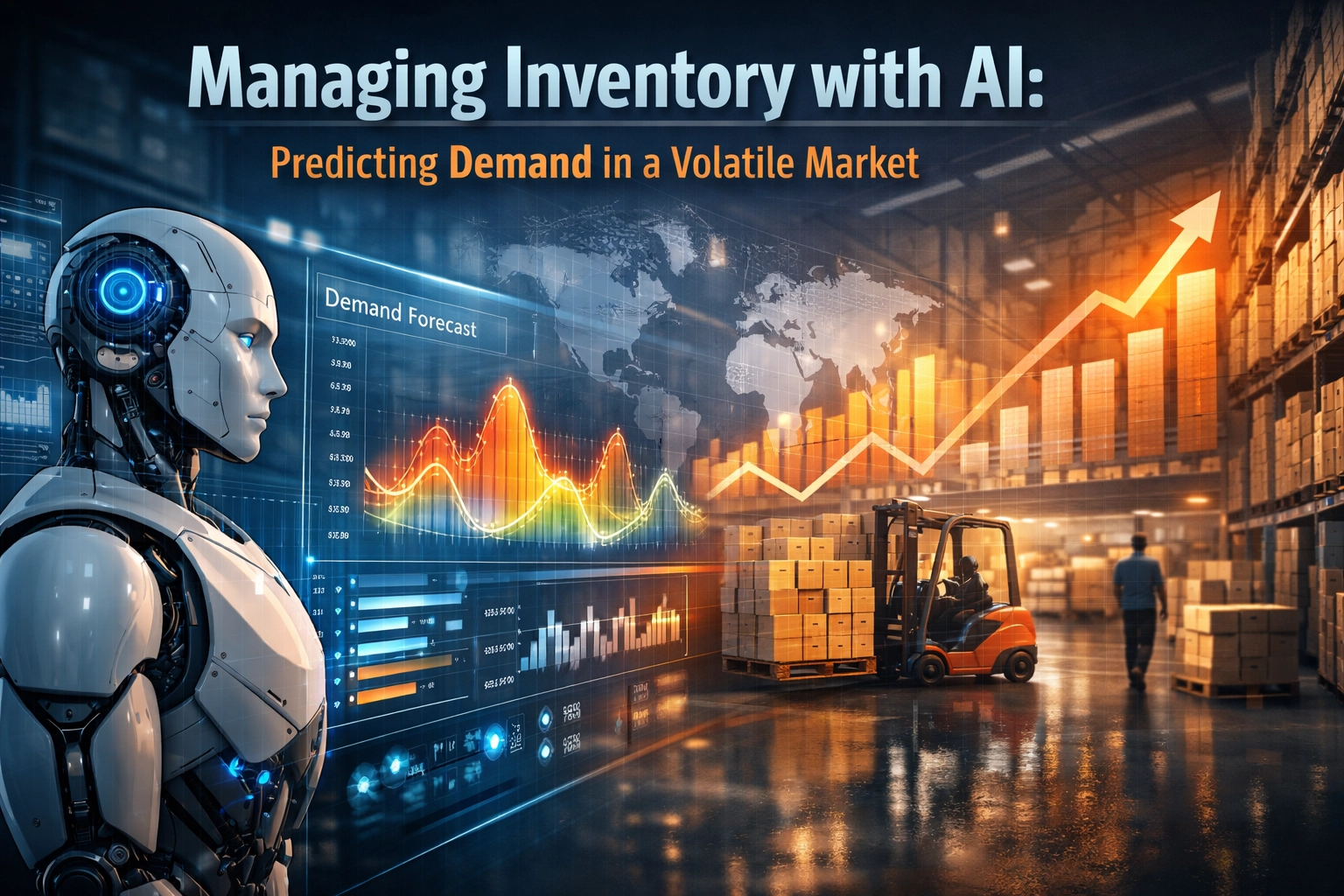
By March 2026, the concept of a "stable market" has become a historical relic. Between rapid shifts in consumer sentiment driven by viral social algorithms, unpredictable geopolitical trade barriers, and the increasing frequency of climate-related logistics disruptions, the traditional "Just-in-Time" (JIT) inventory model has effectively collapsed.
If you’re still relying on spreadsheet-based moving averages or basic linear regression to decide how many units to stock, you’re not just behind: you’re bleeding capital. In the current landscape, inventory isn't just physical goods; it’s stranded cash. AI-driven demand forecasting has moved from a "nice-to-have" luxury for enterprise giants to a survival requirement for any solo media brand, e-commerce micro-brand, or traditional retailer.
The Death of Static Forecasting
For decades, inventory management relied on historical data. You looked at what you sold last March, added a 5% growth factor, and placed your orders. In 2026, that approach is a recipe for disaster. Why? Because historical data assumes the future will look like the past.
Modern volatility is non-linear. A single "de-influencing" trend on TikTok or a sudden surge in the price of raw lithium can render your 12-month forecast useless in 48 hours. This is where Demand Sensing takes over. Unlike traditional forecasting, which looks at long-term horizons, demand sensing uses Machine Learning (ML) to analyze real-time data signals to predict what will happen in the next hours, days, or weeks.

The 2026 Tech Stack: Beyond Simple Algorithms
To build a resilient supply chain today, you need to understand the architectural shift in the models we use. We’ve moved past simple Seasonal Decomposition (STLM). Today’s winners are using a combination of three specific technologies:
1. Transformer-Based Models (Temporal Fusion Transformers)
Originally designed for Natural Language Processing (the tech behind GPT-4 and Gemini), Transformers have been adapted for time-series forecasting. Temporal Fusion Transformers (TFTs) are particularly effective because they can handle "multi-horizon" forecasting. They don't just give you one number; they provide a range of probabilities based on both static metadata (like brand category) and dynamic inputs (like daily sales).
2. Graph Neural Networks (GNNs)
Your inventory doesn’t exist in a vacuum. It exists in a network. GNNs allow businesses to model their entire supply chain as a "graph": a web of nodes (warehouses, suppliers, ports, retail outlets) and edges (shipping lanes, lead times). If a port in Durban is congested, a GNN understands the ripple effect on your warehouse in Johannesburg instantly, adjusting your demand forecast and reorder points before the delay even hits your books.
3. Probabilistic Forecasting
Stop asking "How many units will I sell?" and start asking "What is the probability that I will sell more than 500 units?" AI models now provide a probability distribution (P10, P50, P90).
- P10: 10% chance demand will be below this (useful for avoiding overstock).
- P90: 90% chance demand will be below this (crucial for ensuring you don't run out of stock during a surge).
Integrating Exogenous Data: The Secret Sauce
The biggest mistake brands make in 2026 is feeding their AI only internal sales data. To predict demand in a volatile market, your ML models need "Exogenous Data": external signals that influence buyer behavior.
- Hyper-Local Weather Data: If you’re selling seasonal apparel, a 2-degree shift in the projected temperature for April can swing demand by 20%. Modern AI integrations (like IBM Environmental Intelligence) feed this data directly into your inventory ROP (Reorder Point).
- Social Sentiment & Trend Mapping: By the time a product is "Trending" on a dashboard, it’s too late. AI agents now scrape "latent intent": conversations in niche subreddits or Discord servers: to identify demand spikes before they hit the mainstream.
- Geopolitical Risk Indices: In 2026, trade routes change overnight. Integrating live feeds from logistics trackers and risk assessment AI allows your system to automatically pivot sourcing to a secondary supplier when a "high-risk" signal is detected in your primary lane.

Digital Twins: Testing "What-If" Scenarios
One of the most powerful applications of AI in supply chain resilience is the creation of a Digital Twin. This is a virtual replica of your entire inventory and logistics ecosystem.
Before committing $500k to a new product line, you can run thousands of simulations:
- "What happens to my cash flow if the lead time from Vietnam doubles?"
- "What happens if a competitor drops their price by 15%?"
- "How does a 3-day power grid failure affect my cold-chain storage?"
By running these "Monte Carlo" simulations, you can move from a "Just-in-Time" model to a "Just-in-Case" model that is mathematically optimized. You aren't just hoarding stock; you’re holding exactly the amount of safety stock required to survive a specific, high-probability disruption.
Turning Insights into Action: Autonomous Procurement
The final frontier in 2026 is closing the loop. It’s one thing for an AI to tell you that you're going to run out of stock; it’s another for the AI to fix it.
Autonomous Procurement systems are now being integrated with Warehouse Management Systems (WMS). When the AI detects a high probability of a demand spike (e.g., a P90 forecast exceeding current stock + incoming shipments), it can:
- Automatically scan a pre-approved list of secondary suppliers.
- Compare current shipping rates across air, sea, and rail (using real-time APIs).
- Generate a Purchase Order (PO) and send it for human "one-click" approval: or, for trusted micro-transactions, execute the order autonomously.
Technical Challenges: The "Black Box" Problem
While AI offers incredible precision, it isn't perfect. The biggest hurdle for teams in 2026 is Explainable AI (XAI). When a model tells you to triple your inventory for an obscure SKU, you need to know why.
Is it because of a genuine demand signal, or is it "hallucinating" based on a data anomaly? High-end inventory AI now includes "Feature Importance" dashboards. These show you that the recommendation was driven 40% by weather trends, 30% by competitor out-of-stock events, and 30% by historical seasonality. This transparency is vital for building trust between the AI and the operations team.
How to Start (Without an Enterprise Budget)
You don't need a team of 50 data scientists to implement this. In 2026, the barrier to entry has dropped significantly.
- Clean Your Data: AI is only as good as its fuel. Ensure your SKU-level data, historical returns, and lead times are digitized and clean.
- Use "AI-First" Inventory Tools: Platforms like InventoryPlanner, Anvyl, or customized Python-based tools using AWS Forecast offer sophisticated ML models out of the box.
- Start with Your "Tail": Don't try to automate your top 10% of products first. Apply AI to your "Long Tail": the hundreds of slower-moving SKUs where human intuition usually fails. That’s where the most "trapped cash" usually lives.

The Competitive Edge
In a volatile market, the winner isn't necessarily the brand with the best product; it’s the brand with the best availability. If your competitor is out of stock because they didn't see a disruption coming, and you're ready to ship because your AI predicted it three weeks ago, you win the customer for life.
Predicting demand with AI isn't about having a crystal ball. It’s about having a system that is faster, more granular, and more connected than the market itself. In 2026, resilience is the new growth.
About the Author: Penny
Penny is an AI-driven content strategist and technical writer at blog and youtube. Specializing in the intersection of Machine Learning and operational efficiency, Penny helps business leaders navigate the complexities of the 2026 digital economy. With a focus on actionable data and future-proofed strategies, Penny’s mission is to turn complex technical shifts into competitive advantages for solo entrepreneurs and growing brands alike. When not analyzing supply chain graphs, Penny is usually optimizing her own neural pathways for better creative output.
About the Author


