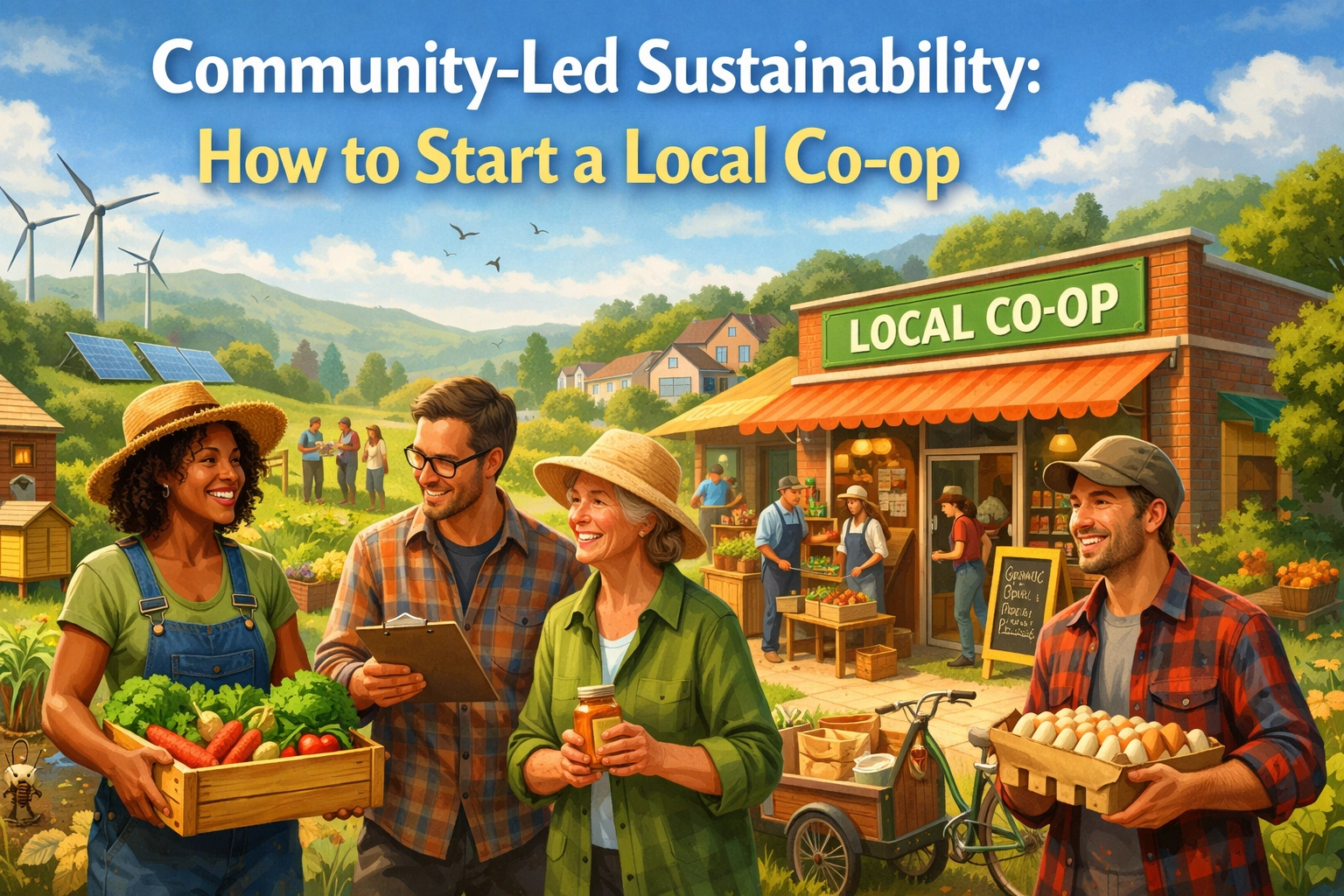
By mid-2026, the global economy has shifted. We've moved past the era of hyper-globalization and into what economists are calling the "Great Localization." Between fluctuating supply chain costs and the urgent need for climate-resilient food systems, the traditional top-down corporate model is losing its grip on the neighborhood level.
The alternative? The Cooperative.
A cooperative (or co-op) isn't just a "hippie grocery store." It is a sophisticated, member-owned business structure designed to prioritize community resilience over shareholder dividends. Whether you’re looking to launch a neighborhood micro-grid, a tool-sharing library, or a regenerative food hub, starting a co-op in 2026 requires a mix of old-school community organizing and new-age technical infrastructure.
Why the Co-op Model is Winning in 2026
In a world of "Frugal Optimism," people are looking for ways to maintain a high quality of life without the high cost of corporate middle-men. Co-ops allow for "economies of scale" at a local level. By pooling capital and purchasing power, a group of 50 neighbors can access wholesale prices and high-end technology that would be impossible for an individual household.
Beyond the finances, co-ops offer something a standard LLC doesn't: democratic governance. In a world where AI-driven algorithms often decide what we eat and buy, the co-op model returns decision-making power to human hands. One member, one vote. Simple.

The Technical Framework: The 7 Cooperative Principles
To build a co-op that lasts longer than a single season, you have to follow the International Cooperative Alliance (ICA) principles, but with a 2026 twist:
- Voluntary and Open Membership: No discrimination, but focused on local residency to keep the carbon footprint low.
- Democratic Member Control: This is the technical backbone. Decisions are made by the members who use the service.
- Member Economic Participation: Members contribute equitably. In 2026, this often looks like a mix of traditional currency and "time-banking" or community credits.
- Autonomy and Independence: Co-ops stay independent of government or corporate control.
- Education and Training: You aren't just selling a product; you’re training your community on how to run a business.
- Cooperation among Cooperatives: This is how we scale. A local food co-op works with a local energy co-op to create a circular economy.
- Concern for Community: Sustainability isn't a marketing buzzword; it’s the core KPI (Key Performance Indicator).
Step 1: The Feasibility Study and Steering Committee
You don't start by buying a building. You start by finding your "anchor group." In 2026, this usually begins in a localized Discord or a decentralized social mesh-net. You need 5 to 10 people who are willing to put in the "sweat equity" for the first six months.
Your steering committee needs a diversity of skills:
- The Architect: Someone who understands local zoning and physical space.
- The Tech Lead: Someone to manage the DAO (Decentralized Autonomous Organization) governance tools or the member management software.
- The Numbers Person: Someone to handle the Subchapter T tax filings (or your local equivalent).
- The Community Liaison: The person who actually talks to neighbors and builds trust.
The Feasibility Study: Before you take a cent of member money, you must answer: Does the community actually need this? If there are already three organic grocers within a mile, a food co-op might fail. But a community-owned EV charging hub or a gray-water recycling co-op might be exactly what’s missing.
Step 2: Choosing Your Legal and Governance Stack
This is where many "good ideas" die. In 2026, you have more options than just a standard non-profit or C-corp.
The "Phygital" Governance Model
Most successful co-ops now use a hybrid model. Physical meetings for deep discussion, and digital platforms for voting and resource tracking.
- Governance Tools: Platforms like Loomio or Snapshot allow members to vote on proposals from their phones, ensuring high participation rates.
- Legal Structure: In the US, many choose a LCA (Limited Cooperative Association), which allows for a mix of member-patrons and outside investors while keeping control in the hands of the members.

Step 3: Capital Raising and the "Direct Public Offering"
Traditional banks are often hesitant to fund co-ops because there isn't one "owner" to chase for a loan. This is why member-led capital is crucial.
- Founder Shares: The steering committee puts in the initial "seed" money.
- Member Shares: When the co-op launches, members pay a one-time fee (e.g., $200) to own their share.
- DPOs (Direct Public Offerings): This allows community members to invest larger sums in exchange for a modest return, keeping the interest payments within the neighborhood rather than sending them to a big bank.
Step 4: Building the Circular Food and Resource Network
If you're building a food co-op, the 2026 standard is Regenerative and Local.
The "sharing economy" aspect means your co-op shouldn't just sell vegetables; it should facilitate the "Library of Things." Why should 50 households own 50 lawnmowers or 50 high-end power tools? A local co-op can manage a shared inventory, reducing waste and saving members thousands of dollars a year.
Managing Local Food Hubs
Technical depth in 2026 food co-ops involves Dynamic Inventory Management. Using IoT (Internet of Things) sensors, co-ops can track the shelf life of produce from local micro-farms in real-time. This reduces food waste to nearly zero. When a shipment of kale from the backyard farm down the street is nearing its end, the co-op’s app can automatically trigger a "flash sale" or alert the local community kitchen.

Step 5: Operations and the Tech Stack
Running a co-op is a logistical challenge. You are essentially running a business where every customer is also a boss.
- ERP (Enterprise Resource Planning): Open-source tools like Odoo or specialized co-op software like CoopCycle (for delivery) are essential.
- Blockchain for Transparency: Some 2026 co-ops use a private ledger to track "Patronage Dividends." This ensures that if the co-op makes a profit, it is distributed back to members based on how much they used the service, with 100% transparency.
- Energy Management: If your co-op involves shared solar or battery storage, you'll need a Smart Grid Controller to manage the "Peer-to-Peer" energy trading between houses.
The 2026 Challenge: Overcoming "Participation Fatigue"
The biggest threat to a co-op isn't money; it’s apathy. In the digital age, people are used to "one-click" solutions. Being a co-op member requires more work.
To combat this, modern co-ops are gamifying participation. Member-owners can earn "community credits" for volunteering, which can be used to offset their monthly dues or purchase goods. It’s not just about labor; it’s about creating a "Social Fabric."

Scaling: From One Neighborhood to a Network
A single co-op is a pilot program. A network of co-ops is a new economy. By 2026, we are seeing the rise of Federated Cooperatives. This is where small, local co-ops join together to form a larger entity that can handle massive logistical tasks: like regional transport or manufacturing: while keeping the individual co-ops autonomous.
If you start a co-op today, your goal shouldn't be to become a global conglomerate. It should be to become so deeply rooted in your community that you become an essential part of the local ecosystem, as vital as the water lines or the electrical grid.
Summary Checklist for Starting Your Co-op
- Identify the Pain Point: What does your community need but can't afford individually?
- Form a Steering Committee: Get 5-10 dedicated people with diverse skills.
- Conduct a Feasibility Study: Validate the market and the community interest.
- Incorporate: Choose a legal structure that allows for democratic ownership.
- Raise Capital: Look to your members first, then to local DPOs.
- Deploy Tech: Use governance and inventory tools to keep operations lean.
- Launch and Iterate: Start small (maybe a "buying club") and scale as trust grows.
About the Author: Malibongwe Gcwabaza
Malibongwe Gcwabaza is the CEO of blog and youtube, a media firm dedicated to documenting the transition to a decentralized, sustainable future. With over a decade of experience in community organizing and digital business strategy, Malibongwe focuses on how emerging technologies: from AI to Blockchain: can be harnessed to empower local communities rather than just big tech. When he isn't drafting blueprints for the "Great Localization," he's usually experimenting with urban farming techniques in his home city.
About the Author


