
By 2026, the "grow your own" movement has shifted from a backyard hobby to a high-tech necessity for urban dwellers. With global supply chains remaining volatile and the cost of organic produce hitting all-time highs, vertical farming is no longer just for industrial warehouses. It’s moved into our kitchens, balconies, and spare closets.
But we aren't talking about a few pots of basil on a windowsill. We’re talking about precision-controlled, high-yield systems that use 95% less water than traditional soil farming and produce food up to 3x faster. If you’re living in a high-rise or a compact studio, your square footage is your most valuable asset. Vertical farming allows you to trade height for harvest.
The State of Home Farming in 2026
The technology surrounding indoor agriculture has matured significantly. In 2026, the "plug-and-play" nature of these systems means you don't need a PhD in botany to get results. However, to truly master a home setup that provides a meaningful percentage of your caloric or nutritional intake, you need to understand the mechanics of hydroponics and aeroponics.
The shift toward decentralized food production is driven by three factors:
- Nutrient Density: Produce loses up to 30% of its nutrients within three days of harvest. Home-grown food is consumed within minutes.
- AI Integration: Low-cost sensors now monitor pH, Electrical Conductivity (EC), and water temperature in real-time, sending alerts to your phone.
- LED Efficiency: The PAR (Photosynthetically Active Radiation) output of modern LEDs has doubled compared to five years ago, while energy consumption has plummeted.
Hydroponics vs. Aeroponics: Choosing Your Method
For the urban farmer, the choice usually boils down to two soil-less methods. Both rely on a nutrient solution: a precise cocktail of nitrogen, phosphorus, potassium (NPK), and micronutrients: but they deliver it differently.
1. Hydroponics: The Reliable Workhorse
In a hydroponic system, the plant roots are either submerged in a nutrient solution or a thin film of water flows over them constantly.
- Nutrient Film Technique (NFT): This is the most common vertical setup. You use tilted PVC pipes or gutters. A pump lifts the nutrient solution to the top, and gravity pulls it down across the roots of your plants. It’s simple, relatively cheap to build, and highly effective for leafy greens.
- Deep Water Culture (DWC): Better for larger plants, but harder to "stack" vertically due to the weight of the water reservoirs.
2. Aeroponics: The High-Tech Speedster
Aeroponics is the "Ferrari" of vertical farming. Instead of sitting in water, the roots hang in the air and are misted with a high-pressure nutrient solution every few minutes.
- The Benefit: Roots have maximum access to oxygen, which supercharges growth. Research shows aeroponic systems can increase yields by 40% to 60% compared to hydroponics.
- The Catch: It’s technically demanding. If your pump fails or a misting nozzle clogs, your plants can die within hours because there is no water "buffer."

Technical Blueprint: Building Your Vertical Tower
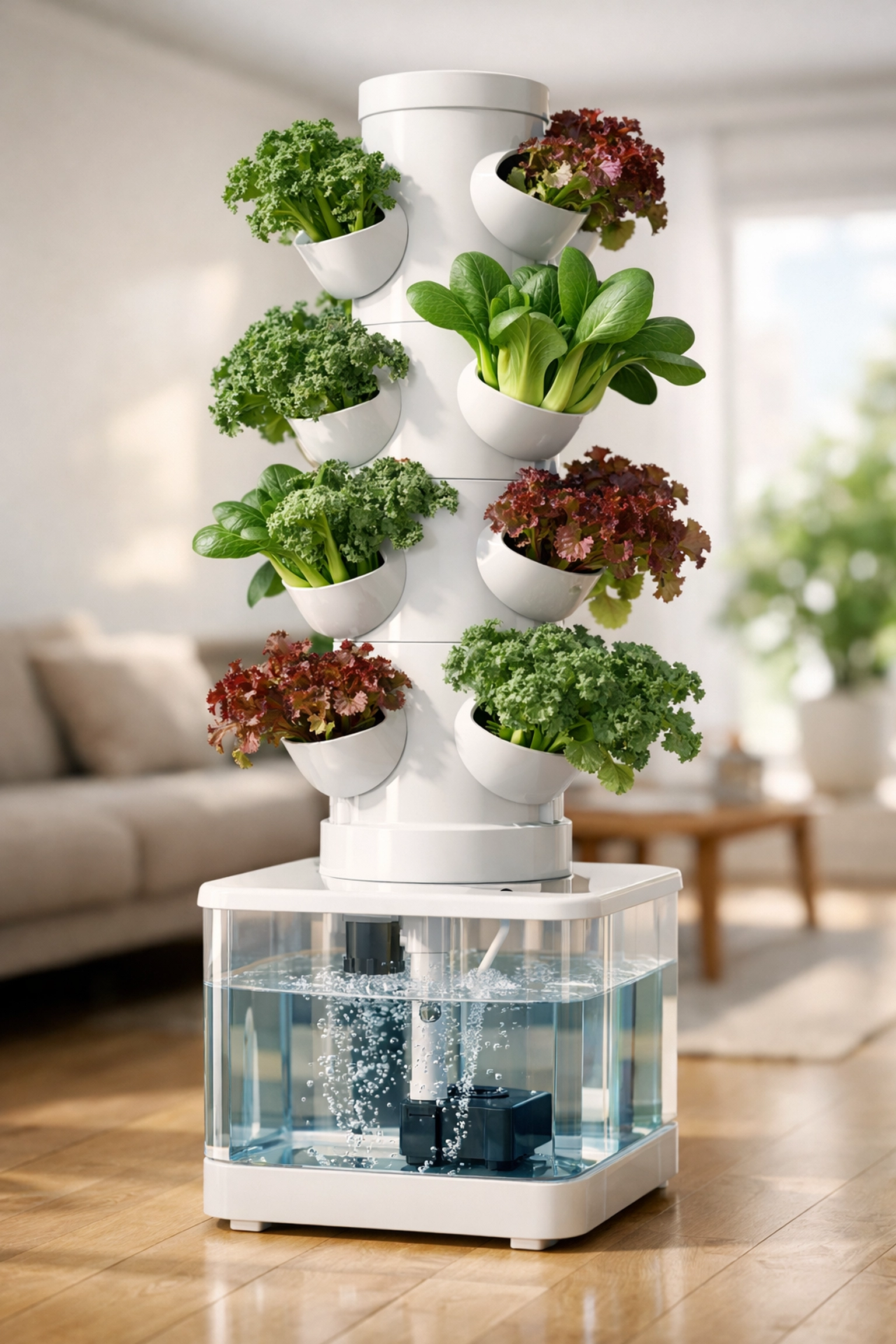
If you want to move beyond the pre-built (and often overpriced) consumer kits, building your own system is the way to go. A 5' x 5' corner of a room can easily support 150+ plants if you build a "Tower" system.
The Materials List
- PVC Piping: 3" or 4" PVC for the main towers. Use food-grade (NSF certified) plastic to ensure no chemicals leach into your food.
- Submersible Pump: Look for a high-head pump. If your tower is 6 feet tall, you need a pump rated for at least 8-10 feet of "lift" to ensure consistent flow at the top.
- Reservoir: A 15-20 gallon BPA-free plastic bin.
- Grow Lights: Full-spectrum LED bars with a high PPFD (Photosynthetic Photon Flux Density) rating.
The Construction Logic
- Tower Prep: Drill holes in your PVC pipe every 6-8 inches, staggered. Use a heat gun to soften the plastic and a mold to create "pockets" that hold your net pots at a 45-degree angle.
- The Manifold: Connect the pump to a 1/2" vinyl hose that runs up the center of the tower. At the top, install a distribution cap to ensure water drips evenly down the inner walls.
- The Drainage: The bottom of the towers should sit in a return gutter or directly on top of the reservoir lid. This creates a closed-loop system where water is constantly recycled.
Lighting Science: PAR, DLI, and Spectrum
In 2026, we’ve moved past "blurple" (blue + red) lights. To grow high-quality produce indoors, you need to mimic the sun’s full spectrum.
PAR (Photosynthetically Active Radiation) is the range of light (400 to 700 nanometers) that plants actually use for photosynthesis. When buying lights, ignore "watts" and look for PPF (Photosynthetic Photon Flux).
DLI (Daily Light Integral) is the "total dose" of light your plants get in a 24-hour period.
- Leafy Greens: Need a DLI of 12-16 mol/m²/d.
- Fruiting Plants (Tomatoes/Peppers): Need 20-30 mol/m²/d.
By calculating your DLI, you can set your timers perfectly. For most home systems, running your LEDs for 14-16 hours a day is the sweet spot.
Automation: The "Smart" Farm
One of the biggest barriers to home farming used to be the daily maintenance. In 2026, we use Answer Engine Optimization (AEO) for our homes. You can now integrate your farm with AI agents that analyze sensor data.
Critical Sensors for 2026:
- pH Sensors: Keep your solution between 5.5 and 6.5. If it drifts, plants lose the ability to "up-take" nutrients, leading to "nutrient lockout."
- EC/TDS Meters: This measures the concentration of salts in your water. Too high and you burn the roots; too low and the plants starve.
- Hygrometers: In a vertical setup, humidity is your enemy. If your "micro-climate" gets too humid, you’ll deal with powdery mildew. Aim for 50-60% humidity with active airflow (use small PC fans mounted to the towers).

Advanced Nutrient Management
You can't just throw Miracle-Gro into a hydroponic system. You need water-soluble nutrients. In 2026, many home farmers are moving toward bioponics or aquaponics (using fish waste), but for most, a three-part mineral solution is the most reliable.
- Part A: High in Calcium and Nitrogen.
- Part B: Magnesium and Sulfur.
- Part C: Phosphorus, Potassium, and micronutrients.
By adjusting the ratios, you can "steer" the plant. High nitrogen during the vegetative stage for big leaves, and high phosphorus when you want your indoor tomatoes to flower.
Future-Proofing for 2026: The "Zero-Waste" Setup
Sustainability is a core pillar of the 2026 lifestyle. To make your vertical farm truly sustainable, consider the following:
- Solar Integration: With the efficiency of modern LEDs, a small balcony solar array and a battery backup (like a 2kWh portable power station) can run your entire farm off-grid.
- Heat Recovery: Remember that 50% of the energy your lights use is converted into heat. In the winter, your vertical farm acts as a space heater for your apartment. In the summer, you need an exhaust system that vents this heat outside to keep your cooling bills down.
- Seed Saving & Micro-Cloning: Stop buying seeds. Learn to "clone" your best-performing plants by taking cuttings and placing them in a simple aeroponic cloner. You can turn one heirloom tomato plant into twenty in a matter of weeks.

The Economics: Does It Actually Pay Off?
Let's look at the data. A DIY vertical tower costs roughly $200–$400 to build. Operating costs (electricity + nutrients) usually run around $15–$25 per month.
In a single 5-foot tower, you can harvest:
- 40-50 heads of lettuce every 4 weeks.
- 5-10 lbs of strawberries per season.
- Infinite herbs (basil, cilantro, mint).
If you compare this to the 2026 retail price of organic, pesticide-free produce, most systems pay for themselves within 8 to 12 months. Beyond the money, there is the "security premium": knowing that no matter what happens at the grocery store, you have a 24/7 food source in your living room.
Final Technical Tips for Success
- Sterilization is Key: Every 3 months, flush your system with a weak food-grade hydrogen peroxide solution to kill any algae or root pathogens.
- Oxygenate Your Reservoir: Even in hydroponics, use an aquarium air stone in your reservoir. Highly oxygenated water prevents root rot and speeds up growth.
- Check Your Water Quality: If your tap water has a high PPM (parts per million) of chlorine or heavy metals, use an RO (Reverse Osmosis) filter first. Your plants are only as healthy as the water they drink.
Vertical farming at home in 2026 is about more than just food; it's about reclaiming autonomy in an increasingly complex world. By leveraging aeroponics and smart automation, you can turn a corner of your home into a high-yield biological engine.
About the Author: Malibongwe Gcwabaza
Malibongwe Gcwabaza is the CEO of blog and youtube, a forward-thinking digital media house dedicated to exploring the intersection of technology, sustainability, and personal sovereignty. With over a decade of experience in tech-driven lifestyle optimization, Malibongwe focuses on making complex systems: from AI to aeroponics: accessible to the modern urbanite. When he’s not overseeing content strategy, he’s experimenting with IoT-integrated vertical farms in his own workspace.
About the Author


