
In 2026, the hospital is no longer just a building you visit when things go wrong; it’s a decentralized network that begins in your bedroom. We’ve moved past the era of simply counting steps or tracking sleep stages with a basic wristband. Today, "Smart Home Health" refers to a sophisticated ecosystem of medical-grade sensors, ambient monitoring, and AI-driven diagnostics integrated into our physical living spaces.
The shift toward the "Home-as-a-Clinic" has been driven by two major factors: the mass adoption of the Matter 2.0 protocol, which finally allowed health devices to talk to each other regardless of brand, and the integration of generative AI into Remote Patient Monitoring (RPM) systems. We are now at a point where your house can detect a respiratory infection 48 hours before you feel a single symptom.
The Ambient Sensing Revolution: Moving Beyond Wearables
For years, the limitation of home health was "compliance." People forgot to wear their rings, let their watches die, or found chest straps uncomfortable. In 2026, the trend is toward ambient sensing. This is "passive" data collection, monitoring your health without you having to do a single thing.
One of the most significant leaps has been in Wi-Fi sensing. Modern routers now use Channel State Information (CSI) to detect micro-movements in the air. By analyzing how Wi-Fi signals bounce off your chest, these systems can monitor your respiratory rate and heart rate variability (HRV) while you’re sitting on the couch watching a movie. No cameras, no wearables, just radio waves providing a continuous stream of biometric data.
This data is then fed into a local Edge AI hub. Unlike the cloud-based systems of the early 2020s, 2026 technology prioritizes privacy by processing this sensitive medical data locally. Your heart rate data doesn't need to leave your four walls to be analyzed for arrhythmias.
The Smart Toilet: A Laboratory in Your Bathroom
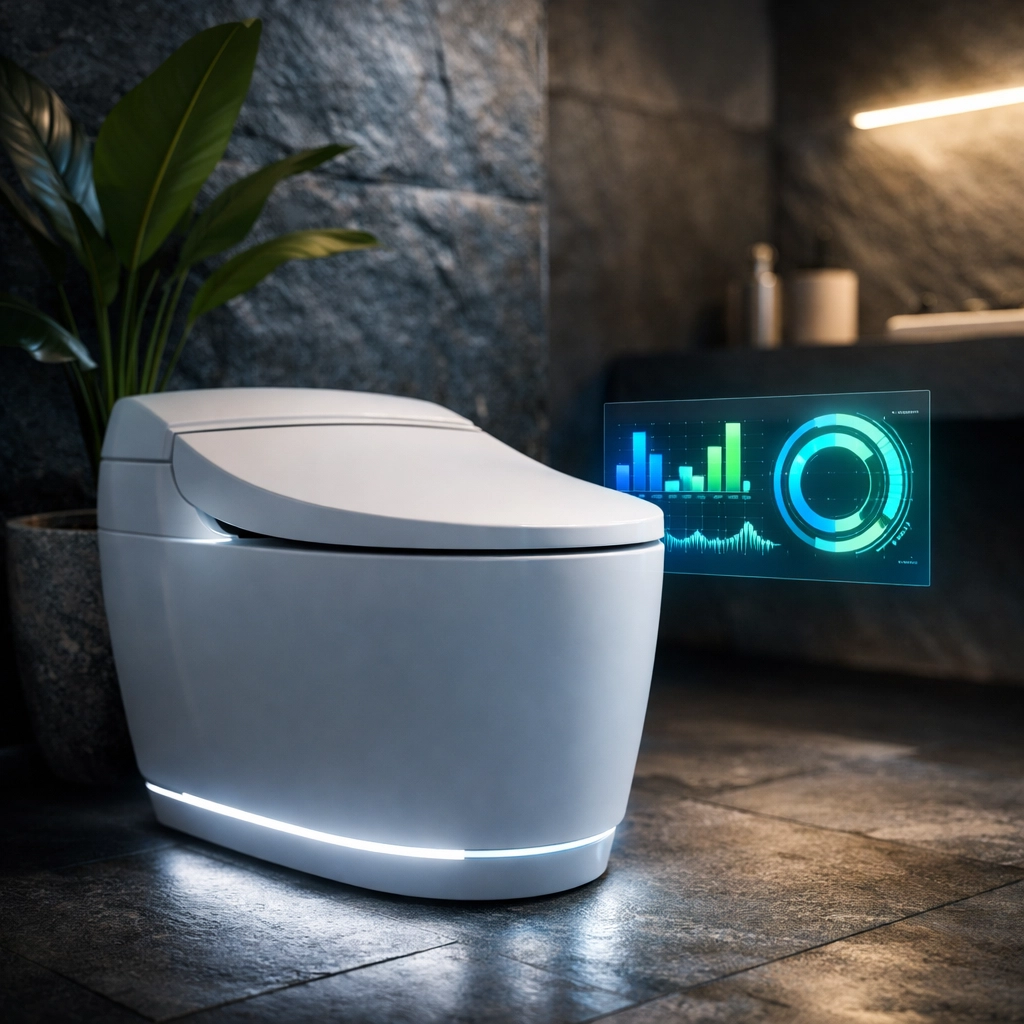
If the kitchen is the heart of the home, the bathroom is now the diagnostic center. The most technical and perhaps most impactful advancement in 2026 is the smart toilet.
While it sounds like a novelty, the medical implications are massive. These devices are equipped with spectrophotometry and biochemical sensors that perform automated urinalysis every time you use the bathroom.
What a 2026 Smart Toilet monitors:
- Hydration Levels: Specific gravity tracking to provide real-time hydration coaching.
- Protein and Glucose: Early detection of kidney issues or shifts in glycemic control, often before a standard blood test would be ordered.
- Sodium-to-Potassium Ratios: Vital for managing hypertension and cardiovascular health.
- Luteinizing Hormone: For those tracking fertility, providing a seamless, stick-free experience.
The tech has matured to include "uroflowmetry," which measures the strength and consistency of the urinary stream, a critical metric for prostate health in men and pelvic floor health in women. Instead of waiting for an annual physical, you have a 365-day dataset that your doctor can access via a secure portal.
Air Quality and the "Internal Biome"
We spend 90% of our time indoors, yet until recently, we had very little data on what we were breathing. In 2026, air quality monitors have evolved from simple CO2 sensors into "biome trackers."
High-end systems now utilize HEPA 14 filtration integrated with particulate matter (PM2.5 and PM1.0) sensors and Volatile Organic Compound (VOC) detectors. But the real 2026 edge is pathogen sensing. New sensors can now detect airborne viral loads and high concentrations of mold spores in real-time.
Technical Specifications of a 2026 Air Clinic Setup:
- Laser Particle Counters: Moving beyond estimates to count individual particles down to 0.1 microns.
- Formaldehyde (HCHO) Sensing: Critical for homes with new furniture or construction, preventing "Sick Building Syndrome."
- Automatic Mitigation: Your air purifier doesn't just turn on; it adjusts its CADR (Clean Air Delivery Rate) based on the specific type of pollutant detected.
If the system detects a spike in CO2, it doesn't just beep; it interfaces with your HVAC system to increase the fresh air intake, directly impacting your cognitive performance and sleep quality.
The IoT Health Stack: Connecting the Dots
A clinic is only as good as its records. In the smart home, the "records" are a series of interconnected IoT devices that create a holistic picture of your health.
The 2026 health stack typically includes:
- Continuous Glucose Monitors (CGMs): Now widely used by non-diabetics for metabolic optimization. These sync via Bluetooth Low Energy (BLE) to your smart fridge, suggesting meals based on your current blood sugar stability.
- Smart Scales with BIA: Bioelectrical Impedance Analysis has become significantly more accurate, measuring visceral fat, muscle mass per limb, and extracellular water.
- Medical-Grade ECG Rugs: Yes, even your floorboards are getting smart. Conductive fabrics in bedside rugs can now take an ECG reading the moment your bare feet touch the ground in the morning.

AI Diagnostics and the "Digital Twin"
The sheer volume of data generated by a smart home would overwhelm any human doctor. This is where the Digital Twin comes in. In 2026, your home health data is used to maintain a virtual model of your biology.
AI models (specifically Large Health Models or LHMs) analyze the correlations between your sleep, air quality, bathroom metrics, and activity levels. If your smart toilet detects a slight increase in protein and your Wi-Fi sensing notices your resting heart rate has risen by 5 BPM over three days, the AI doesn't just flag an error. It compares this to your "Digital Twin" history and might suggest you’re coming down with a specific viral strain, recommending a telehealth consult before you even feel "sick."
This shift from reactive to proactive care is the hallmark of 2026 medicine. We are moving away from "population averages" and toward "n-of-1" medicine, where the only baseline that matters is yours.
Infrastructure: Matter, Thread, and Security
To build a "clinic" at home, the underlying infrastructure must be rock-solid. In 2026, we’ve moved away from congested 2.4GHz Wi-Fi for health devices. Instead, we use Thread.
Thread is a mesh networking protocol that is low-power, self-healing, and has no single point of failure. If your main hub goes down, your smart health devices can still communicate with each other. This is crucial for "fall detection" systems or heart monitors where a 30-second lag could be life-threatening.
Security is the other pillar. In 2026, "Health-as-a-Service" providers use Zero-Knowledge Proofs (ZKPs). This allows your devices to verify you are meeting certain health goals (perhaps for an insurance discount) without actually uploading the raw biometric data to a corporate server. Your "Clinic Home" stays private.

Setting Up Your Home Clinic: A Step-by-Step Guide
If you're looking to upgrade your living space into a health-optimizing environment, don't try to do it all at once. Start with the foundation and scale up.
- Phase 1: The Air Foundation. Install a high-end air quality monitor (like the 2026 Awair or Dyson equivalents) that tracks PM1.0 and VOCs. Link this to your HVAC or a smart air purifier.
- Phase 2: The Sleep Lab. Move to ambient sleep tracking. Look for under-mattress piezo-electric sensors that provide medical-grade sleep staging without requiring a wearable.
- Phase 3: The Metabolic Bathroom. This is the biggest investment. A smart toilet or a retrofitted "lab-on-a-chip" device for your existing toilet will provide the most actionable daily data.
- Phase 4: Integration. Use a platform that supports Matter 2.0 to ensure all these data points can be aggregated into a single dashboard for your primary care physician.
The Future of Remote Patient Monitoring (RPM)
We are seeing a massive shift in how insurance companies view the home. In 2026, many providers are actually subsidizing the installation of smart home health tech. Why? Because a smart toilet that detects a UTI in an elderly patient costs the insurance company $50 for a round of antibiotics, whereas a hospital visit for a late-stage kidney infection costs $15,000.
The home clinic isn't just a luxury for the tech-obsessed; it’s becoming the standard of care for aging populations and those with chronic conditions. It provides a level of autonomy that was previously impossible, allowing people to "age in place" with the security of a 24/7 medical team: even if that team is made of silicon and sensors.

Final Thoughts
Turning your home into a clinic isn't about living in a sterile, hospital-like environment. It’s about the "invisible" integration of health technology into your daily flow. In 2026, the best health tech is the tech you don't even know is there. It’s the air you breathe being cleaned automatically, the toilet that checks your vitals, and the walls that monitor your heart.
As we continue to push the boundaries of what IoT and AI can do, our homes will stop being just shelters and start being the most powerful tools we have for longevity.
Author Bio:
Malibongwe Gcwabaza is the CEO of blog and youtube and a leading voice in the intersection of IoT infrastructure and preventative medicine. With over a decade of experience in digital transformation, Malibongwe focuses on how emerging technologies like Matter, Thread, and Edge AI can be harnessed to improve human longevity and decentralized healthcare. When not deep-diving into technical SEO or home automation, he explores the impact of "Frugal Optimism" on modern living.
About the Author


