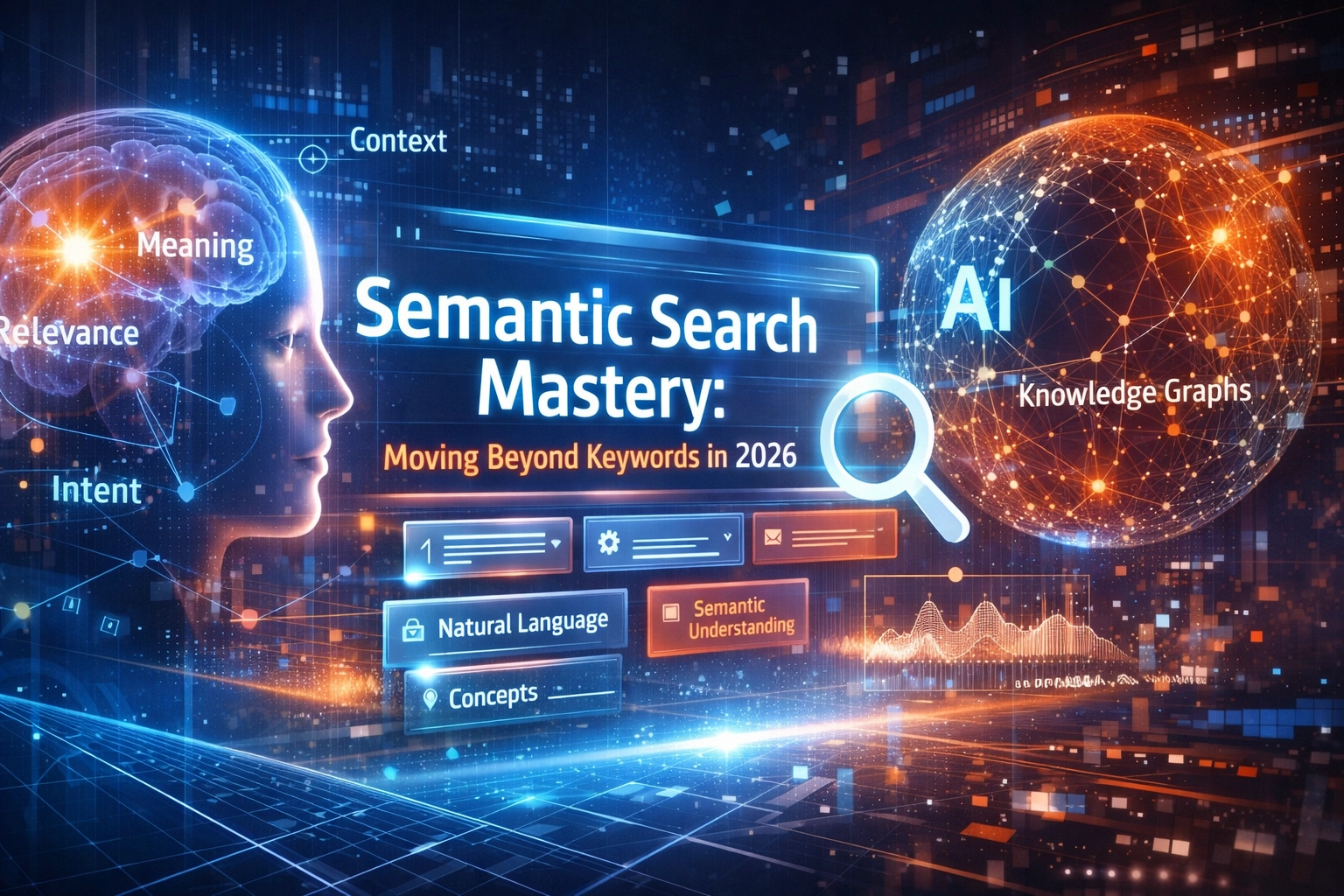
If you’re still obsessing over keyword density and H1 placements like it’s 2018, your traffic is likely living on borrowed time. By mid-2026, the search landscape has undergone a total structural transformation. We’ve moved from "strings" to "things."
The days of matching a specific phrase to a specific page are over. Today, search engines: and the Answer Engines (AEO) like Perplexity, Gemini, and Search Generative Experience (SGE) that have largely replaced traditional SERPs: don't care about your keywords. They care about your entities.
In this guide, we’re going to dismantle the old way of doing SEO and build a technical framework for semantic search mastery that actually survives the AI-driven shifts of 2026.
What is Semantic Search in 2026?
At its core, semantic search is the ability of a search engine to understand the intent and contextual meaning behind a query, rather than just the literal words. But in 2026, this has evolved. It’s no longer just about Google understanding that "jaguar" could mean a cat or a car. It’s about the Knowledge Graph.
Google’s Knowledge Graph is a massive database of entities (people, places, things, concepts) and the relationships between them. When a user searches for something, the engine isn't looking for a document that contains those words; it’s looking for the entity that best satisfies the user's underlying need.
To rank now, you don’t "target keywords." You "claim authority over entities."

The Shift from Keywords to Entities
An entity is a "thing or concept that is singular, unique, well-defined, and distinguishable." In the eyes of an AI crawler, "Malibongwe Gcwabaza" is an entity. "Blockchain" is an entity. "2026 Tax Laws" is an entity.
The goal of your content strategy shouldn't be to rank for "best crypto wallet." Instead, your goal is to prove to the Knowledge Graph that your brand is a primary authority on the entity of "Digital Asset Security."
Why Entities Matter for AdSense and AI
If your content is built on entities, AI systems can easily parse it, cite it, and include it in their generated answers. This is the only way to survive "Zero-Click" searches. When Gemini provides a summarized answer, it cites the sources that best define the relationships between the entities in the query. If your site provides the clearest "Entity-Relationship" data, you get the citation and the high-value traffic that follows.
The Three-Layer Semantic Keyword Strategy
While we say keywords are dead, the concepts behind them still guide our content. In 2026, we use a layered approach to ensure we cover the entire semantic field of a topic.
Level 1: The Core Entity (The What)
This is your primary topic. For example: "Sustainable Home Retrofitting." You don't just use this phrase; you define it. You explain its history, its current state in 2026, and why it matters.
Level 2: Thematic Context (The How)
These are related concepts that the Knowledge Graph expects to see near your core entity. If you’re talking about home retrofitting, the AI expects to see "heat pumps," "R-value insulation," "solar tax credits," and "smart thermostats." If these aren't present, the engine assumes your content is shallow.
Level 3: Stem Inquiries (The Why and Who)
These are the long-tail, intent-driven questions that users actually ask. "Is home retrofitting worth it in a rental?" or "How to finance a heat pump in 2026." This layer captures the actual human intent.

Answer Engine Optimization (AEO): Designing for Extraction
In 2026, we don't just write for humans; we write for extractability. AI models use "retrieval-augmented generation" (RAG) to find snippets of information. To be the snippet that gets picked, you need to structure your data with clinical precision.
The "Answer-First" Format
Stop burying the lead. The most successful semantic content in 2026 follows an inverted pyramid.
- Direct Answer: Within the first 100 words, provide a clear, concise definition or answer to the primary query.
- Supporting Data: Use tables, bullet points, and charts to provide structured evidence.
- Deep-Dive Analysis: This is where your 1,500+ word technical depth comes in for the humans who want to click through and learn more.
Semantic HTML and Schema.org
If you aren't using advanced Schema markup, you’re invisible. In 2026, basic Article schema isn't enough. You should be using:
aboutandmentionsproperties: These tell search engines exactly which entities your page covers.FAQPagemarkup: This remains vital for capturing "People Also Ask" and AI summary boxes.Speakableschema: With the rise of voice-activated AI assistants, marking sections of your text as "speakable" helps you dominate the audio search market.
Building Topic Clusters for Domain Authority
One-off blog posts are a relic of the past. To master semantic search, you must build Topic Clusters. This is a hub-and-spoke model that signals to Google that you have exhaustive knowledge on a subject.
- The Pillar Page: A comprehensive, high-level overview of a broad topic (e.g., "The Complete Guide to Remote Work in 2026").
- The Cluster Content: 10–20 sub-topic articles that dive deep into specifics (e.g., "Ergonomic Chairs for Small Studios," "Digital Nomad Tax Laws," "Best WiFi Hotspots in Lisbon").
- Interlinking: Every cluster article must link back to the pillar page using descriptive, semantic anchor text. Do not use "click here." Use "advanced tax strategies for nomads."

Technical Checks for an "AI-Friendly" Website
Your site’s technical infrastructure needs to be as clean as your content. AI crawlers are more demanding than old-school Googlebots.
- Natural Language Processing (NLP) Friendliness: Avoid overly complex sentences or flowery metaphors. Use clear, declarative language. AI models are trained on logic; if your writing is too abstract, the model may fail to categorize your entity correctly.
- Core Web Vitals 2.0: Speed is still a ranking factor, but "Interaction to Next Paint" (INP) is now the king of metrics. If your site feels sluggish when a user interacts with an AI-integrated search bar or widget, you will be penalized.
- Data Consistency: Ensure your NAP (Name, Address, Phone) and brand narrative are identical across LinkedIn, X (formerly Twitter), YouTube, and your blog. If the Knowledge Graph sees conflicting data about your brand "entity," it will lower your trust score.
E-E-A-T: The Human Element in a Machine World
Experience, Expertise, Authoritativeness, and Trustworthiness (E-E-A-T) are more important in 2026 than ever before. Why? Because AI can hallucinate facts, but it can't replicate human experience.
To stand out in a sea of AI-generated content, you must lean into the "Experience" part of the acronym.
- Case Studies: Show real results you achieved.
- First-Person Narrative: Use "I" and "We." Talk about your specific failures and successes.
- Expert Citations: Link to high-authority peer-reviewed journals or government data.

The Future of Search: Predictive Intent
As we move deeper into 2026, search is becoming predictive. Based on a user's past behavior and current context (location, time of day, device), AI engines are starting to suggest answers before the user finishes typing.
To optimize for predictive intent, you need to understand the User Journey. If someone searches for "how to start a newsletter," the predictive engine knows their next questions will be about "Beehiiv vs. Substack" and "email marketing laws." By having all those answers ready in a semantic cluster, you stay ahead of the curve.
Summary Checklist for 2026 Semantic Mastery
- Identify Entities: List the 5–10 core concepts your brand owns.
- Map the Graph: Use tools like Google’s NLP API to see how the engine perceives your current content.
- Implement Advanced Schema: Go beyond the basics with
aboutandmentions. - Optimize for AEO: Use an "Answer-First" structure in every post.
- Build Clusters: Connect every piece of content to a broader pillar.
- Humanize with E-E-A-T: Prove you aren't just a wrapper for a large language model.
Semantic search isn't a "trick" to get more traffic: it’s a commitment to being the most organized, authoritative source of information in your niche. If you provide the most value to the Knowledge Graph, the rankings will follow naturally.
About the Author
Malibongwe Gcwabaza is the CEO of blog and youtube, a media company dedicated to helping creators and businesses navigate the rapidly evolving digital landscape. With over a decade of experience in SEO, content strategy, and digital brand building, Malibongwe focuses on future-proofing businesses against AI disruption. When not analyzing the latest Google core updates, he’s exploring the intersection of technology and human-centric storytelling.
About the Author


