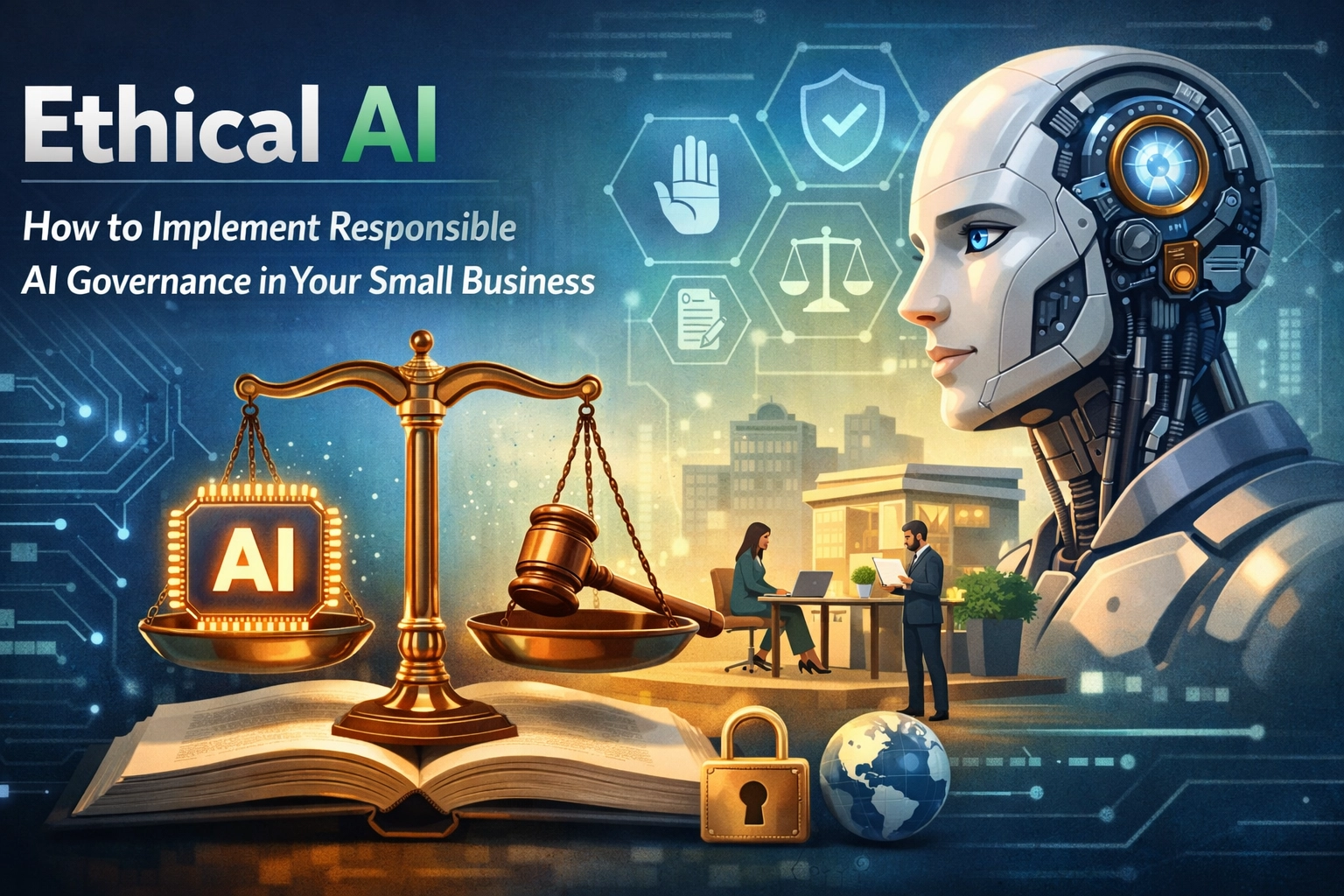
By March 2026, artificial intelligence is no longer a "future tech" roadmap item for small businesses: it is the baseline for operations. Whether you are using Claude to draft client proposals, Midjourney for your branding, or custom GPTs to handle customer support, AI is likely already touching every corner of your workflow.
However, as we move deeper into this decade, the "move fast and break things" era of AI has been replaced by a "move fast but stay compliant" era. For a small business, a single ethical lapse in AI: like a biased hiring algorithm or a data leak through a public LLM: can be a brand-ending event. Implementing responsible AI governance isn't just about being a "good person"; it’s about risk management, legal compliance, and building a moat of trust that your competitors might be ignoring.
The State of AI Ethics in 2026
In 2026, the regulatory landscape has matured. The EU AI Act has set a global precedent, and regional authorities are increasingly scrutinizing how businesses of all sizes handle automated decision-making. For small businesses, the challenge is double-edged: you don't have the massive legal departments of a Fortune 500 company, yet you are held to similar standards regarding data privacy and algorithmic fairness.
Ethical AI governance is the framework of rules, practices, and processes that ensure your company’s AI systems are used safely and fairly. It moves AI from a "black box" that produces magic results to a transparent tool that aligns with your company values.
The Three Pillars of Responsible AI Governance
Before you write a single line of policy, you need to understand the three pillars that support ethical AI:
- Fairness: Ensuring your AI outputs do not discriminate based on race, gender, age, or socioeconomic status. This is particularly critical if you use AI for recruitment, credit scoring, or customer segmentation.
- Transparency: Being open about when and how you use AI. If a customer is chatting with a bot, they should know it. If an article was AI-generated, it should be disclosed.
- Accountability: Establishing a clear "paper trail." If an AI makes a mistake that costs a client money or violates a privacy law, who is responsible? Hint: It’s never the machine.

Phase 1: The AI Readiness Audit
You cannot govern what you haven't identified. Most small business owners are surprised to find out just how many "shadow AI" tools their employees are using.
Step 1: Create an AI Inventory
Ask every team member to list the tools they use. This includes:
- Generative AI (ChatGPT, Claude, Jasper).
- Built-in AI features in existing software (Adobe Firefly, Microsoft 365 Copilot, Canva Magic Studio).
- Automation tools (Zapier, Make.com) that use AI modules.
Step 2: Categorize by Risk
Not all AI use cases are equal. Use a simple traffic light system:
- Green (Low Risk): Using AI to summarize internal meeting notes or brainstorm blog post titles.
- Yellow (Medium Risk): Using AI to write external communications, code, or marketing copy. These require human review.
- Red (High Risk): Using AI for anything involving PII (Personally Identifiable Information), financial advice, or hiring decisions. These require strict governance and potentially a "Human-in-the-Loop" (HITL) mandate.
Phase 2: Developing Your AI Ethics Policy
A responsible AI policy doesn't need to be 50 pages long. It needs to be actionable. For a small business, focus on these five core sections:
1. Approved Toolset
Explicitly list which AI tools are "company-approved." This allows you to vet the terms of service. For example, you might approve the "Enterprise" or "Team" versions of ChatGPT because they offer better data privacy (ensuring your data isn't used to train their models), while banning the free versions for business use.
2. The Disclosure Standard
In 2026, transparency is a competitive advantage. Create a "Disclosure Matrix."
- Full Disclosure: If a customer-facing chatbot is used.
- Partial Disclosure: If a blog post was AI-assisted but human-edited (e.g., "Written with the assistance of AI").
- No Disclosure: Internal brainstorming or grammar checking.
3. Data Privacy and "The Leak" Prevention
This is the most technical part of your governance. You must prohibit employees from pasting sensitive data: such as client lists, passwords, or trade secrets: into public AI prompts.
Technical Tip: If you are building custom solutions, use Retrieval-Augmented Generation (RAG). This allows the AI to "read" your company's private data without that data being sent to train the underlying LLM.
4. Fact-Checking and Hallucination Protocols
AI "hallucinates" (makes things up). Your policy should state that no AI-generated output can be published or sent to a client without a human verifying the facts, links, and data points.
5. Intellectual Property (IP) Safeguards
Currently, AI-generated content cannot be copyrighted in many jurisdictions. Your policy should outline how you will add "human authorship" to AI outputs to ensure your business maintains ownership of its creative assets.

Phase 3: Technical Implementation & Bias Mitigation
How do you actually stop an AI from being biased? It starts with the data and ends with the prompt.
Auditing for Algorithmic Bias
Small businesses often use third-party AI tools. Your governance should include a "Vendor Audit." Ask your AI vendors for their Model Card or transparency report. These documents explain what data the model was trained on and what measures were taken to reduce bias.
If you are using AI for hiring (e.g., screening resumes), perform a manual "blind test" once a month. Compare the AI’s top 10 candidates with a human recruiter’s top 10. If the AI is consistently filtering out a specific demographic, your system is biased and needs recalibration.
The Role of System Prompts
You can bake ethics into your AI at the prompt level. When setting up custom GPTs or API-based agents, use a System Prompt that enforces your values.
Example System Prompt:
"You are a customer service assistant for [Business Name]. You must provide helpful, accurate information. You are prohibited from making promises about discounts not listed in the official manual. You must treat all customers with equal respect and avoid any gendered or racial stereotypes. If a user asks a question about legal or medical advice, you must state that you are an AI and cannot provide professional advice."
Phase 4: Establishing Human Oversight (HITL)
The "Human-in-the-Loop" (HITL) model is the gold standard for responsible AI. It means that while AI does the heavy lifting, a human makes the final call.
In a small business, this might look like:
- Marketing: AI writes the draft; the Marketing Manager checks for brand voice and factual accuracy.
- Customer Support: AI drafts the response; the support agent clicks "Send" after a quick review.
- Coding: AI writes the function; a developer performs a security code review before deployment.
The "Red Team" Approach:
Every quarter, hold a "Red Team" meeting. Encourage your staff to try and "break" your AI or get it to say something unethical. This stress-testing helps you find loopholes in your governance before a customer does.

The Benefits of Ethical AI Governance
Why go through all this trouble?
- AdSense and SEO Compliance: Google’s E-E-A-T (Experience, Expertise, Authoritativeness, and Trustworthiness) guidelines favor content that shows clear human oversight. Transparent AI use helps maintain your search rankings.
- Customer Trust: In a world flooded with AI junk, customers will flock to brands that are honest about their tech.
- Future-Proofing: When stricter AI laws inevitably arrive in your local jurisdiction, you won’t have to scramble. You’ll already have the infrastructure in place.
Ethical AI Checklist for Small Business Owners
- Conducted an AI tool inventory.
- Categorized use cases by risk level (Green/Yellow/Red).
- Written and distributed an AI Ethics Policy.
- Ensured all team members are using "Privacy-First" versions of AI tools.
- Implemented a mandatory "Human-in-the-Loop" review process for external content.
- Set a schedule for quarterly AI audits.
Conclusion
Ethical AI is not a destination; it’s a practice. As the technology evolves from simple text generators to complex autonomous agents, the ethical challenges will only grow. By implementing a governance framework today, you are ensuring that your small business remains agile, compliant, and: most importantly: trusted.
Don't let the speed of AI blind you to the importance of the human touch. The most successful businesses in 2026 won't be the ones that use the most AI, but the ones that use AI the most responsibly.
About the Author: Malibongwe Gcwabaza
Malibongwe Gcwabaza is the CEO of blog and youtube, a forward-thinking digital agency specializing in bridging the gap between cutting-edge technology and human-centric storytelling. With over a decade of experience in digital strategy, Malibongwe focuses on helping small businesses navigate the complexities of AI, SEO, and content automation. He believes that technology should empower people, not replace them, and advocates for "simple" solutions to complex digital problems. When he's not refining AI workflows, he's exploring the intersection of tech and remote work culture across Africa.
About the Author


