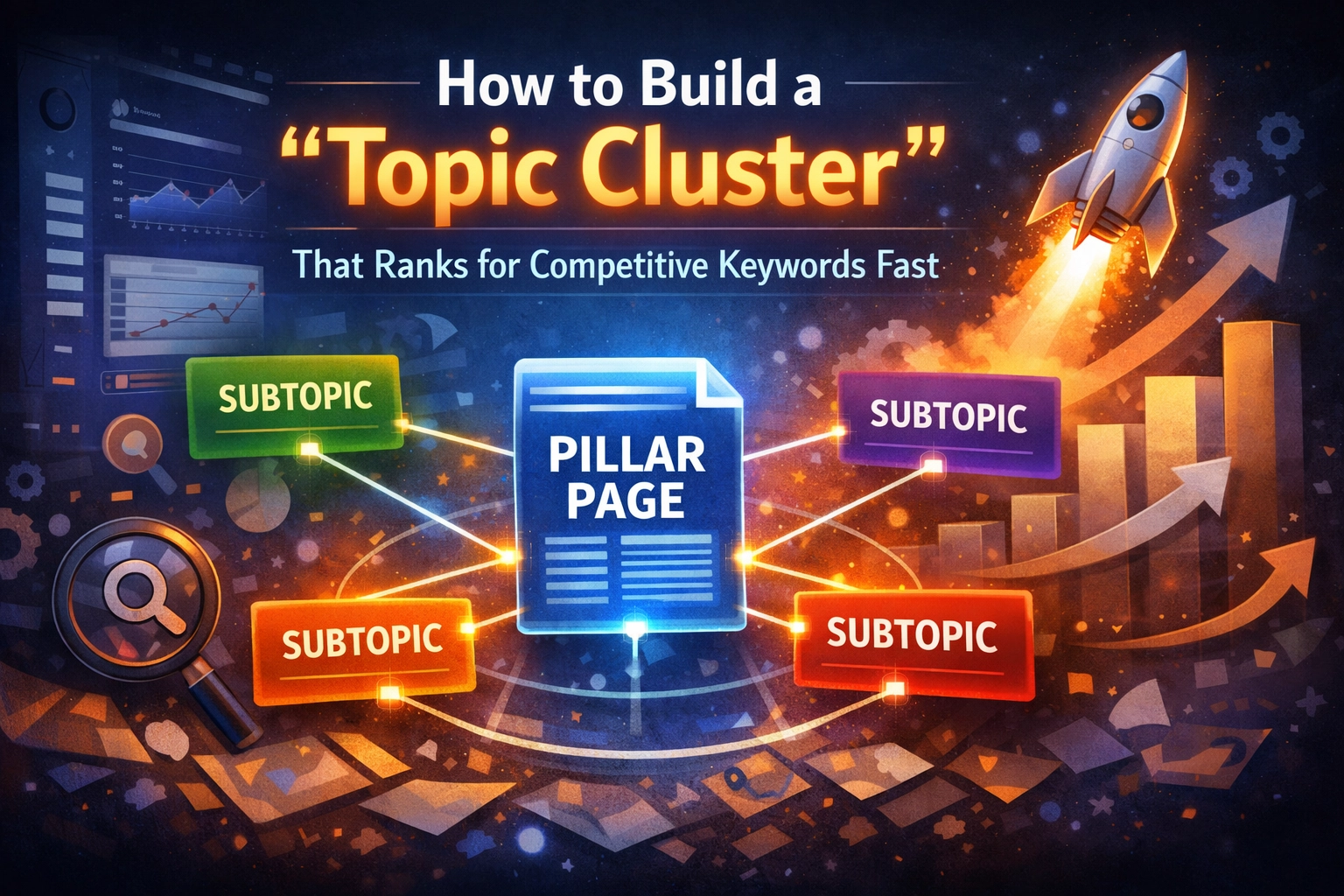
In the current landscape of search engine optimization, the traditional "one keyword, one page" strategy has become a relic of the past. As search engines like Google transition toward entity-based indexing and Generative Engine Optimization (GEO), the focus has shifted from matching strings of text to understanding the depth of a website's expertise. To rank for high-competition keywords today, you need more than just a well-optimized page; you need a Topic Cluster.
A topic cluster is a strategic grouping of content that covers a broad subject in-depth. By creating a central "Pillar Page" supported by several related "Cluster Content" pages, all interconnected through a deliberate internal linking structure, you signal to search engines that your site is a definitive authority on the subject. This approach doesn't just rank one page; it lifts the organic visibility of your entire site.
The Architecture of a Winning Topic Cluster
Before diving into the execution, it is critical to understand the three core components of this framework:
- The Pillar Page: A comprehensive resource page that covers a core topic in depth. It targets high-volume, broad keywords.
- Cluster Content (Spoke Pages): More specific, long-tail articles that dive into the nuances of subtopics mentioned on the pillar page.
- Internal Links: The "glue" that connects the spokes to the pillar and vice versa, distributing PageRank and context throughout the cluster.

Step 1: Identifying Your Pillar Topic with Data-Driven Precision
Not every keyword deserves a topic cluster. To rank fast, you must choose a pillar topic that sits at the intersection of business value, search demand, and your current "topical baseline."
Evaluating Business Value (BV)
Rate your potential topics on a scale of 1 to 5 based on how likely they are to convert. If you are a SaaS company, a pillar page about "Project Management Frameworks" has higher BV than "History of the Office Cubicle."
Analyzing Search Demand and Competition
Use tools like Ahrefs, SEMrush, or Google Keyword Planner to find broad terms with high monthly search volume (MSV). However, do not target the most competitive term immediately. Instead, look for "Parent Topics" where the top-ranking sites have a low Domain Rating (DR) or where the content is outdated.
Pro Tip: Look for "Content Gaps." If the top results for "Digital Marketing for Small Business" are all generic lists, there is an opportunity to create a technical, data-heavy pillar that provides more utility.
Step 2: Mapping the Cluster Using Semantic Intelligence
Once you have your pillar topic (e.g., "Remote Team Management"), you need to identify 10 to 15 subtopics. These are your cluster pages. To find these, move beyond basic keyword research and look into semantic relationships.
Using Search Generative Experience (SGE) for Clues
Look at the "People Also Ask" sections and the AI-generated summaries in Google. These are direct indicators of what Google considers semantically related to your core topic.
Mining "Zero-Volume" Keywords
Don't be afraid of keywords with low reported volume in SEO tools. Often, these represent specific user pain points. Check Reddit, Quora, and industry-specific forums. For "Remote Team Management," a cluster page might be: "How to handle asynchronous time zones in Scrum." This might only have 50 searches a month, but it establishes incredible topical authority.

Step 3: Engineering the Pillar Page for Maximum "Stickiness"
Your pillar page must be the most comprehensive resource on the internet for that topic. If a reader lands there, they shouldn't need to click back to the search results to find more information.
The Technical Structure of a Pillar Page
- Word Count: Usually 3,000+ words.
- Interactivity: Include a clickable Table of Contents (TOC) with anchor links. This helps Google’s crawlers understand the hierarchy.
- Breadth over Depth: Mention every sub-topic briefly, then link to the dedicated cluster page for the "deep dive."
- Media Enrichment: Use original charts, infographics, and embedded videos. This increases "Dwell Time," a key signal for ranking.
Example Pillar Structure: "The Ultimate Guide to SEO in 2026"
- H1: The Ultimate Guide to SEO in 2026
- H2: Technical SEO Fundamentals (Link to Cluster Page)
- H2: On-Page Optimization & Content Clusters (Link to Cluster Page)
- H2: Off-Page Authority Building (Link to Cluster Page)
- H2: The Role of AI and GEO (Link to Cluster Page)
Step 4: Mastering the Internal Linking Strategy
Internal links are the most underrated lever in SEO. In a topic cluster, they serve a specific purpose: telling Google which page is the "boss."
The "Power Link" Protocol
- Cluster to Pillar: Every single cluster page must link back to the pillar page using a descriptive anchor text (e.g., "read our guide on remote management").
- Pillar to Cluster: The pillar page should link out to every cluster page within the relevant section.
- Cross-Cluster Linking: Cluster pages should link to each other only if they are directly relevant. Over-linking can dilute the focus.

Anchor Text Optimization
Avoid generic "click here" text. Use exact-match or partial-match keywords for your internal links. This helps search engines associate specific entities with your URLs. For example, use "SaaS content strategy" as the anchor text rather than "this article."
Step 5: Leveraging Technical SEO and Schema Markup
To rank competitive keywords fast, you need to make it as easy as possible for search engines to parse your cluster.
Schema Markup
Use CollectionPage schema for the pillar page to indicate it is a curated list of resources. For cluster pages, use Article or BlogPosting schema. If the cluster page answers a specific question, implement FAQPage schema to take up more "real estate" on the Search Engine Results Page (SERP).
Core Web Vitals (CWV)
Because topic clusters involve high-word-count pages with many images, performance can suffer. Ensure you are using:
- Next-gen image formats: (WebP or AVIF).
- Lazy Loading: For images and videos below the fold.
- CDN: To serve content faster to a global audience.

Step 6: Monitoring Velocity and Adjusting for Results
SEO is not "set it and forget it." Use Google Search Console (GSC) to monitor the "Impression Velocity" of your cluster.
The "Near-Miss" Strategy
After 60 days, check GSC for keywords where your cluster pages are ranking in positions 11–20. These are your "near-misses." Update these specific pages with more data, better images, or fresh quotes from experts to push them into the Top 3.
If the pillar page isn't ranking, but several cluster pages are, it’s a sign that your pillar page needs more "internal link juice" from other sections of your site, or perhaps the content isn't authoritative enough compared to the spokes.
Case Study: From Position 50 to Top 3 in 90 Days
Consider a financial blog targeting the keyword "Passive Income Ideas." This is one of the most competitive terms on the internet.
Instead of writing one giant post, they built a cluster:
- Pillar: The Comprehensive Guide to Building Passive Income.
- Cluster 1: High-Yield Dividend Stocks for Beginners.
- Cluster 2: How to Rent Out Real Estate Using Management Apps.
- Cluster 3: Creating and Scaling a YouTube Channel.
- Cluster 4: Automated Dropshipping Models.
By linking all four specific guides back to the "Passive Income Ideas" pillar, the site demonstrated deep expertise. Within three months, the pillar page moved from the fifth page of Google to the first, as Google recognized the site didn't just have one good article: it had a library of expertise.

Why Clusters are Vital for AdSense Approval
If your goal is Google AdSense approval, topic clusters are your best friend. Google’s manual reviewers and algorithms look for "High Value Content." A site that demonstrates a logical structure, deep expertise, and a clear user journey is much more likely to be approved than a site with 50 unrelated articles. Topic clusters prove that you are running a professional publication, not a "thin content" farm.
The Bottom Line
Building a topic cluster requires more upfront planning than writing a single blog post, but the ROI is significantly higher. By focusing on topical authority rather than individual keywords, you insulate your site against algorithm updates and build a sustainable competitive advantage. Start by identifying your pillar, map your semantic spokes, and link them with surgical precision.
About the Author: Malibongwe Gcwabaza
Malibongwe Gcwabaza is the CEO of blog and youtube, a leading digital strategy firm specializing in content architecture and organic growth. With over a decade of experience in the SEO industry, Malibongwe has helped hundreds of brands transition from fragmented keyword targeting to authoritative topic clustering. His data-driven approach focuses on merging technical SEO with simple, effective communication, ensuring that high-level strategies translate into tangible business results. When he isn't analyzing search trends, he is passionate about mentoring the next generation of digital creators and entrepreneurs.
About the Author


