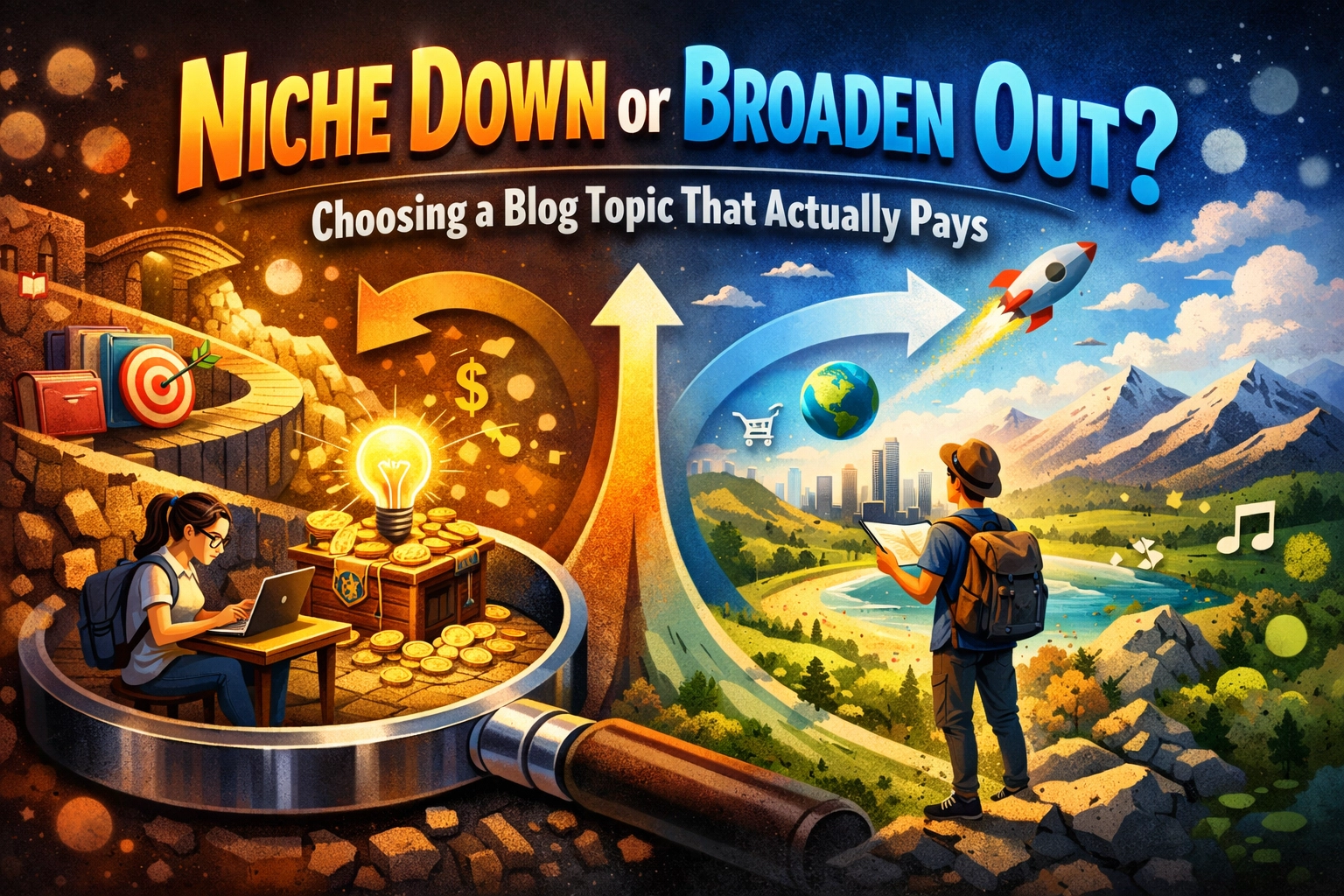
In the early days of blogging, you could write about your morning coffee, your weekend hike, and a tech review all on the same site and still find an audience. In 2026, that approach is a recipe for digital invisibility. The "lifestyle blog" that covers everything is largely dead, replaced by hyper-focused authorities that Google can easily categorize and trust.
If you want to build a blog that generates consistent revenue through AdSense, high-ticket affiliate marketing, or direct sponsorships, you face a critical crossroads: Do you niche down into a tiny corner of the internet, or do you broaden your scope to capture more traffic?
The data is clear: Profitability lives in the specific. Here is how to choose a topic that doesn't just satisfy your passion but actually pays the bills.
The Myth of "Write What You Love"
We have all heard the advice: "Follow your passion and the money will follow." In the world of content business, this is dangerous half-truth. Passion is necessary for consistency: you won't write 100 posts about a topic you hate: but passion without market demand is just a hobby.
To build a profitable blog, you need to find the intersection of three things:
- Your Expertise/Interest: Can you write 50 high-quality articles on this without burning out?
- Search Volume: Are people actually looking for help in this area?
- Commercial Intent: Are there products, services, or software that people buy to solve these problems?
If you love 18th-century French poetry, you have expertise and passion. However, the commercial intent is near zero. If you focus on "AI-driven productivity workflows for remote project managers," you have entered a high-value niche where companies are willing to pay for software (SaaS) and tools, leading to much higher revenue per visitor.

Why Niche Blogs Outperform General Sites in 2026
Google’s search algorithms have evolved to prioritize E-E-A-T (Experience, Expertise, Authoritativeness, and Trustworthiness). When you try to cover "Technology" as a whole, you are competing with giants like Verge or Wired. You will lose.
However, if you focus exclusively on "Solar-powered camping gear for off-grid enthusiasts," you can become the undisputed authority in that micro-segment.
1. Higher AdSense RPMs
Advertisers bid higher to appear on sites that are highly relevant to their products. A general news site might see an RPM (Revenue Per Mille/1,000 views) of $2 to $5. A specialized site focusing on "Enterprise Cybersecurity Software" can see RPMs exceeding $50 because the advertisers are fighting for a very specific, high-value lead.
2. The Power of "Solution-Based" Content
Broad topics like "Travel" are informational. Specific topics like "Budgeting for Digital Nomad Families in Southeast Asia" are solution-based. People searching for the latter are closer to making a purchase decision (travel insurance, gear, flight aggregators), which translates to higher conversion rates for your affiliate links.
3. Ease of Ranking
It is significantly easier to rank for long-tail keywords. "Best laptop" is impossible to rank for. "Best lightweight laptop for architecture students using Revit" is a keyword you can win with one deep-dive, high-quality post.
Identifying Profitable Sub-Niches
If you start with a broad category, you must "drill down" at least three levels. Here is what that looks like in practice:
-
Level 1 (Too Broad): Food
-
Level 2 (Better): Vegan Food
-
Level 3 (Profitable Niche): Budget-friendly vegan meal prep for college students.
-
Level 1 (Too Broad): Finance
-
Level 2 (Better): Investing
-
Level 3 (Profitable Niche): Dividend growth investing for early retirees in their 30s.
By the time you reach Level 3, you have a defined audience with specific pain points. You aren't just a "food blogger"; you are a resource for a specific person with a specific problem.

Validating Your Niche: The 3-Step Research Framework
Before you buy a domain name and write your first 2,000-word guide, you need to validate that the niche has "legs."
Step 1: The Keyword "Floor" and "Ceiling"
Use a tool like Ahrefs, Semrush, or even the free Google Keyword Planner. Look for the "seed" keywords of your niche.
- The Floor: Are there at least 10–20 related keywords with a search volume of 100–500 per month? (These are your easy wins).
- The Ceiling: Is there a "big" keyword in the niche with 10k+ searches? (This represents your long-term growth potential).
Step 2: The Affiliate Audit
Search for "[Your Niche] + affiliate program." If you see high-quality SaaS products offering 20-30% recurring commissions, or physical products on Amazon with high price tags (over $100), you have found a goldmine. For example, the health-tech sector: specifically women's wearables and biohacking tools: is currently seeing massive growth and offers high-margin affiliate opportunities.
Step 3: The Competition Check
Search for your top 5 keyword ideas on Google. If the first page is filled with massive sites like Forbes, Wikipedia, and Reddit, the niche might be too broad or competitive. If you see smaller, specialized blogs or outdated forums, that is your signal to enter. You can beat them by providing more current, more technical, and better-formatted content.

When (and How) to Broaden Out
"Niche down" is the strategy for growth, but it doesn't have to be the ceiling for your brand. Once you have "owned" your specific corner: meaning you rank in the top 3 for most of your target keywords: you can begin the Hub and Spoke expansion.
If your niche was "Budget-friendly vegan meal prep for college students," you can eventually broaden out to "Vegan meal prep for busy professionals." You have already built the domain authority and trust in the vegan cooking space; now you are just applying that authority to a slightly wider demographic.
The mistake most bloggers make is trying to be everything to everyone on day one. Start as a sniper, not a shotgun.
Optimizing for AdSense and User Experience
To maximize your earnings once you’ve picked your niche, your content structure matters as much as the topic.
- High Intent Headers: Use H2 and H3 tags that mirror search queries. Instead of "Conclusion," use "Which [Product] is Right for You?"
- Technical Depth: Avoid thin content. A 500-word post tells Google you aren't an expert. A 2,000-word post with data, personal testing, and original images tells Google (and AdSense advertisers) that your site is a premium placement.
- Formatting for "Skimmers": Most readers want the answer fast. Use bullet points, bold text for key takeaways, and summary boxes. Ironically, the longer they stay on the page to read your deep-dive content, the more ad impressions you generate.

Final Thoughts: The Riches are in the Niches
Choosing a blog topic isn't just about what you want to say; it’s about what the market needs to hear. In 2026, the most successful bloggers are those who act like specialist consultants rather than general journalists. Find a problem that people are willing to pay to solve, narrow your focus until the competition disappears, and then provide the most in-depth, high-value response available on the internet.
About the Author
Malibongwe Gcwabaza is the CEO of blog and youtube. With over a decade of experience in digital publishing and content strategy, Malibongwe focuses on building sustainable, high-authority digital assets. He specializes in niche validation and helping creators transition from hobbyists to business owners through data-driven content frameworks and advanced monetization strategies. Under his leadership, blog and youtube has become a leading resource for creators looking to navigate the evolving landscape of SEO and digital entrepreneurship.
About the Author


