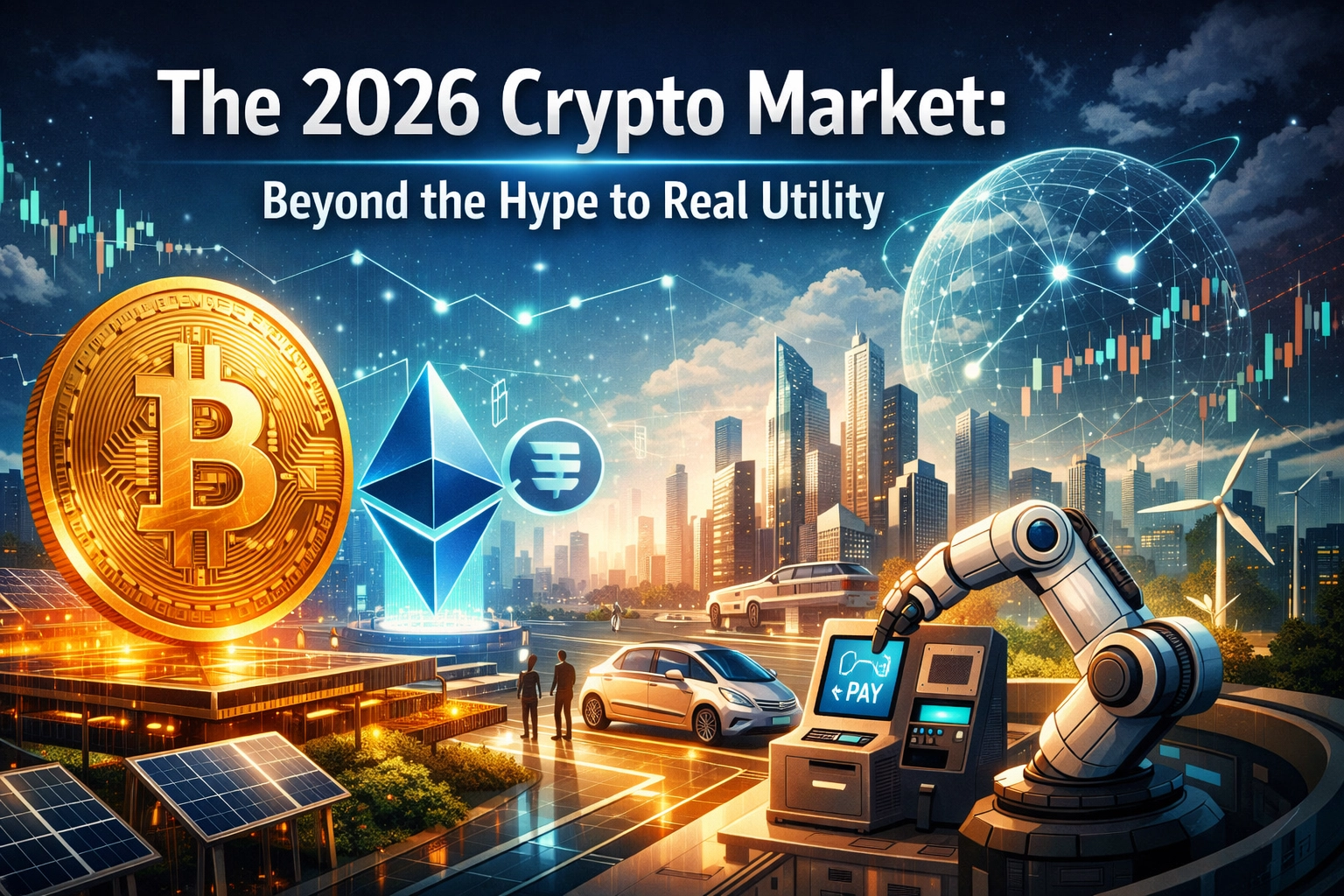
By March 2026, the digital asset landscape has undergone a fundamental structural shift. The era of "blind speculation": where retail investors threw capital at any token with a catchy ticker: has largely been replaced by an era of "institutional utility." If 2021 was defined by NFTs and 2024 by the arrival of the Spot ETFs, 2026 is defined by the integration of blockchain into the plumbing of global finance.
We are no longer asking if crypto is useful; we are measuring how much cost it shaves off a cross-border settlement or how much liquidity it adds to private credit markets. This isn't just a change in sentiment; it's a change in the very math of the market.
The Stablecoin Sovereignty: The Internet’s Dollar
In 2026, stablecoins have officially graduated from being "trading collateral" to becoming "payment infrastructure." We’ve moved past the $500 billion total value locked (TVL) mark for stablecoins, and the trajectory toward $2 trillion is becoming clearer.
The primary driver here is the shift toward B2B settlement. Traditionally, moving $10 million across borders via the SWIFT network could take 3-5 business days and cost thousands in intermediary fees. Today, enterprises are using stablecoins like USDC and regulated Euro-backed tokens to settle these transactions in seconds for a fraction of the cost.

What’s changed in 2026 is the regulatory clarity. With the full implementation of frameworks like MiCA in Europe and the clarity provided by the "Project Crypto" legislative push in the US, corporations can now hold stablecoins on their balance sheets without the fear of a sudden regulatory crackdown. We are seeing "Programmable Money" in action: where a payment is automatically released only when a bill of lading is digitally signed, removing the need for traditional letters of credit.
Real-World Asset (RWA) Tokenization: The "Killer App" of 2026
If you want to understand where the smart money moved in 2026, look at Real-World Assets (RWAs). The tokenization of "off-chain" value is no longer a pilot program; it is a multi-billion dollar industry.
Tokenized Treasuries and Private Credit
In a world where interest rates remain a key focus, the ability to hold tokenized U.S. Treasuries that earn yield in real-time is a game-changer. Small-to-medium enterprises (SMEs) that were previously locked out of high-yield institutional products can now buy fractionalized shares of government bonds.
Data from the first quarter of 2026 shows that tokenized private credit has doubled in volume compared to 2025. This allows for:
- Instant Liquidity: You can exit a "loan" position by selling the token on a secondary market rather than waiting for a 5-year maturity.
- Fractional Ownership: Investing $1,000 into a commercial real estate bond that previously required a $100,000 minimum.
- Transparency: Every interest payment and principal repayment is visible on-chain, reducing the "black box" risk of traditional private equity.

The "Innovation Exemption" and Institutional Reallocation
A massive catalyst for the 2026 market has been the SEC’s "Innovation Exemption." This policy allows for the trading of tokenized equities under a modified regulatory framework, effectively merging the stock market with the blockchain.
We are seeing a massive reallocation of capital. Institutional investors aren't just buying Bitcoin as "Digital Gold" anymore. They are moving into Ethereum and Solana-based protocols because they want exposure to the network fees generated by these RWA and stablecoin transactions. In 2026, "Yield" is the metric that matters. If a protocol facilitates $10 billion in monthly RWA volume, the token holders governing that protocol have a tangible, cash-flow-producing asset.
AI and On-Chain Intelligence: The Rise of the Agentic Economy
2026 is the year AI agents became the primary users of the blockchain. We’ve moved beyond humans clicking buttons on MetaMask.
Advanced AI platforms are now integrated with on-chain data to provide institutional-grade research and execution. These "AI Agents" manage DAO treasuries, execute complex arbitrage across decentralized exchanges (DEXs), and even negotiate credit terms between protocols.

The intersection of AI and Crypto solves two major problems:
- Verification: Using Zero-Knowledge (ZK) proofs to verify that an AI model hasn't been tampered with.
- Payments: AI agents don't have bank accounts. They have crypto wallets. When an AI needs to "rent" more GPU power or buy data, it pays in stablecoins. This "machine-to-machine" economy is a significant portion of the transaction volume we see in 2026.
Privacy vs. Compliance: The ZK-Proof Middle Ground
For years, the crypto industry struggled with the tension between privacy and the "Know Your Customer" (KYC) requirements of big banks. In 2026, Zero-Knowledge Proofs (ZK-proofs) have solved this.
Institutions are now using "Privacy-Enabled Compliance." This allows a user to prove they are a "verified accredited investor" or "not on a sanctions list" without revealing their specific identity or their entire transaction history to the public. This breakthrough has allowed pension funds and sovereign wealth funds: who require absolute privacy for their strategies: to finally enter the DeFi (Decentralized Finance) space in a big way.
Prediction Markets: The New Source of Truth
Prediction markets like Polymarket were once seen as a niche for political junkies. In 2026, they have evolved into the world's most accurate "Oracle" for real-world events.
Corporations are using these markets to hedge against supply chain disruptions, weather events, and geopolitical shifts. Because these markets are globally accessible and have "skin in the game," they often provide more accurate data than traditional polling or expert analysis. For a trader in 2026, the "Price of Truth" is found on-chain.

Technical Infrastructure: L2s and Interoperability
The "User Experience" (UX) hurdle has finally been cleared. In 2026, most users don't even know they are using a blockchain. Layer 2 (L2) and Layer 3 (L3) solutions have made transactions nearly free and instantaneous.
Interoperability protocols have matured to the point where moving an asset from Ethereum to Solana or a private bank chain (like JPMorgan’s Onyx) is a one-click process. The "fragmentation" of liquidity that plagued the market in 2023 and 2024 has been largely solved by intent-centric architecture: where you simply tell the wallet what you want to do, and the back-end finds the best path across multiple chains to execute it.
The Risks: What to Watch Out For
Despite the maturity, 2026 isn't without its challenges. The primary risks have shifted from "outright scams" to "systemic infrastructure risks."
- Centralization of Sequencers: As we rely more on L2s, the decentralization of the "sequencers" that order transactions is a major technical debate.
- Regulatory Divergence: While the US and EU have provided clarity, other regions remain fragmented, creating "regulatory havens" that could lead to systemic imbalances.
- AI Collusion: The rise of AI agents trading on-chain introduces the risk of algorithmic flash crashes that happen faster than human intervention can stop them.
Conclusion: The New Normal
The crypto market of 2026 is a boring, high-efficiency, multi-trillion dollar financial layer. The "get rich quick" noise has faded, replaced by the steady hum of millions of transactions per second moving value across the globe.
For the investor, the focus has shifted from "Which coin is going to 100x?" to "Which protocol is the most efficient at processing RWA settlements?" It’s a market driven by data, utility, and institutional adoption. The hype is dead; the real work has begun.
About the Author: Malibongwe Gcwabaza
Malibongwe Gcwabaza is the CEO of blog and youtube, a leading digital consultancy specializing in the intersection of emerging technology and financial infrastructure. With over a decade of experience in digital strategy and a deep focus on blockchain economics, Malibongwe has become a trusted voice for institutions navigating the transition to Web3. Under his leadership, blog and youtube provides data-driven insights and technical roadmaps for enterprises looking to leverage decentralized technology for real-world utility. When he isn't analyzing on-chain metrics, he’s passionate about simplifying complex tech for the next generation of digital entrepreneurs.
About the Author


