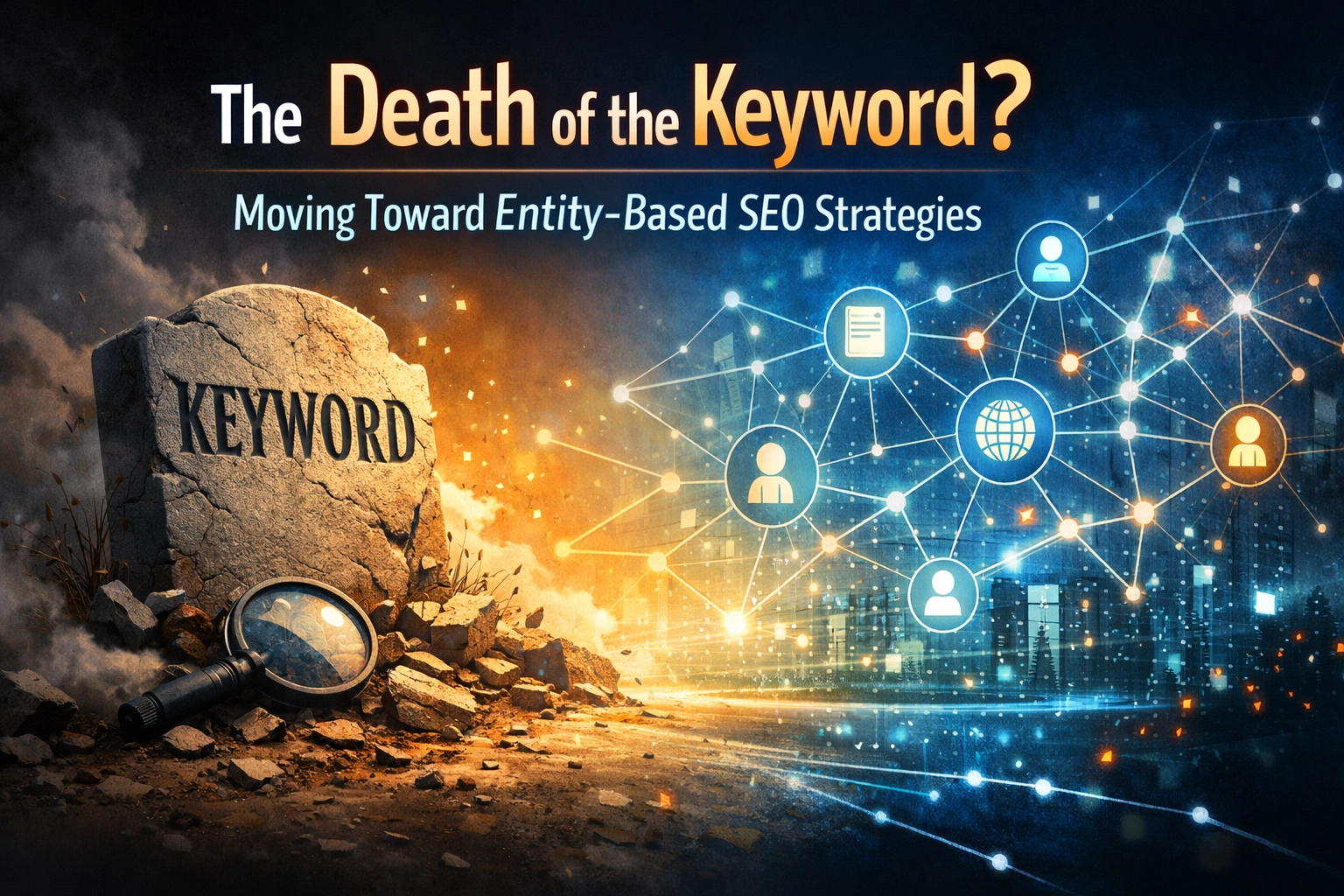
For nearly two decades, the "keyword" was the undisputed king of search engine optimization. SEO professionals spent countless hours inside tools like Ahrefs or Semrush, hunting for high-volume, low-difficulty strings of text. If you wanted to rank for "best coffee maker," you ensured that exact phrase appeared in your H1, your first paragraph, and your meta description.
But as we navigate through 2026, the fundamental architecture of search has shifted. We are no longer optimizing for "strings": collections of characters: but for "things": entities with defined relationships and context.
This isn't just a subtle change in the algorithm; it is a total paradigm shift. Google, Bing, and the rising tide of AI-first search engines (like Perplexity and OpenAI’s SearchGPT) now operate on Knowledge Graphs. They don't just see words; they see a web of interconnected concepts. If you are still building your content strategy around a spreadsheet of keywords, you are effectively speaking a dead language to a modern AI.
Understanding the Shift: From Strings to Things
The phrase "strings to things" was first coined by Google back in 2012 with the introduction of the Knowledge Graph. However, it took over a decade of advancements in Natural Language Processing (NLP), specifically the development of Large Language Models (LLMs) and Transformers (like BERT and MUM), for this vision to fully materialize.
In the old world (Keyword SEO), a search engine looked for the presence of specific words. In the new world (Entity SEO), the search engine attempts to understand the identity of the subject.
What is an Entity?
Technically speaking, an entity is any object or concept that can be uniquely identified. It doesn't have to be a physical object like "The Eiffel Tower." It can be a person (Malibongwe Gcwabaza), a place (Johannesburg), an idea (Capitalism), or even a color (Electric Blue).
Google assigns these entities a unique ID (formerly known as a Machine-Readable Entity ID or MREID). When you write about "Apple," Google uses the surrounding "entities" in your content to disambiguate the term. If your page also mentions "Steve Jobs," "Silicon Valley," and "iOS," Google knows with 99.9% certainty you are talking about the tech giant, not the fruit.

The Technical Backbone: Knowledge Graphs and Triples
To understand how to rank in 2026, you need to understand how search engines store information. They use a structure called a "triple." A triple consists of a Subject, a Predicate (or relationship), and an Object.
- Subject: Tesla
- Predicate: CEO is
- Object: Elon Musk
By connecting millions of these triples, search engines create a dense web of information. When a user asks a question, the search engine doesn't just look for pages that contain the words in the question; it traverses its Knowledge Graph to find the most authoritative "nodes" related to those entities.
This is why "Entity-Based SEO" is more resilient than keyword SEO. If you establish your brand as a recognized entity within a specific niche (e.g., "Sustainable Gardening"), you will rank for thousands of related queries, even if you never specifically targeted those exact keywords.
Why Keyword Research is Evolving into Entity Mapping
Traditional keyword research is linear. You find a word, check its volume, and write a post. Entity mapping is multidimensional.
Instead of asking, "What keywords should I target?" you should be asking, "What entities are most closely related to my core topic, and how can I demonstrate my expertise across that entire map?"
How to Perform Entity Mapping:
- Identify Core Entities: Start with your main topic.
- Identify Related Attributes: If your topic is "Remote Work," related entities include "Zoom," "Digital Nomads," "Ergonomic Chairs," "Asynchronous Communication," and "Slack."
- Analyze the Gap: Look at the top-ranking results for your target topic. Use tools like Google’s Natural Language API demo to see which entities Google extracts from those pages. If the top results all mention "Cybersecurity for Remote Teams" and you don't, you have an entity gap.

Structured Data: Speaking the Search Engine’s Native Language
If you want to move toward entity-based SEO, Schema Markup (Structured Data) is no longer optional. It is the direct line of communication between your server and the search engine's Knowledge Graph.
While many sites use basic "Article" or "Product" schema, advanced entity SEO requires using sameAs and about properties within your JSON-LD.
- The
sameAsAttribute: This tells Google exactly which entity you are. For example, if you are writing about a specific software, you should link to its Wikipedia page or its official social media profiles within your Schema to "bridge" your content to a known entity in Google's graph. - The
mentionsAttribute: This allows you to explicitly state which entities are discussed in your post, removing any guesswork for the crawler.
By providing this structured context, you increase your "Entity Salience": a score that determines how central an entity is to a specific piece of text.
The Role of E-E-A-T in Entity SEO
In 2026, Google’s E-E-A-T (Experience, Expertise, Authoritativeness, and Trustworthiness) is the mechanism used to verify the "authority" of an entity.
Google doesn't just want to know what was said; it wants to know who said it. Authors are entities. Brands are entities. When a recognized "Expert" entity writes a piece of content, that content inherits the authority of the author's node in the Knowledge Graph.
This is why generic, AI-generated content often fails to rank long-term. It lacks a connection to a trusted, verifiable entity. To succeed, you must:
- Build a robust "About Us" page that links to external proof of expertise.
- Ensure every author has a detailed bio with links to their other works and social profiles (establishing them as a "Person" entity).
- Get mentioned (not just linked to) on other authoritative sites within your niche.

Topic Clusters: Building Your Own Internal Knowledge Graph
The most effective way to implement entity-based SEO is through "Topic Clusters." Instead of publishing 50 random articles, you create a "Pillar Page" (the core entity) and surround it with "Cluster Content" (related sub-entities).
For example, if your Pillar Page is "The Future of AI," your cluster content might include:
- "The Impact of LLMs on SaaS"
- "Neural Networks vs. Deep Learning"
- "Ethical Implications of Generative AI"
By interlinking these pages, you are signaling to Google that your website is a comprehensive source of information for that specific "cluster" of entities. This builds "Topical Authority," which allows you to rank for competitive terms much faster than a site posting disconnected content.
Measuring Success Beyond Keyword Rankings
If the keyword is dying, then "Keyword Rankings" as a primary KPI must also evolve. In an entity-first world, we should track:
- Topical Visibility: What percentage of the "entity map" do you cover compared to competitors?
- Knowledge Panel Presence: Does your brand or its key people trigger a Knowledge Panel in the SERPs?
- Generative AI Citations: Is your content being cited as a source in AI-generated overviews (GEO)?
- Dwell Time and Interaction: Because entity SEO is about satisfying intent, metrics like "Time on Page" and "Internal Click-Through Rate" are more indicative of success than a simple "Rank #1" spot.

The Survival Guide for 2026 and Beyond
The death of the keyword isn't a funeral; it's a graduation. It’s an evolution from trying to trick an algorithm into recognizing a string of text, to providing genuine value that a sophisticated AI can understand and categorize.
To stay ahead, stop obsessing over exact-match percentages. Start focusing on:
- Breadth and Depth: Cover every facet of a topic to leave no entity unmentioned.
- Technical Precision: Use JSON-LD to define your entities clearly.
- Human Experience: Entities are for machines, but content is for people. The most powerful signal an entity can have is consistent, high-quality engagement from human users.
The future of search belongs to those who own the "concepts," not just the "words."
About the Author: Malibongwe Gcwabaza
Malibongwe Gcwabaza is the CEO of blog and youtube, a leading-edge digital strategy firm focused on the intersection of AI and content marketing. With over 15 years of experience in the tech industry, Malibongwe has helped hundreds of brands navigate the transition from traditional search to the era of Generative Engine Optimization (GEO). He is a frequent speaker on technical SEO and a passionate advocate for human-centric AI integration. When he’s not deconstructing Google’s latest algorithm updates, he can be found exploring the latest in digital productivity tools or mentoring the next generation of African tech entrepreneurs.
About the Author


