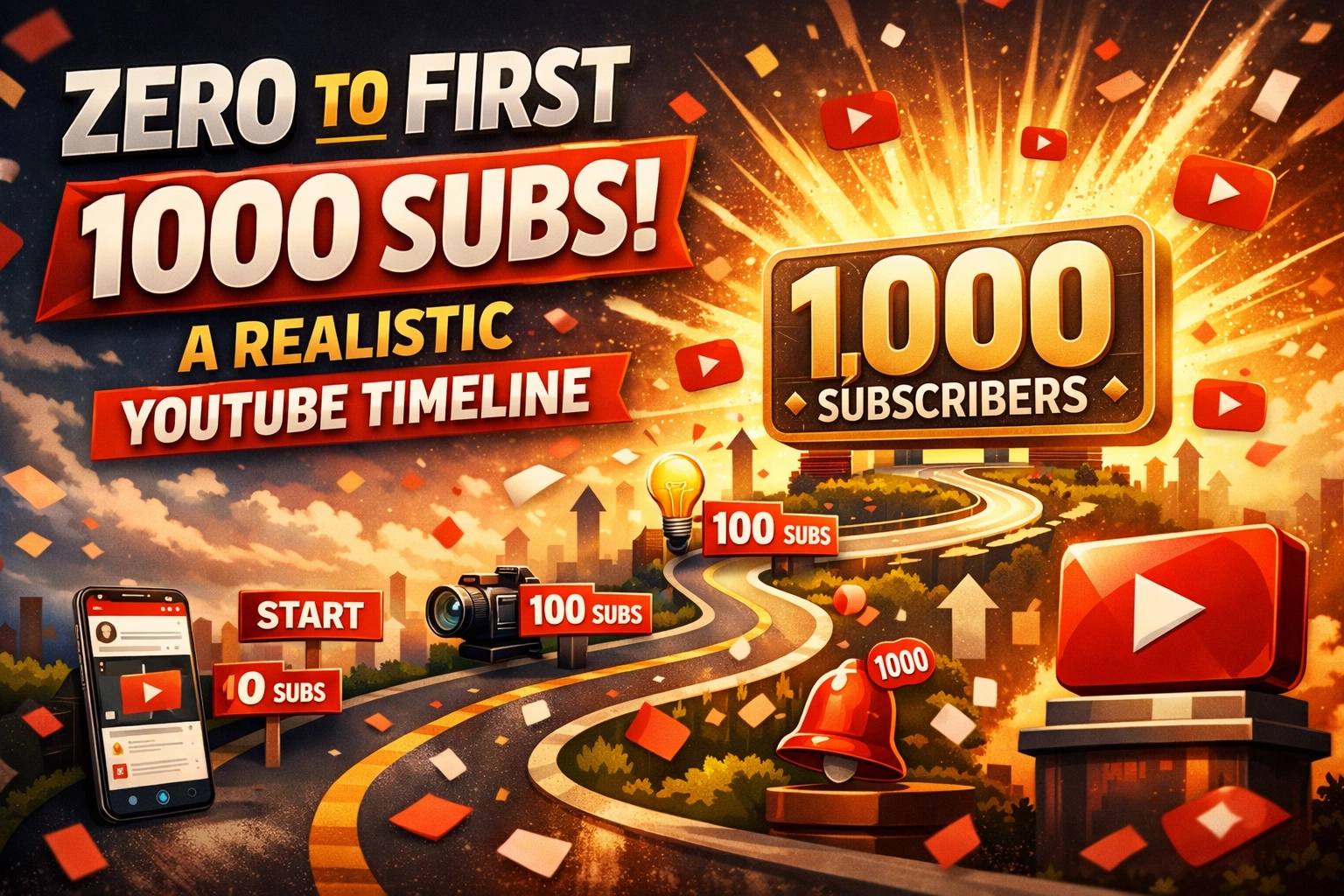
Data from millions of channels suggests that the average time to reach 1,000 subscribers on YouTube is approximately 254 days. That is roughly eight and a half months of consistent uploading, title tweaking, and thumbnail designing before hitting the first major milestone of the YouTube Partner Program (YPP).
While the "overnight success" narrative dominates social media feeds, the reality for the vast majority of creators is a slow, often frustrating grind through what many call the "Ghost Town" phase. If you are starting a channel today, March 11, 2026, understanding the actual phases of growth: rather than the viral outliers: is the only way to stay motivated long enough to see results.
The Mathematical Reality of 1,000 Subscribers
To understand the timeline, we have to look at the distribution of growth. Research into top-performing channels shows that the top 10% of creators can hit the 1,000-subscriber mark in as little as 41 to 45 days. However, these creators often come to the table with previous editing experience, a background in marketing, or they are leveraging high-velocity formats like YouTube Shorts.
For the average creator starting from scratch, the timeline is more likely to follow this trajectory:
- 0 to 100 Subscribers: 3 months.
- 100 to 500 Subscribers: 3 to 6 months.
- 500 to 1,000 Subscribers: 2 to 4 months.
Notice how the timeline compresses as you get closer to the goal. This is the power of the YouTube algorithm's compounding effect. Once the system understands who your audience is, it becomes more efficient at finding them.

Phase 1: The Proving Ground (0-100 Subscribers)
Estimated Time: 1 to 3 Months
The first 100 subscribers are arguably the hardest to get. At this stage, you have no "social proof." When a random viewer lands on your video, they see a low subscriber count and may assume the content isn't worth their time.
During this phase, your primary goal isn't actually subscriber growth: it’s "the 10-video test." Most creators quit before they upload their tenth video. The first 100 subscribers are usually a mix of friends, family, and the first few strangers who stumble upon your content through search.
Key Milestones:
- Finding your workflow: Learning how to record, edit, and export without spending 40 hours per video.
- The SEO Foundation: Learning how to use tools like Google Trends and Search Suggest to find topics people are actually looking for.
- CTR Baseline: Establishing your first Click-Through Rate (CTR) average. Anything above 4% at this stage is a win.
Even the world’s biggest creators started here. PewDiePie famously only had about 2,500 subscribers after his first 100 videos. If the most successful YouTuber in history grew that slowly at the start, you should expect the same.
Phase 2: The Data Gathering (100-500 Subscribers)
Estimated Time: 3 to 6 Months
Once you hit 100 subscribers, you finally have enough data in YouTube Studio to make informed decisions. This is where you move from "guessing" to "optimizing."
In this phase, you should be looking at your Audience Retention graphs. If viewers are dropping off in the first 30 seconds, your intro is too long or doesn't deliver on the thumbnail's promise. If they drop off halfway through, your pacing is dragging.
Why growth accelerates here:
YouTube begins to test your videos with "lookalike audiences." If your first 100 subscribers all watch 80% of your video, YouTube will show that video to 1,000 people who have similar watch histories.

Phase 3: The Compounding Effect (500-1,000 Subscribers)
Estimated Time: 2 to 4 Months
This is where the momentum shifts. By the time you hit 500 subscribers, you likely have 20 to 50 videos on your channel. This "back catalog" starts doing the work for you. A viewer might find your newest video, like it, and then binge-watch three older ones, hitting the subscribe button in the process.
At 500 subscribers, you also unlock the Community Tab. This is a massive tool for hitting the 1,000-sub mark. Polls, images, and text updates can reach people who aren't even subscribed to you, appearing in their home feeds and acting as a secondary discovery mechanism.
Variables That Can Speed Up or Slow Down Your Timeline
Not all niches are created equal. If you are in a highly competitive niche like "Gaming" or "Lifestyle Vlogs," your timeline may be longer because you are competing with millions of established channels.
1. Format Choice: Shorts vs. Long-form
Data shows that Shorts-focused creators reach 1,000 subscribers significantly faster (averaging around 41 days for top performers). This is because the "barrier to subscribe" is lower on the Shorts feed. However, there is a catch: Shorts subscribers are often less "loyal" and may not watch your long-form content, which is where the real AdSense revenue lives.
2. Niche Specificity
A channel dedicated to "Repairing 1970s Seiko Watches" will likely grow faster than a channel about "General Men's Fashion." Why? Because the Seiko audience is underserved. When you provide high-quality content for a specific, underserved group, they subscribe at a much higher rate.
3. Posting Frequency
Consistency is the only "hack" that actually works.
- 1 video per week: Standard growth.
- 2-3 videos per week: Accelerated growth (if quality remains high).
- Inconsistent (e.g., 3 videos in one week, then nothing for a month): Stagnant growth. The algorithm rewards predictability because it wants to know when to check for your new content to serve to your fans.

The "Watch Hour" Trap
While you are chasing 1,000 subscribers, don't ignore the other half of the YPP requirement: 4,000 hours of public watch time.
Many creators hit 1,000 subscribers through Shorts but find they only have 200 hours of watch time. To hit the watch hour goal, you need long-form content (8–12 minutes) that keeps people engaged. If your goal is monetization, your timeline must balance both subscriber acquisition and retention-heavy long-form videos.
Common Pitfalls That Delay the 1,000 Sub Mark
If you have been posting for six months and are still under 100 subscribers, you likely have one of three problems:
- The Packaging Problem: Your titles and thumbnails aren't getting people to click. If your CTR is under 2%, it doesn't matter how good the video is: nobody is seeing it.
- The Value Problem: You are making content you want to make, rather than content an audience wants to watch. Ask yourself: "Would a stranger find this useful or entertaining?"
- The Audio Problem: Viewers will forgive poor video quality, but they will click away instantly if the audio is thin, echoing, or too quiet. Invest in a basic $50 USB microphone early on.
A Realistic Checklist for Your First 254 Days
To stay on track for the average 8-9 month timeline, follow this roadmap:
- Days 1-30: Upload 4-8 videos. Focus on learning your editing software. Don't check your stats.
- Days 31-90: Analyze your top 3 videos. What do they have in common? Double down on those topics.
- Days 91-180: Experiment with 2-3 different thumbnail styles. Focus on increasing your Average View Duration (AVD).
- Days 181-254: Use the Community Tab to engage your core fans. Start a "series" that gives people a reason to return every week.

Final Thoughts
The path to 1,000 subscribers is a marathon, not a sprint. The 254-day average exists because most people take that long to get "good" at making videos. YouTube isn't just a platform; it’s a skill set. Every video you post is a rep in the gym.
By the time you hit 1,000 subscribers, you won't just have a monetized channel; you’ll have the skills to grow that channel to 10,000 and beyond. Stay consistent, watch your data, and remember that even the biggest channels on the platform once celebrated their very first subscriber.
About the Author
Malibongwe Gcwabaza is the CEO of blog and youtube, a media consultancy dedicated to helping creators and brands navigate the evolving landscape of digital content. With years of experience in content strategy and platform analytics, Malibongwe focuses on sustainable growth strategies that move beyond viral trends to build lasting digital assets. Under his leadership, blog and youtube has become a go-to resource for practical, data-driven advice for the modern creator economy.
About the Author


